
Arcadia: Difference between revisions

More actions
Created page with "{{InfoboxPlanet|name = Arcadia|code = HIP 98813 3|parent = HIP 98813|image = Arcadia.jpg|moons = 7|sma = 0.51 AU|orbperiod = 126.735 days|mass = 2.1148 M⊕|diameter = 15402.6..." |
m Text replacement - "Category:SpaceGeorge1's Articles" to "Category:Author: SpaceGeorge1" |
||
| (48 intermediate revisions by 6 users not shown) | |||
| Line 1: | Line 1: | ||
{{Adopt Me}}{{LocalUniverse}}=='''Overview'''== |
|||
{{InfoboxPlanet|name = Arcadia|code = HIP 98813 3|parent = HIP 98813|image = Arcadia.jpg|moons = 7|sma = 0.51 AU|orbperiod = 126.735 days|mass = 2.1148 M⊕|diameter = 15402.61 km|rotperiod = 4.670 days|avgtemp = 78.129 °C|atm = 2.39 atm|gravity = 1.4505 g|age = 6 billion years|naturallife = Organic Multicellular (marine, terrestrial)|dominant = Humans|population = 8.5 million|controller = Arcadian Administration}}Arcadia is a warm E-class planet orbiting the G-type star HIP 98813 in the Sagittarius constellation. |
|||
== Overview == |
|||
| ⚫ | |||
{{Infobox World|article_creator=[[User:SpaceGeorge1|SpaceGeorge]]|moons=7|day_length=4.67 Days (112.08 Hours)|year_length=126.735 Days|land_color=Yellowish-Green With Plants |
|||
| ⚫ | |||
Beige Without|water_color=Blue|cloud_color=White|atmosphere_color=Blue|major_inhabitants=[[Humans]]|population=8.5 million|affiliation=[[Arcadian Administration]]|economic_value=<font color="Yellow>Medium</font>|production_value=<font color="Yellow>Medium</font>|image1=Arcadia.jpg}} |
|||
| ⚫ | |||
| ⚫ | |||
| ⚫ | |||
== Climate == |
|||
| ⚫ | |||
| ⚫ | |||
Tropical storms, rapid winds, water spouts and rain are some examples of the weather that occurs on this world but aside from that, it usually has summer-like temperatures. |
|||
== |
=='''Climate'''== |
||
| ⚫ | Arcadia has a tropical climate and is very hot, reaching temperatures up to 78 °C which is why Humanity cooled it down slightly and introduce a little more oxygen to the atmosphere. Luckily the slight increase of oxygen did not affect any of the native life. Tropical storms, rapid winds, water spouts and rain are some examples of the weather that occurs on this world but aside from that, temperatures are otherwise, summer-like. |
||
| ⚫ | |||
=='''Native life'''== |
|||
| ⚫ | Glomphs: Squatty quadrupeds that mainly inhabit the beaches and shorelines in herds. They are named after the sound they make |
||
| ⚫ | |||
'''Ballbush: '''A species of bush-like plants that naturally grow into the shape of a ball. They can found all around Arcadia and some have even genetically engineered so they can be kept in homes. Ballbushes have an interesting life cycle, after growing for 5 years, they detach from their root and become mobile, relying on the wind to move them about and spreading their seeds along the way. |
|||
Mawks: Small flightless avians that live in the countrysides and valleys. They remain solitary until mating season when they mate and raise their own hatchlings. Mawks are only found on the main northern continent. |
|||
| ⚫ | '''Glomphs:''' Squatty quadrupeds that mainly inhabit the beaches and shorelines in herds. They are named after the sound they make and have a diet that consists of small fish-like creatures. Glomphs are very friendly and will slowly approach if one sees you. Because of how docile they are, Glomps have even been domesticated by some and are common on Arcadia. |
||
| ⚫ | |||
'''Mawks:''' Small flightless avians that live in the countrysides and valleys. They remain solitary until mating season when they mate and raise their own hatchlings. Mawks are only found on the main northern continent and their diet consists of insects. |
|||
| ⚫ | |||
| ⚫ | |||
'''Ferocias:''' A large predatory avian that usually preys on Glomphs. They are twice the size of an Andean Condor and could easily pick up a Human. Ferocias have for eyes, too for flight and two for searching prey. Fortunately, Ferocias only seem to be found in the northern parts of the planet so they aren't considered a major threat. |
|||
| ⚫ | |||
=='''Gallery'''== |
|||
<gallery> |
|||
Arcadia (2).jpg |
|||
Arcadia (3).jpg |
|||
Arcadian sunset.jpg|Sunset over a mountain range on the surface. |
|||
Arcadian beach.jpg|A beach on a Arcadia. |
|||
Approaching Arcadia.jpg|A colony ship approaching Arcadia. |
|||
Approaching Arcadia (2).jpg |
|||
Arcadia (4).jpg |
|||
</gallery> |
|||
[[Category:Planets]] |
|||
[[Category:Scope: Local Universe - Via Aylathiya]] |
|||
[[Category:Author: SpaceGeorge1]][[Category:Scope: Local Universe]] |
|||
Latest revision as of 22:02, March 7, 2025


==Overview==
Arcadia

4.67 Days (112.08 Hours)
8.5 million
Arcadia was discovered in 2545 and was declared a great candidate for colonization. The surface consists of expansive blue oceans, vast green valleys and scenic mountain ranges.
After the domed city of Utopia was constructed in 2587, the citizens of Arcadia or Arcadians as they called their selves, wished to be independent. Eventually, Arcadia became independent and a celebration known as the Independence Festival took place in Utopia.
After independence was achieved, Arcadia formed its own democratic government known as the Arcadian Administration.
Climate
Arcadia has a tropical climate and is very hot, reaching temperatures up to 78 °C which is why Humanity cooled it down slightly and introduce a little more oxygen to the atmosphere. Luckily the slight increase of oxygen did not affect any of the native life. Tropical storms, rapid winds, water spouts and rain are some examples of the weather that occurs on this world but aside from that, temperatures are otherwise, summer-like.
Native life
A variety of unique and interesting lifeforms inhabit Arcadia:
Ballbush: A species of bush-like plants that naturally grow into the shape of a ball. They can found all around Arcadia and some have even genetically engineered so they can be kept in homes. Ballbushes have an interesting life cycle, after growing for 5 years, they detach from their root and become mobile, relying on the wind to move them about and spreading their seeds along the way.
Glomphs: Squatty quadrupeds that mainly inhabit the beaches and shorelines in herds. They are named after the sound they make and have a diet that consists of small fish-like creatures. Glomphs are very friendly and will slowly approach if one sees you. Because of how docile they are, Glomps have even been domesticated by some and are common on Arcadia.
Mawks: Small flightless avians that live in the countrysides and valleys. They remain solitary until mating season when they mate and raise their own hatchlings. Mawks are only found on the main northern continent and their diet consists of insects.
Shovelhorns: Herbivorous quadrupeds known for their shovel-shaped "horn" that grows on top of their heads. The males compete for dominance over the pack, and wild Shovelhorns tend to be territorial so approaching a wild Shovelhorn is not recommended.
Ferocias: A large predatory avian that usually preys on Glomphs. They are twice the size of an Andean Condor and could easily pick up a Human. Ferocias have for eyes, too for flight and two for searching prey. Fortunately, Ferocias only seem to be found in the northern parts of the planet so they aren't considered a major threat.
Bulb Whales: Enormous whale-like animals that live in the planet's oceans. They are rather massive, growing up to 40 feet long and are considered one of the largest specimens of marine life found on any world. They are named Bulb Whales due to their bulbous appearance.
Gallery
-
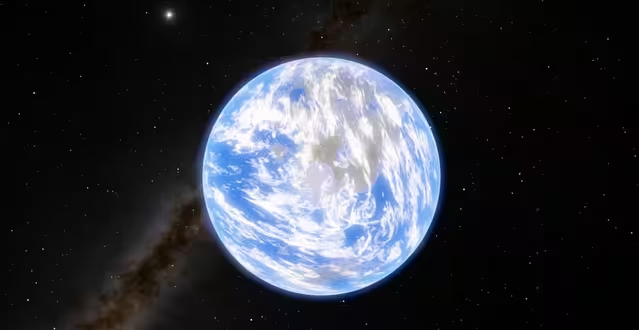
-
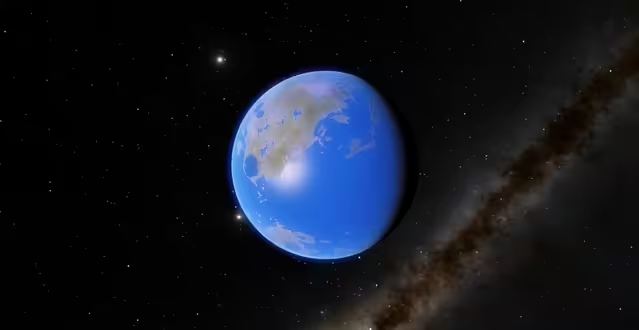
-
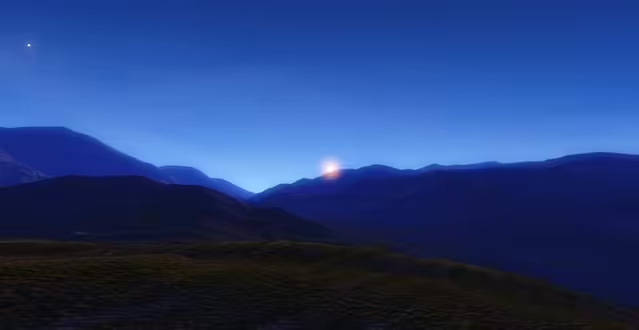 Sunset over a mountain range on the surface.
 -
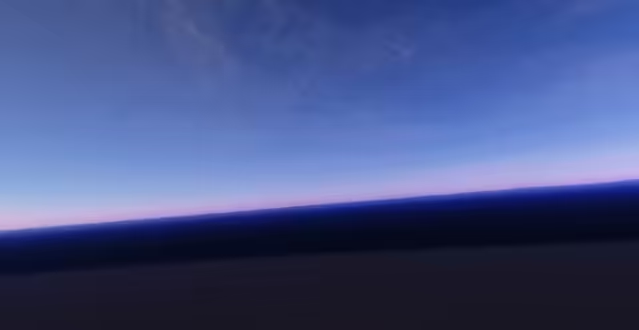 A beach on a Arcadia.
 -
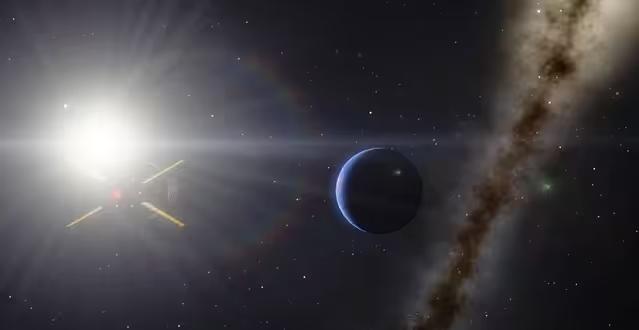 A colony ship approaching Arcadia.
 -
-
.jpg)
.jpg)


.jpg)
.jpg)