
Calida: Difference between revisions

More actions
Created page with "<gallery widths="310" position="center" spacing="small"> Calida2.png|The Calida system. Calida A is on the left and Calida B is on the right. Calida1.png|The Calida system's l..." |
No edit summary Tag: 2017 source edit |
||
| (8 intermediate revisions by 4 users not shown) | |||
| Line 1: | Line 1: | ||
<gallery widths="310" position="center" spacing="small"> |
{{LocalUniverse}}<gallery widths="310" position="center" spacing="small"> |
||
Calida2.png|The Calida system. Calida A is on the left and Calida B is on the right. |
Calida2.png|The Calida system. Calida A is on the left and Calida B is on the right. |
||
Calida1.png|The Calida system's location in the Small Magellanic Cloud. |
Calida1.png|The Calida system's location in the Small Magellanic Cloud. |
||
</gallery> |
</gallery> |
||
Calida is a binary star system located |
Calida is a binary star system located in the [[Ventemir Galaxy]]. It is the home to one life-bearing planet, [[Kalder]]. |
||
==Overview== |
==Overview== |
||
The Calida system was discovered in 9961 CE during one of the earliest [[human ]]intergalactic missions targeted at the Magellanic Clouds. Calida was only one of dozens to be charted and examined by scientists during the time, but the exotic life existing on the titan Kalder was what made the system excellent for further study. Currently a permanent research station is planned for construction in the next decade. |
The Calida system was discovered in 9961 CE during one of the earliest [[Humans|human ]]intergalactic missions targeted at the Magellanic Clouds. Calida was only one of dozens to be charted and examined by scientists during the time, but the exotic life existing on the titan Kalder was what made the system excellent for further study. Currently a permanent research station is planned for construction in the next decade. |
||
The largest star of the system is Calida A, a bright type F2 V white main sequence star over twice the size of [[Sol]]. Orbiting it are eight planets, the final being Kalder. While the star has no asteroid belt, it does have many comets. These comets are what makes Calida A a notable candidate for terraforming and colonization. |
The largest star of the system is Calida A, a bright type F2 V white main sequence star over twice the size of [[Sol System|Sol]]. Orbiting it are eight planets, the final being Kalder. While the star has no asteroid belt, it does have many comets. These comets are what makes Calida A a notable candidate for terraforming and colonization. |
||
Calida B is a K2 V orange dwarf as is smaller and dimmer than Calida A. It holds ten planets, none of which have life. This star is orbited by countless comets, too. |
Calida B is a K2 V orange dwarf as is smaller and dimmer than Calida A. It holds ten planets, none of which have life. This star is orbited by countless comets, too. |
||
The Calida system is 1.1 billion years old. |
The Calida system is 1.1 billion years old. |
||
[[Category:Star Systems]] |
|||
Latest revision as of 20:13, April 3, 2025

-
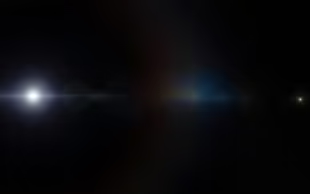 The Calida system. Calida A is on the left and Calida B is on the right.
 -
 The Calida system's location in the Small Magellanic Cloud.


Calida is a binary star system located in the Ventemir Galaxy. It is the home to one life-bearing planet, Kalder.
Overview
The Calida system was discovered in 9961 CE during one of the earliest human intergalactic missions targeted at the Magellanic Clouds. Calida was only one of dozens to be charted and examined by scientists during the time, but the exotic life existing on the titan Kalder was what made the system excellent for further study. Currently a permanent research station is planned for construction in the next decade.
The largest star of the system is Calida A, a bright type F2 V white main sequence star over twice the size of Sol. Orbiting it are eight planets, the final being Kalder. While the star has no asteroid belt, it does have many comets. These comets are what makes Calida A a notable candidate for terraforming and colonization.
Calida B is a K2 V orange dwarf as is smaller and dimmer than Calida A. It holds ten planets, none of which have life. This star is orbited by countless comets, too.
The Calida system is 1.1 billion years old.