
Castro-Lux system: Difference between revisions

More actions
mNo edit summary |
No edit summary Tag: 2017 source edit |
||
| (27 intermediate revisions by 5 users not shown) | |||
| Line 1: | Line 1: | ||
| ⚫ | |||
{{Legacy Lore}}{{MoreLinks}} |
|||
| ⚫ | |||
== Overview == |
== Overview == |
||
The Castro-Lux system |
The Castro-Lux system is a star system on the edge of the Treana Molecular Cloud Complex and is home to the capital of the [[Areial Union]], [[Eiar]]. It contains 9 bodies with liquids on their surface, a stupendously large amount for such a system. |
||
Two of them are |
Two of them are oceanic planets, three of them hydrocarbonia planets and the remaining are all hydrocarbonia moons. As a result, this system has attracted much attention among civilizations originally descended from hydrocarbonia worlds, who actually sort of want to conquer it. |
||
== System == |
== System == |
||
Castro: A small M7.5V red dwarf |
Castro: A small M7.5V red dwarf with 8 planets. |
||
* Myach: A small desertic dwarf planet, and the most suitable for a colony not on the water-bearing planets of the system. |
* Myach: A small desertic dwarf planet, and the most suitable for a colony not on the water-bearing planets of the system. |
||
* Oblachno: A large ringed gas giant with easily differentiable bands |
* Oblachno: A large ringed gas giant with easily differentiable bands. |
||
* Testament: A tidally locked, puffy waterworld |
* Testament: A tidally locked, puffy waterworld. It has many culturally diverse cities on its surface and is nearly subject to permanent study, in one way or another.[[File:TestamentFirst.jpg|thumb|220x220px|First clear image of Testament]] |
||
* Ingentis: One of the largest planets in the entire system, Ingentis is a gas giant |
* Ingentis: One of the largest planets in the entire system, Ingentis is a gas giant. It has one moon, and even more magnificent rings than Oblachno. |
||
* Obliqua: A strange world, Obliqua is a |
* Obliqua: A strange world, Obliqua is a hydrocarbonia world but it is tilted on its side. It has thin rings and an atmosphere rich in methane. |
||
* Glacipsum: A distant, very cold ice giant. |
* Glacipsum: A distant, very cold ice giant. |
||
* Parvastra: Most likely the least significant of Castro's worlds, Parvastra is a tiny iceball. |
* Parvastra: Most likely the least significant of Castro's worlds, Parvastra is a tiny iceball. |
||
* Eiar-Ver: A binary planet. |
* Eiar-Ver: A binary planet. |
||
** [[Eiar]]: A cool |
** [[Eiar]]: A cool hydrocarbonia world with many interesting features and capital of the [[Areial Union]]. It is warmer than normal due to tidal heating. |
||
** Ver: A desert world |
** Ver: A desert world slightly warmer than Eiar. |
||
Lux: A small L6.6 brown dwarf. (9 planets) |
Lux: A small L6.6 brown dwarf. (9 planets) |
||
* Eostre: A tidally locked waterworld. Basically Testament, but orbiting Lux. (Lux b) |
* Eostre: A tidally locked waterworld. Basically Testament, but orbiting Lux. (Lux b) |
||
| Line 26: | Line 25: | ||
* Khione: A completely frigid dwarf planet. It takes 4.39 years to orbit Lux, and is the coldest independently orbiting body of the entire system. (Lux j) |
* Khione: A completely frigid dwarf planet. It takes 4.39 years to orbit Lux, and is the coldest independently orbiting body of the entire system. (Lux j) |
||
Elorus: A large gas giant with 26 moons. It orbits both Castro and Lux. |
Elorus: A large gas giant with 26 moons. It orbits both Castro and Lux. |
||
* Mote: A small |
* Mote: A small hydrocarbonia moon orbiting Elorus. It has seas of neon. (Elorus 4) |
||
Ogian: A |
Ogian: A hydrocarbonia planet orbiting both Castro and Lux. |
||
Brigid: The largest gas giant and the furthest out, Brigid is only heated by tidal heating from its moons. |
Brigid: The largest gas giant and the furthest out, Brigid is only heated by tidal heating from its moons. |
||
* Eurus, Nerthus and Mokosh (Brigid 5, 6, 7): 3 |
* Eurus, Nerthus and Mokosh (Brigid 5, 6, 7): 3 hydrocarbonia moons orbiting Brigid. |
||
== Discovery == |
== Discovery by Outside Civilizations == |
||
Discovered in |
Discovered in 82621 by the UNFG-funded Treana Young Fusor Survey Telescope (TY-FuST for short), this star system initially doesn't look special. From the stars' perspective, this is just a somewhat young binary consisting of a red dwarf and a brown dwarf. It wasn't until a multitude of planets had been discovered around Castro, the primary star, that this system gained a bit of interest. |
||
Testament (Castro d) could be habitable and had an absurdly low density, which sparked confusion among scientists. As a result, the |
Testament (Castro d) could be habitable and had an absurdly low density, which sparked confusion among scientists. As a result, the UNFG sent a few solar sail probes to investigate Castro's planetary system. What they found out shocked the entire scientific community - Testament was in fact an oceanic planet. This was a huge surprise, considering the young age of the system. What surprised scientists even more was that both Obliqua and Eiar, two planets in the Castro system, were hydrocarbon worlds. |
||
== Further exploration == |
== Further exploration == |
||
The probes were next directed to Lux, the brown dwarf of this system. In fact, the system around Lux seemed like a normal brown dwarf system. But again, this system is young, so it's a slight surprise that Eostre managed to cool down so quickly to become an |
The probes were next directed to Lux, the brown dwarf of this system. In fact, the system around Lux seemed like a normal brown dwarf system. But again, this system is young, so it's a slight surprise that Eostre managed to cool down so quickly to become an oceanic world. |
||
But the most surprise came from the outer 3 planets. Somehow, |
But the most surprise came from the outer 3 planets. Somehow, there were 5 hydrocarbonia worlds here. |
||
== Eiar's Civilization == |
|||
The first colonies in this veritable star system began as simple bases on Myach. The colonists began exploring the Castro system on their own, sending probes and rovers to most planets of the system, notably Eiar and Testament. The next step came with a small base on Eiar, and a domed town on Myach, at around 4000 AD. |
|||
The probes, when they passed over Eiar, did not notice much at first. Later heat signature scans indicated a concentration of life-forms deep underground, but when they sent drilling probes they were astonished to find a massive, well-lit city on the scale of twenty kilometers across in the deep cave. The inhabitants were also surprised and ran like hell, so time was spent in orbit studying the planet's language so that proper contact could be made. This contact was made in 77,049 CE. |
|||
| ⚫ | |||
Slowly but surely, the colonists spread around system, eventually settling places such as Eostre, Ver and the moon of Ingentis. By 8000 AD, there were colonies on nearly every Castro rocky body, and many of Lux's bodies. |
|||
| ⚫ | |||
[[Category:Florathel - Celestial Bodies]] |
|||
== Inclusion of other civilisations == |
|||
[[Category:United Nations of the Florathel Galaxy]] |
|||
However, expanding to the outer planets stopped as by 13000 AD several T-type planet civilizations (Such as the Plu'ani(Obviously before their cataclysmic extinction)) had asked the CoB if they could have the outer planets, because of obvious reasons. The CoB agreed, and they signed a treaty that allowed the civilizations to slowly develop on these planets. They coexisted with the CoB and exchanged many things, such as technologies, culture and skills, to name a few. |
|||
Today, this system is a thriving trading hub and one of the most important systems in the entire Orion MCC, and houses many places individuals of many species can be. Currently the most populated worlds in the system are Testament, Eiar, Ogian and Obliqua. |
|||
== Other uses == |
|||
* The three circumbinary planets' moon systems are used for housing massive data storage systems and various supercomputers. This is so due to the very low temperatures of these moons, which range from 58 Kelvins to 20 Kelvins, and data storage systems and supercomputers work especially well in cooled conditions. |
|||
| ⚫ | |||
[[Category:Trolligi's new articles]] |
|||
| ⚫ | |||
Latest revision as of 20:27, April 3, 2025

Castro-Lux system

Castro, Lux
1.427 billion years
~166,000,000,000
Overview
The Castro-Lux system is a star system on the edge of the Treana Molecular Cloud Complex and is home to the capital of the Areial Union, Eiar. It contains 9 bodies with liquids on their surface, a stupendously large amount for such a system.
Two of them are oceanic planets, three of them hydrocarbonia planets and the remaining are all hydrocarbonia moons. As a result, this system has attracted much attention among civilizations originally descended from hydrocarbonia worlds, who actually sort of want to conquer it.
System
Castro: A small M7.5V red dwarf with 8 planets.
- Myach: A small desertic dwarf planet, and the most suitable for a colony not on the water-bearing planets of the system.
- Oblachno: A large ringed gas giant with easily differentiable bands.
- Testament: A tidally locked, puffy waterworld. It has many culturally diverse cities on its surface and is nearly subject to permanent study, in one way or another.
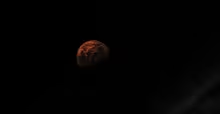
First clear image of Testament - Ingentis: One of the largest planets in the entire system, Ingentis is a gas giant. It has one moon, and even more magnificent rings than Oblachno.
- Obliqua: A strange world, Obliqua is a hydrocarbonia world but it is tilted on its side. It has thin rings and an atmosphere rich in methane.
- Glacipsum: A distant, very cold ice giant.
- Parvastra: Most likely the least significant of Castro's worlds, Parvastra is a tiny iceball.
- Eiar-Ver: A binary planet.
- Eiar: A cool hydrocarbonia world with many interesting features and capital of the Areial Union. It is warmer than normal due to tidal heating.
- Ver: A desert world slightly warmer than Eiar.

Lux: A small L6.6 brown dwarf. (9 planets)
- Eostre: A tidally locked waterworld. Basically Testament, but orbiting Lux. (Lux b)
- Soranus: An angry-looking desert world that is surprisingly not tidally locked to Lux. (Lux c)
- 5 unnamed ice worlds.
- Imset: A shiny reflective snowball orbiting Lux at 0.69 AU. No jokes please. (Lux i)
- Khione: A completely frigid dwarf planet. It takes 4.39 years to orbit Lux, and is the coldest independently orbiting body of the entire system. (Lux j)
Elorus: A large gas giant with 26 moons. It orbits both Castro and Lux.
- Mote: A small hydrocarbonia moon orbiting Elorus. It has seas of neon. (Elorus 4)
Ogian: A hydrocarbonia planet orbiting both Castro and Lux.
Brigid: The largest gas giant and the furthest out, Brigid is only heated by tidal heating from its moons.
- Eurus, Nerthus and Mokosh (Brigid 5, 6, 7): 3 hydrocarbonia moons orbiting Brigid.
Discovery by Outside Civilizations
Discovered in 82621 by the UNFG-funded Treana Young Fusor Survey Telescope (TY-FuST for short), this star system initially doesn't look special. From the stars' perspective, this is just a somewhat young binary consisting of a red dwarf and a brown dwarf. It wasn't until a multitude of planets had been discovered around Castro, the primary star, that this system gained a bit of interest.
Testament (Castro d) could be habitable and had an absurdly low density, which sparked confusion among scientists. As a result, the UNFG sent a few solar sail probes to investigate Castro's planetary system. What they found out shocked the entire scientific community - Testament was in fact an oceanic planet. This was a huge surprise, considering the young age of the system. What surprised scientists even more was that both Obliqua and Eiar, two planets in the Castro system, were hydrocarbon worlds.
Further exploration
The probes were next directed to Lux, the brown dwarf of this system. In fact, the system around Lux seemed like a normal brown dwarf system. But again, this system is young, so it's a slight surprise that Eostre managed to cool down so quickly to become an oceanic world.
But the most surprise came from the outer 3 planets. Somehow, there were 5 hydrocarbonia worlds here.
Eiar's Civilization
The probes, when they passed over Eiar, did not notice much at first. Later heat signature scans indicated a concentration of life-forms deep underground, but when they sent drilling probes they were astonished to find a massive, well-lit city on the scale of twenty kilometers across in the deep cave. The inhabitants were also surprised and ran like hell, so time was spent in orbit studying the planet's language so that proper contact could be made. This contact was made in 77,049 CE.