
Dralora (Local Universe): Difference between revisions

More actions
LordSkorne7 (talk | contribs) No edit summary |
LordSkorne7 (talk | contribs) No edit summary |
||
| (51 intermediate revisions by 4 users not shown) | |||
| Line 1: | Line 1: | ||
{{LocalUniverse}}{{LocalUniverse Ambrosia}}{{Infobox World |
|||
{{InfoboxPlanet|parent = Talora A|image = Dralora.jpg|caption = Dralora from space.|moons = 1: Yckar|sma = 0.90 AU|orbperiod = 319 Standard days.|mass = 0.52448|diameter = 11582km|axialtilt = 1°|avgtemp = -28°C|atm = 0.582 atm|gravity = 0.63612 g|age = 9,204,100,000|naturallife = Unicellular (Marine, Terrestrial) |
|||
| title1 = Dralora |
|||
| image1 = Dralora - 2.png |
|||
| caption-image1 = Dralora from space |
|||
| article_creator = LordSkorne7 |
|||
| scope = [[Local Universe]] |
|||
| setting = [[Ambrosia Galaxy (Local Universe)]] |
|||
| author = LordSkorne7 (January 30th 2019) |
|||
| distance_from_galactic_center = 1.31 AU |
|||
| sector = Hope Sector |
|||
| region = [[Mid Arm (Local Universe)]] |
|||
| system = Talora System |
|||
| world_type = Planet |
|||
| parent_body = Talora (A) |
|||
| semimajor_axis = 0.90 AU |
|||
| orbital_period = 319 Standard Days |
|||
| orbital_position = A4 |
|||
| mass = 0.52448 |
|||
| diameter = 11,582 kilometers |
|||
| surface_gravity = 0.63612 G |
|||
| roche_limit = 10,067 kilometers above surface |
|||
| average_temperature = -28°C |
|||
| aquatic_surface = 38% |
|||
| atmospheric_pressure = 0.582 atm |
|||
| atmospheric_composition = *Carbon Dioxide |
|||
*Oxygen |
|||
*Nitrogen |
|||
*Water |
|||
| age = 9,204,100,000 |
|||
| rotation_period = 21 Standard Hours |
|||
| axial_tilt = 1° |
|||
| major_oceans = Valdonian Sea |
|||
| highest_peak = Mt. Carolia |
|||
| primary_terrain = *Dense woodlands |
|||
*Icy tundra |
|||
*Snow-capped mountains |
|||
*Grassy meadows |
|||
*Sandy beaches |
|||
| average_cloud_coverage = 45% |
|||
| average_wind_speed = Thirteen kilometers an hour |
|||
| average_annual_rainfall = 15 inches |
|||
| ring_system = Rings of Valdona |
|||
| ring_system_width = 25,000 kilometers |
|||
| ring_system_composition = *Rock |
|||
*Ice |
|||
*Dust |
|||
| ring_system_origin = Major moon (Valdona) crossing into Roche Limit |
|||
| number_of_rings = One |
|||
| major_moons = [[Yckar (Local Universe)]] |
|||
| native_life = *Unicellular (marine and terrestrial) |
|||
*Multicellular (marine, aerial, subglaical, and terrestrial) |
|||
| native_flora = Darlorain Great Oak |
|||
| native_sapient_species = None |
|||
| dominant_species = [[Humans (Local Universe)]] |
|||
| population = 17,400,000,000 |
|||
| affiliation = *[[Havenborne Alliance of Ambrosia (Local Universe)]]: 10,280 CE to 10,388 CE |
|||
| ⚫ | |||
*[[Ambrosia Alliance of United Systems (Local Universe)]]: 10,526 CE to present. |
|||
}} |
|||
Dralora is the fourth planet of the [[Talora System]] in the [[Ambrosia Galaxy]]. It is a colder type of terrestrial world, with life covering its entire surface. It served as the capital planet of the [[True Alliance of Man]] from 10,388 CE to 10,526 CE. |
|||
Multicellular (Marine, Terrestrial)|dominant = Human|population = 7,400,000,000|controller = Human Alliance of Ambrosia (10265 CE to 10388 CE) |
|||
| ⚫ | |||
| ⚫ | |||
| ⚫ | Dralora is a planet teeming with many forms of life. Millions of lifeforms, both unicellular, and multicellular, marine and terrestrial, make their home there. This life has existed on the planet for over nine billion years, however no intelligent species is known to have ever inhabited the planet. Even the once galaxy spanning [[The Etymology|Etymology]] would not lay claim to it. |
||
Though it may look like it, due to the lack of tectonic plates Dralora has no continents. Instead, the planet's axial tilt leaves its poles frozen over and covering a vast area, while the middle section of the planet is warm enough for liquid water and life to inhabit it. |
|||
| ⚫ | |||
| ⚫ | |||
| ⚫ | Dralora is a planet teeming with many forms of life. Millions of lifeforms, both unicellular, and multicellular, marine and terrestrial, make their home there. This life has existed on the planet for over nine billion years, however no intelligent species is known to have ever inhabited the planet. Even the once galaxy spanning [[ |
||
| ⚫ | Unlike most ring systems, Dralora has only one large ring almost made up of entirely dust particles. This ring was created when an ancient moon of Dralora, nicknamed ''"Valdona"'', entered the planet's rouche limit, tearing the moon apart and forming the ring system we see today. As such, the rings have been given the nickname: ''"The Rings of Valdona"''. |
||
Though it may look like it, due to the lack of tectonic plates, Dralora has no continents. Instead, the planet's axial tilt leaves its poles frozen over and covering a vast area, while the middle section of the planet is warm enough for liquid water and life to inhabit it. |
|||
| ⚫ | |||
| ⚫ | |||
| ⚫ | The planet would be the first celestial body to leave the [[Havenborne Alliance of Ambrosia]] , and would also be the world where the [[True Alliance of Man]] formed on March 4th 10388 CE. As such, it served as the capital of the rebel government for the entirety of its existence. Even after the True Alliance of Man's dismantling, it still serves as a "sub-capital" for humans in [[the Ambrosia Alliance of United Systems]], after the planet [[Haven]]. |
||
| ⚫ | Unlike most ring systems, Dralora has only one large ring almost made up of entirely dust particles. This ring was created when an ancient moon of Dralora, nicknamed "Valdona", entered the planet's rouche limit, tearing the moon apart and forming the ring system we see today. As such, the rings have been given the nickname "The Rings of Valdona". |
||
| ⚫ | It was also the world where the final battle of the [[Second Alliance War]] would take place. This battle was known as the Retaking of Dralora. The battle was caused due to the current leader of the True Alliance of Man at the time, [[Romeo Carolina]], being discovered as the true assassin of the original leader [[Farda Yckar]]. Once he was discovered he would retreat onto the planet with the followers he still had. After the battle, and Romeo's death, the True Alliance of Man would join the Ambrosia Alliance of United Systems. |
||
| ⚫ | |||
| ⚫ | The planet would be the first celestial body to leave the [[ |
||
| ⚫ | It was also the world where the final battle of the Second Alliance War would take place. This battle was known as the Retaking of Dralora. The battle was caused due to the current leader of the True Alliance of Man at the time, Romeo Carolina, being discovered as the true assassin of the original leader Farda Yckar. Once he was discovered he would retreat onto the planet with the followers he still had. After the battle, and Romeo's death, the True Alliance of Man would join the Ambrosia Alliance of United Systems. |
||
== Life == |
|||
Life on Dralora is very diverse, its multicellular life is very Earth like. Insects, Fish, Birds, Mammals, Reptiles, and many more are known to exist on the planet. However unlike Earth life, these life forms are usually quite large and live for hundreds of years. |
|||
While its unicellular life is quite different. This form of life exists in an endless cycle of subsuming other members into one entity. These entities continue to vye for more and more organisms to join their collective. At some point in the future, all unicellular life on the planet will exist as one being, however this will not happen for millions of years to come. |
|||
== History == |
== History == |
||
Dralora and its moon Yckar formed alongside their parent star, Talora A, in 9,204,100,000 BCE. During their formation the two bodies became gravitationally bound to each other, becoming a duel-planet system. Its second moon, Valdona, formed from the left over debris shortly after. |
Dralora and its moon Yckar formed alongside their parent star, Talora A, in 9,204,100,000 BCE. During their formation the two bodies became gravitationally bound to each other, becoming a duel-planet system. Its second moon, Valdona, formed from the left over debris shortly after. |
||
Life began to appear shortly after the planet's formation around 9,100,000,000 BCE. This life began as a single-cell organism in the planet's oceans, however after millions of years of evolution this life began to grow more and more complex to the point of being able to exist on land and in the air. |
Life began to appear shortly after the planet's formation around 9,100,000,000 BCE. This life began as a single-cell organism in the planet's oceans, however after millions of years of evolution this life began to grow more and more complex to the point of being able to exist on land and in the air. |
||
After billions of years, interacting as a " |
After billions of years, interacting as a: ''"companion satellite to both bodies"'', Voldana would gradually slow its orbit and move closer to Dralora. Eventually, the moon would enter the planet's rouche limit and was torn apart in 6,450,000,000 BCE, becoming a ring system. |
||
in 5,210,550,089 BCE, the [[Talora System|Talora System's]] orbit in the galaxy crossed within the path of a passing by binary star system, the three stars' gravity would combine their respective worlds into a triple star system. Dralora remained unaffected by this event, still orbiting in Talora A's habitable zone. |
in 5,210,550,089 BCE, the [[Talora System|Talora System's]] orbit in the galaxy crossed within the path of a passing by binary star system, the three stars' gravity would combine their respective worlds into a triple star system. Dralora remained unaffected by this event, still orbiting in Talora A's habitable zone. |
||
Dralora would remain untouched by any Ambrosian civlization for billions of years. That was until the |
Dralora would remain untouched by any Ambrosian civlization for billions of years. That was until the Havenborne Alliance of Ambrosia discovered the planet in 10,280 CE. Once it was discovered that it could naturally support human colonization, many cities were erected across the planet. Most famously, the city Verum Capitis would be constructed in 10,304 CE. |
||
When the |
When the Havenborne Alliance of Ambrosia hit their now famous economic disaster in 10,334 CE, Dralora and its cities originally remained unaffected. However with the increasing presence of corporation in the government, in the span of fifty four years, Dralora, as well as the rest of the Talora System would see fewer funds and higher taxes like many star systems at the time. This lead to the populace of Dralora to be very disfranchised with the Human Alliance also like many worlds at the time. |
||
These flames of discontent were fanned by the then current prime minister of Dralora, Farda Yckar with his often quite zealotris rhetoric. This came to a head when the people of Dralora disarmed the Human Alliance military on the planet. After this, Farda Yckar, as well as the respective leaders of the other worlds in the Talora System, formed the True Alliance of Man on March 4th |
These flames of discontent were fanned by the then current prime minister of Dralora, Farda Yckar with his often quite zealotris rhetoric. This came to a head when the people of Dralora disarmed the Human Alliance military on the planet. After this, Farda Yckar, as well as the respective leaders of the other worlds in the Talora System, formed the True Alliance of Man on March 4th 10,388 CE. With its creation, planet Dralora was selected as the new government's capital. When the group was formed, many worlds and star systems would follow suit and join this new rebel movement. |
||
Throughout the First Alliance and Second Alliance Wars, the planet, as well as the rest of the star system would be untouched throughout the majority of the conflicts. However once it was discovered that Romeo Carolina, then leader of the True Alliance, was the true assassin of Farda Yckar. The True Alliance, as well as the Ambrosia Alliance, would attack Romeo and his followers in the city of Verum Capitis, this battle was know as the Retaking of Dralora. The battle would only last around six standard hours, ending with the surrendering of Romeo's forces and the death with their leader. |
Throughout the First Alliance and Second Alliance Wars, the planet, as well as the rest of the star system would be untouched throughout the majority of the conflicts. However once it was discovered that Romeo Carolina, then leader of the True Alliance, was the true assassin of Farda Yckar. The True Alliance, as well as the Ambrosia Alliance, would attack Romeo and his followers in the city of Verum Capitis, this battle was know as the Retaking of Dralora. The battle would only last around six standard hours, ending with the surrendering of Romeo's forces and the death with their leader. |
||
After the battle, the True Alliance would join the Ambrosia Alliance of United Systems, ending both the Second Alliance War and the True Alliance of Man. |
After the battle, the True Alliance would join the Ambrosia Alliance of United Systems, ending both the Second Alliance War and the True Alliance of Man. |
||
== Gallery == |
== Gallery == |
||
<gallery> |
<gallery> |
||
File:Map_of_Dralora.png|Map of Dralora |
|||
Dralora' |
File:Dralora's_Rings_.jpg|View of the Rings of Valdona. |
||
File:Close_up_Dralora_rings.jpg|Close up view of the Rings of Valdona |
|||
File:Alternate_Dralora.jpg|Different view of Dralora with the vast Mid Arm of the behind it. Its moon Yckar can be seen. |
|||
</gallery> |
</gallery> |
||
[[Category: |
[[Category:Author: LordSkorne7]] |
||
[[Category:Alien Colonies]] |
|||
Latest revision as of 03:12, October 24, 2025

Dralora

LordSkorne7
LordSkorne7 (January 30th 2019)
1.31 AU
Hope Sector
Talora System
Planet
Talora (A)
0.90 AU
319 Standard Days
A4
0.52448
11,582 kilometers
0.63612 G
10,067 kilometers above surface
-28°C
38%
0.582 atm
- Carbon Dioxide
- Oxygen
- Nitrogen
- Water
9,204,100,000
21 Standard Hours
1°
Valdonian Sea
Mt. Carolia
- Dense woodlands
- Icy tundra
- Snow-capped mountains
- Grassy meadows
- Sandy beaches
45%
Thirteen kilometers an hour
15 inches
Rings of Valdona
25,000 kilometers
- Rock
- Ice
- Dust
Major moon (Valdona) crossing into Roche Limit
One
- Unicellular (marine and terrestrial)
- Multicellular (marine, aerial, subglaical, and terrestrial)
Darlorain Great Oak
None
17,400,000,000
- Havenborne Alliance of Ambrosia (Local Universe): 10,280 CE to 10,388 CE
- True Alliance of Man (Local Universe): 10,388 CE to 10,526 CE
- Ambrosia Alliance of United Systems (Local Universe): 10,526 CE to present.
Dralora is the fourth planet of the Talora System in the Ambrosia Galaxy. It is a colder type of terrestrial world, with life covering its entire surface. It served as the capital planet of the True Alliance of Man from 10,388 CE to 10,526 CE.
Overview
Dralora is a planet teeming with many forms of life. Millions of lifeforms, both unicellular, and multicellular, marine and terrestrial, make their home there. This life has existed on the planet for over nine billion years, however no intelligent species is known to have ever inhabited the planet. Even the once galaxy spanning Etymology would not lay claim to it.
Though it may look like it, due to the lack of tectonic plates Dralora has no continents. Instead, the planet's axial tilt leaves its poles frozen over and covering a vast area, while the middle section of the planet is warm enough for liquid water and life to inhabit it.
The planet exists within a duel-planet system with its moon Yckar. This means the planet and moon orbit each other rather than one orbiting the other. Though due to the planet being larger than its partner, Dralora is the planet while Yckar is the moon.
Unlike most ring systems, Dralora has only one large ring almost made up of entirely dust particles. This ring was created when an ancient moon of Dralora, nicknamed "Valdona", entered the planet's rouche limit, tearing the moon apart and forming the ring system we see today. As such, the rings have been given the nickname: "The Rings of Valdona".
Its atmosphere is primarily made up of oxygen, carbon dioxide, nitrogen, and water. This has made the planet's atmosphere naturally habitable to humans. However due to the planet's cool temperature, humans living on the surface need temperature regulation in order to survive.
The planet would be the first celestial body to leave the Havenborne Alliance of Ambrosia , and would also be the world where the True Alliance of Man formed on March 4th 10388 CE. As such, it served as the capital of the rebel government for the entirety of its existence. Even after the True Alliance of Man's dismantling, it still serves as a "sub-capital" for humans in the Ambrosia Alliance of United Systems, after the planet Haven.
It was also the world where the final battle of the Second Alliance War would take place. This battle was known as the Retaking of Dralora. The battle was caused due to the current leader of the True Alliance of Man at the time, Romeo Carolina, being discovered as the true assassin of the original leader Farda Yckar. Once he was discovered he would retreat onto the planet with the followers he still had. After the battle, and Romeo's death, the True Alliance of Man would join the Ambrosia Alliance of United Systems.
History
Dralora and its moon Yckar formed alongside their parent star, Talora A, in 9,204,100,000 BCE. During their formation the two bodies became gravitationally bound to each other, becoming a duel-planet system. Its second moon, Valdona, formed from the left over debris shortly after.
Life began to appear shortly after the planet's formation around 9,100,000,000 BCE. This life began as a single-cell organism in the planet's oceans, however after millions of years of evolution this life began to grow more and more complex to the point of being able to exist on land and in the air.
After billions of years, interacting as a: "companion satellite to both bodies", Voldana would gradually slow its orbit and move closer to Dralora. Eventually, the moon would enter the planet's rouche limit and was torn apart in 6,450,000,000 BCE, becoming a ring system.
in 5,210,550,089 BCE, the Talora System's orbit in the galaxy crossed within the path of a passing by binary star system, the three stars' gravity would combine their respective worlds into a triple star system. Dralora remained unaffected by this event, still orbiting in Talora A's habitable zone.
Dralora would remain untouched by any Ambrosian civlization for billions of years. That was until the Havenborne Alliance of Ambrosia discovered the planet in 10,280 CE. Once it was discovered that it could naturally support human colonization, many cities were erected across the planet. Most famously, the city Verum Capitis would be constructed in 10,304 CE.
When the Havenborne Alliance of Ambrosia hit their now famous economic disaster in 10,334 CE, Dralora and its cities originally remained unaffected. However with the increasing presence of corporation in the government, in the span of fifty four years, Dralora, as well as the rest of the Talora System would see fewer funds and higher taxes like many star systems at the time. This lead to the populace of Dralora to be very disfranchised with the Human Alliance also like many worlds at the time.
These flames of discontent were fanned by the then current prime minister of Dralora, Farda Yckar with his often quite zealotris rhetoric. This came to a head when the people of Dralora disarmed the Human Alliance military on the planet. After this, Farda Yckar, as well as the respective leaders of the other worlds in the Talora System, formed the True Alliance of Man on March 4th 10,388 CE. With its creation, planet Dralora was selected as the new government's capital. When the group was formed, many worlds and star systems would follow suit and join this new rebel movement.
Throughout the First Alliance and Second Alliance Wars, the planet, as well as the rest of the star system would be untouched throughout the majority of the conflicts. However once it was discovered that Romeo Carolina, then leader of the True Alliance, was the true assassin of Farda Yckar. The True Alliance, as well as the Ambrosia Alliance, would attack Romeo and his followers in the city of Verum Capitis, this battle was know as the Retaking of Dralora. The battle would only last around six standard hours, ending with the surrendering of Romeo's forces and the death with their leader.
After the battle, the True Alliance would join the Ambrosia Alliance of United Systems, ending both the Second Alliance War and the True Alliance of Man.
Gallery
-
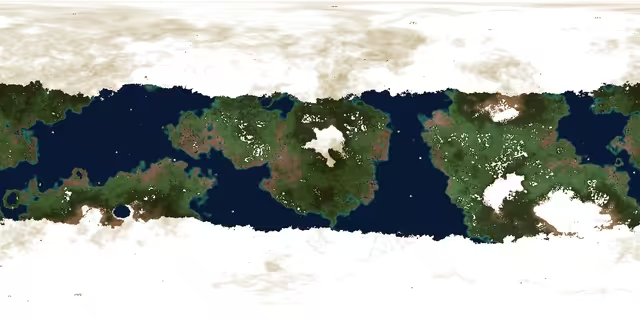 Map of Dralora
 -
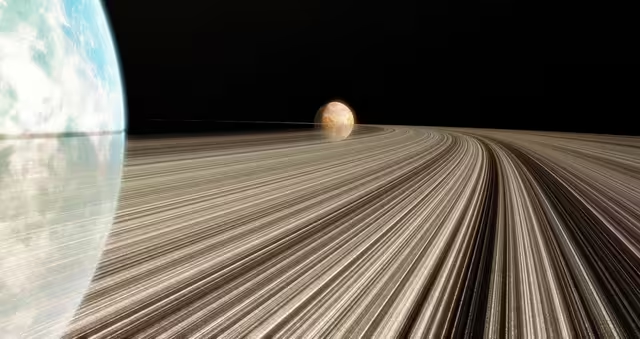 View of the Rings of Valdona.
 -
 Close up view of the Rings of Valdona
 -
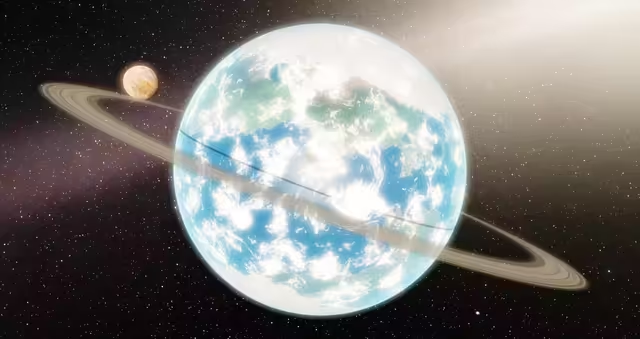 Different view of Dralora with the vast Mid Arm of the behind it. Its moon Yckar can be seen.


