
Luia: Difference between revisions
More actions
No edit summary Tag: 2017 source edit |
No edit summary Tag: 2017 source edit |
||
| Line 53: | Line 53: | ||
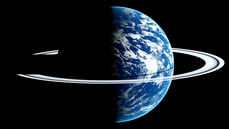
'''Luia''' is the farthest planet orbiting the bright stars of [[Aya (Vela)|Aya]] in [[Midonia|Midonia's]] outlying [[Nebulon]] region. Deep, briny oceans of ammonia envelop the frigid planet, broken up by vast glacial landmasses, giving rise to desolate ice sheets, spectacular archipelagos, and massive ice shelves. An ancient collision gave rise to Luia's vibrant set of rings, and is likely the reason for the planet's lack of natural satellites. |
'''Luia''' is the farthest planet orbiting the bright stars of [[Aya (Vela)|Aya]] in [[Midonia|Midonia's]] outlying [[Nebulon]] region. Deep, briny oceans of ammonia envelop the frigid planet, broken up by vast glacial landmasses, giving rise to desolate ice sheets, spectacular archipelagos, and massive ice shelves. An ancient collision gave rise to Luia's vibrant set of rings, and is likely the reason for the planet's lack of natural satellites. |
||
Devoid of any significant resources, the planet has seen little activity ever since its discovery, |
Devoid of any significant resources, the planet has seen little activity ever since its discovery, only ever harboring three research outposts. [[Tale:The Last Sunrise|Sellis Station]] is by far the most famous, having met a deadly end at the hands of a vast storm. They rely on local hydroponics, solar panels, and regular deliveries of supplies to sustain their populace. Travelers are advised to bring a generous supply of oxygen, lest they succumb to hypoxia in minutes. |
||
Once thought to be incapable of supporting life, geological studies and the discovery of microbes on the seabed suggest that Luia is too young to sustain a proper biosphere. Despite theoretically being able to host life, the twin suns of Aya will likely die before any significant evolutionary diversification would occur. |
Once thought to be incapable of supporting life, geological studies and the discovery of microbes on the seabed suggest that Luia is too young to sustain a proper biosphere. Despite theoretically being able to host life, the twin suns of Aya will likely die before any significant evolutionary diversification would occur. |
||
| Line 69: | Line 69: | ||
=== Terrestrial === |
=== Terrestrial === |
||
<gallery widths="230" heights="230" mode="nolines"> |
<gallery widths="230" heights="230" mode="nolines"> |
||
LuiaLandscape1.png|A frigid coast featuring distant |
LuiaLandscape1.png|A frigid coast featuring distant mountains |
||
LuiaLandscape2.png|Aerial shot of Luia's vast, frozen landscape |
LuiaLandscape2.png|Aerial shot of Luia's vast, frozen landscape |
||
</gallery> |
</gallery> |
||
Revision as of 00:50, March 1, 2026

"This is it. Selis Station, Luia, the frontier of the galaxy. It's a strange sense of solitude out here that I can't exactly put into words. I've seen my fair share of the universe, but here? There are around eight thousand people on this rock, only a couple of cities on Sirona, and that's it for over a thousand light-years. Beyond this outpost lie lands that have never been walked by anyone, ever..."
Luia

Luian
14.02 astronomical units
22y 157d
0.032
0.46 Me
10,414 kilometers
0.71 G
-86.5 °C
0.72 atmospheres
79% nitrogen
13% hydrogen
5% oyxgen
52.2 Ma
11h 34m
176°
7596
Luia is the farthest planet orbiting the bright stars of Aya in Midonia's outlying Nebulon region. Deep, briny oceans of ammonia envelop the frigid planet, broken up by vast glacial landmasses, giving rise to desolate ice sheets, spectacular archipelagos, and massive ice shelves. An ancient collision gave rise to Luia's vibrant set of rings, and is likely the reason for the planet's lack of natural satellites.
Devoid of any significant resources, the planet has seen little activity ever since its discovery, only ever harboring three research outposts. Sellis Station is by far the most famous, having met a deadly end at the hands of a vast storm. They rely on local hydroponics, solar panels, and regular deliveries of supplies to sustain their populace. Travelers are advised to bring a generous supply of oxygen, lest they succumb to hypoxia in minutes.
Once thought to be incapable of supporting life, geological studies and the discovery of microbes on the seabed suggest that Luia is too young to sustain a proper biosphere. Despite theoretically being able to host life, the twin suns of Aya will likely die before any significant evolutionary diversification would occur.
Miscellaneous
Gallery
Orbital
-
 Overhead shot of Luia
 -
 Sideways shot of Luia


Terrestrial
-
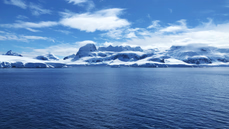 A frigid coast featuring distant mountains
 -
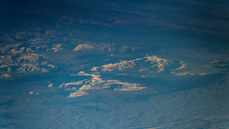 Aerial shot of Luia's vast, frozen landscape

