
Sirona: Difference between revisions
More actions
No edit summary Tags: Manual revert 2017 source edit |
No edit summary Tag: 2017 source edit |
||
| Line 96: | Line 96: | ||
=== Orbital === |
=== Orbital === |
||
<gallery widths="270" heights="270" mode="nolines"> |
<gallery widths="270" heights="270" mode="nolines"> |
||
File:Sirona3. |
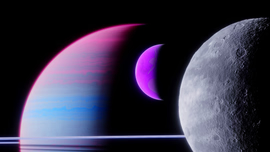
File:Sirona3.png|Sirona, Bloom, and Boulder |
||
File:Sirona4. |
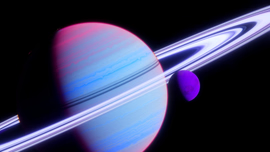
File:Sirona4.png|Sirona and Bloom |
||
File:Sirona2. |
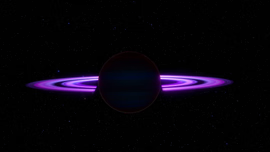
File:Sirona2.png|Ethereal glow of Sirona's rings |
||
</gallery> |
</gallery> |
||
Latest revision as of 15:56, March 4, 2026


Sirona

Sironan
Siroan
10.59 astronomical units
14y 162d
0.021
8.41 Me
34,741 kilometers
-15.7 °C (1 atm depth)
72% hydrogen
14% helium
6% methane
52.6 Ma
12h 53m
3°
~400,000 (Planetary)
~270,000 (Lunar)
~30,000 (Orbital)
7596
The ice giant of Sirona is the second planet orbiting the sapphire suns of Aya, deep in the Nebulon region of Midonia. Discovered in 7596, the ice giant would be overlooked until the discovery of Arwall Maba four years later, an event which shaped Aya into a waypoint to the lush garden world. A subsequent deeper survey of the planetary system led to the discovery of rich, previously unnoticed resource deposits on the moons of Sirona, and as a result, the public interest in Aya began to rise.
Pioneering expeditions in the clouds of Sirona discovered the presence of cloud-dwelling creatures in the ice giant's atmosphere, sparking a wave of curiosity among the colonists. These lifeforms, violet medusoid floaters gracefully gliding in the upper clouds, were the first among the plentiful species to be gradually uncovered on the planet. The discovery of Sirona's unique biosphere has since attracted countless people across the galaxy and vastly contributed to the star system's development.
The industry-leading astrohabitation corporation, Orbital Intergalactic, has since turned Sirona into a site of thriving expansion, creating countless opportunities for people across the galaxy. Initially, the corporation constructed outposts in orbit of the ice giant its major moons; however, it has lately begun to construct enclosed habitats in the clouds of Sirona, supported by hot-air balloons. Central to this expansion is Aeris, a vast sky city and resort enclosed in a grand dome.
Governance
Sirona and its moons are governed directly by Orbital Intergalactic, ruled by a board of fifteen members that oversee the local development. Public votes are held on the thirteenth of Calder every year, letting the workers of the corporation have a say in the budget. Though Aeris is the capital, it is in the midst of construction, leading Apollo to unofficially take on that role.
Infrastructure
Orbital
Hos
Hos is the central security checkpoint in Aya, and nearly every ship ends up there at one point or another. That is, with the exception of vessels registered to Orbital Intergalactic, for whom specialized security checkpoints have been established. In contrast to said corporate checkpoints, Hos is far larger and sees nearly constant activity.
Aerial
Aeris
Astrography
Sirona orbits the stars of Aya at a distance of ten point fifty nine astronomical units, completing a single revolution once every fourteen years and a hundred and sixty two days. Seventy nine moons orbit the planet, of whom three are large enough to be spherical.
A vast set of colorful rings encircles Sirona, measuring around fifty thousand kilometers in length. It is believed that they formed after a collision with a large planetary body shortly after the system's birth.
Satellites
Apollo
The largest population center in Aya, Sirona's asteroid moon Apollo harbors roughly one hundred and fifty thousand inhabitants. Nearly every one of them is employed by Orbital Intergalactic, tasked to uphold the system's infrastructure, process any incoming deliveries before they reach Sirona, and refine raw ores into usable resources. The interior of Apollo is divided into seven districts, each serving a distinct purpose. They are interconnected by an intricate subway network.
Bloom
The innermost of Sirona's major moons, Bloom's orbit leads it through a harsh radiation belt, requiring specialized shielding for any close-range surveys. Its dense atmosphere, composed largely of greenhouse gases, shrouds the world in a brilliant violet haze and raises the temperatures to over thirty degrees Celsius.
Flourish
The second of Sirona's round moons, Flourish is blanketed by a tenuous sulfur dioxide atmosphere. The terrain is largely characterized by rocky hills and vast mountain ranges, sparsely interrupted by dunes and impact craters. Relatively poor in resources, Flourish has seen little activity since Sirona's inhabitation. Though, the moon's temperate climate and relatively pleasant gravity have led it to becoming a fairly active colonization target. By today, roughly one hundred and five thousand people live in its domed cities of Ves and Eora in the northern hemisphere.
Boulder
Boulder sits farther than any other satellite in Sirona's grasp, having traveled for eons through interstellar space until it was captured in a stable orbit. Unlike the other moons of Sirona, Boulder lacks an atmosphere and is a desolate wasteland of rocks and dust, inhabited only by microbes in the scarce water ice at the poles. What sets the moon apart is its remarkable concentration of rare-earth element deposits, fundamental for the construction of countless vital technologies. Consequently, vast extraction sites and factories obscure the barren landscape of Boulder, employing both people and robots to fuel the expansion in Aya.
Once the extracted ores are refined, mass drivers launch the cargo into the orbit of Boulder in specialized containers, eventually being utilized by the countless construction drones that tirelessly assemble the infrastructure of Sirona and beyond. The trade lanes in the moon's vicinity have been heavily patrolled by local corporate forces in the wake of a daring orbital raid unleashed in 7618, bringing about the destruction of three ore freighters and the death of over a dozen workers.
Biosphere
The discovery of an intricate biosphere in the clouds of Sirona, an exceptionally rare biological phenomenon, has led to great scientific interest on the planet. In the recent years, several research habitats have been established across the ice giant in order to study the native life up close. On top of that, local companies have began to run shuttle tours across the clouds in order to let the tourists take a closer look at the otherworldly creatures of Sirona.
As opposed to terrestrial worlds, the greater lack of natural barriers on Sirona has led to a lesser diversity across the planet. Virtually every species can be found in any corner of the ice giant. The greatest obstacle is the vertical fluctuations of temperature and pressure on Sirona, which have enabled varied ecosystems to develop. The other obstacle on the planet is the zones and belts; regions of ascending and descending currents, respectively. The elevating air of zones propels nutrients and microbes upward, leading to a greater quantity of life in such regions.
The upper layers of Sirona are home to a diverse collection of luminous medusoid and bulbous floaters, taking advantage of lighter-than-air gases in order to traverse the clouds. They gracefully feed on the ever-abundant sunlight and the microbes in the air. Life in the deeper clouds of Sirona is nearly the polar opposite, as translucent lifeforms swim through the dense gas, feeding on both local aeroplankton and the radiation in order to mature and reproduce.
Miscellaneous
Trivia
- Sirona's spacelanes are heavily patrolled following the pirate raid on Boulder two years ago.
- In the twenty years since its inhabitation, no one has accidentally stumbled off the aerial platforms and plunged into the endless clouds.
Gallery
Orbital
-
 Sirona, Bloom, and Boulder
 -
 Sirona and Bloom
 -
 Ethereal glow of Sirona's rings


