
Woake (Planet): Difference between revisions
More actions
mNo edit summary |
No edit summary |
||
| Line 20: | Line 20: | ||
Wuta is the closest moon to Woake. Wuta has an extremely thin atmosphere, mostly composed of oxygen and traces of water vapour, suggesting this moon may have been an Earth-like moon almost 4 billion years ago. |
Wuta is the closest moon to Woake. Wuta has an extremely thin atmosphere, mostly composed of oxygen and traces of water vapour, suggesting this moon may have been an Earth-like moon almost 4 billion years ago. |
||
Woakes first landed on Wuta in 1980 |
Woakes first landed on Wuta in 1980. It is currently home to 500 million Woakes. |
||
| Line 30: | Line 29: | ||
[[File:Muyta.jpg|thumb|left|300px|Muyta is the second closest moon to Woake.]]Muyta is the largest moon of Woake, with a diameter of 3763 km. Like Wuta, it also has a thin atmosphere also containing oxygen and trace amounts of sulfur dioxide, suggesting the moon had experienced extreme volcanism in the distant past. |
[[File:Muyta.jpg|thumb|left|300px|Muyta is the second closest moon to Woake.]]Muyta is the largest moon of Woake, with a diameter of 3763 km. Like Wuta, it also has a thin atmosphere also containing oxygen and trace amounts of sulfur dioxide, suggesting the moon had experienced extreme volcanism in the distant past. |
||
Woakes first landed on Muyta in 1985 |
Woakes first landed on Muyta in 1985. Currently, 1.2 billion Woakes live on Muyta. |
||
| Line 39: | Line 38: | ||
[[File:Twya.jpg|thumb|left|300px|Twya is the third moon from Woake.]]Twya is the third moon from Woake. Unlike its sister moons, it does not have an atmosphere, leaving the moon exposed to UV radiation and solar winds. |
[[File:Twya.jpg|thumb|left|300px|Twya is the third moon from Woake.]]Twya is the third moon from Woake. Unlike its sister moons, it does not have an atmosphere, leaving the moon exposed to UV radiation and solar winds. |
||
Woakes first landed on Twya in 1989 |
Woakes first landed on Twya in 1989. It is now home to roughly 880 million Woakes. |
||
| Line 48: | Line 47: | ||
== |
==Timeline== |
||
1 Million BCE: [[Woakes (Species)|Woakes]] first appear on Woake. |
1 Million BCE: [[Woakes (Species)|Woakes]] first appear on Woake. |
||
400000 BCE: An ancient civilization |
400000 BCE: An ancient civilization visits Woake and leaves behind a monolith on the equator. |
||
1800 CE: Space exploration begins. |
1800 CE: Space exploration begins. |
||
| Line 59: | Line 58: | ||
2042 - 2053 CE: Terraforming of Wuta, Muyta and Twya begin. |
2042 - 2053 CE: Terraforming of Wuta, Muyta and Twya begin. |
||
2130 |
2130 - 2140 CE: Wuta, Muyta and Twya are terraformed. |
||
3024 CE: Woakes send a signal in the direction of Earth (without any knowledge of Humanity). |
3024 CE: Woakes send a signal in the direction of Earth (without any knowledge of Humanity). |
||
Revision as of 12:51, September 12, 2015

Woake (RS 8409-1353-7-1358771-76 5 in 0.9.7.4 beta patch 5) is a temperate O-Class planet found in Barnard's Loop at about 1590 light years from Earth.
It is the homeworld of the Woakes, a mid-Type I civilization. They are an aquatic species, evolving in their planet-wide ocean for almost a million years. For almost 200 years, they have explored outer space with manned space stations, probes into interstellar space and colonzing their three larger moons.
Woake was discovered in 3026 by Humanity when the Woakes sent a signal into deep space, hoping they would discover alien civilizations.
The planet population is currently 22 billion.
Overview
Woake is the fifth planet from its sun at a distance of 1.63 AU with an orbital period of 2.13 years. This places the planet within the middle of the habitable zone, where temperatures aren't too cold and a stable greenhouse effect can take place. It has a greenhouse effect of 80.9 celsius, raising its temperatures to -5.2 celsius.
The axial tilt is an extreme 149 degrees. An observer on the surface would see the sun rise in the west and set in the east, instead of east to west. The climate may seem calm from above but once within the lower atmosphere, the weather can produce strong winds of almost 100mph and can very suddenly drop down to between 6mph to 10mph.
The planet is orbited by 15 moons, three larger moons: (in distance from Woake) Wuta, Muyta and Twya. The other twelve moons are captured asteroids.
Moons
Woake is orbited by 15 moons. This includes three large moons and twelve captured asteroids in highly inclined and elliptical orbits.
Wuta

Wuta is the closest moon to Woake. Wuta has an extremely thin atmosphere, mostly composed of oxygen and traces of water vapour, suggesting this moon may have been an Earth-like moon almost 4 billion years ago.
Woakes first landed on Wuta in 1980. It is currently home to 500 million Woakes.
Muyta

Muyta is the largest moon of Woake, with a diameter of 3763 km. Like Wuta, it also has a thin atmosphere also containing oxygen and trace amounts of sulfur dioxide, suggesting the moon had experienced extreme volcanism in the distant past.
Woakes first landed on Muyta in 1985. Currently, 1.2 billion Woakes live on Muyta.
Twya

Twya is the third moon from Woake. Unlike its sister moons, it does not have an atmosphere, leaving the moon exposed to UV radiation and solar winds.
Woakes first landed on Twya in 1989. It is now home to roughly 880 million Woakes.
Timeline
1 Million BCE: Woakes first appear on Woake.
400000 BCE: An ancient civilization visits Woake and leaves behind a monolith on the equator.
1800 CE: Space exploration begins.
1980 - 1989 CE: Manned missions to Wuta, Muyta and Twya.
2042 - 2053 CE: Terraforming of Wuta, Muyta and Twya begin.
2130 - 2140 CE: Wuta, Muyta and Twya are terraformed.
3024 CE: Woakes send a signal in the direction of Earth (without any knowledge of Humanity).
3026 CE: Woakes and Humanity first contact.
Gallery
-
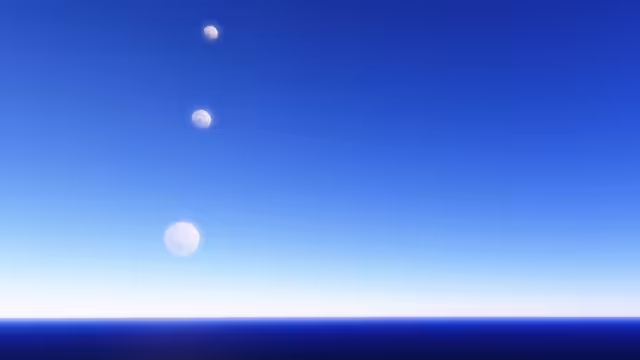 Woake's three moons from sea level.
 -
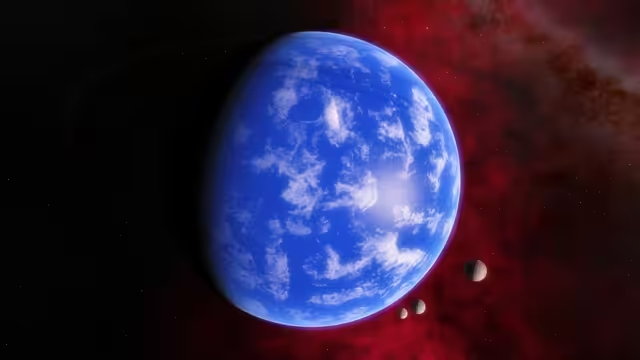 Woakes and its three moons from space. The red gas of Barnard's Loop can be seen.
 -
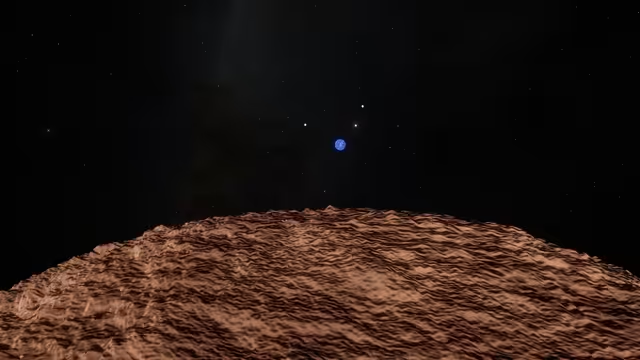 Woakes from its furthest asteroid moon.
 -
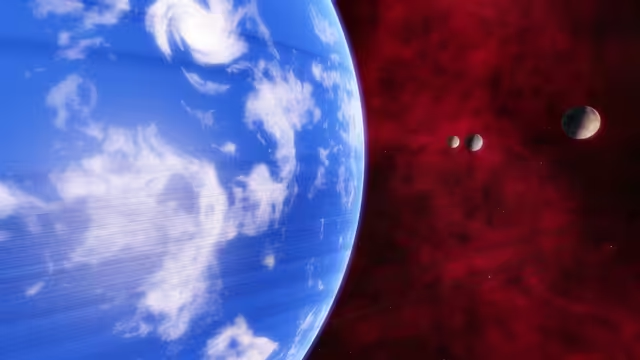 Woake's thin ring system. A tropical storm can be seen.


