
Melyos System: Difference between revisions
More actions
Redit category and add infobox |
mNo edit summary |
||
| Line 1: | Line 1: | ||
{{Stub}} |
|||
{{Star_System|title1=Melyos System|suns=* Melyos |
{{Star_System|title1=Melyos System|suns=* Melyos |
||
* Lemerya|dominant_species=[[Humans]] from [[Aureiga]]|age=4.57*10<sup>9</sup>|image1=0 Melyos System - Architect - 0.png|caption1=Melyos System|life=Organic multicellular life on: |
* Lemerya|dominant_species=[[Humans]] from [[Aureiga]]|age=4.57*10<sup>9</sup>|image1=0 Melyos System - Architect - 0.png|caption1=Melyos System|life=Organic multicellular life on: |
||
Revision as of 12:56, April 3, 2021
Template:Stub Template:Star System
Overview
The Melyos System is located 27999.68 ly (or 8584.74 pc) from the galactic center of Via Lactea and 55999.35 ly (or 17169.48 pc) from the Helyar System. The system has the particularity of being located at this time exactly behind the galactic center from Helyar System and being at the same distance from the galactic center as Helyar System. In addition, it is also the mother system of a human civilization as well as a wormhole.
Composition
-
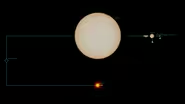 Melyos System
 -
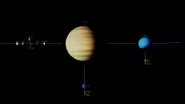 Melyos System - Zoom on Melyos
 -
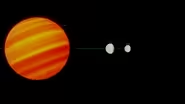 Melyos System - Zoom on Lemerya


The Melyos System is made up of two stars, Melyos, a G2 V type solar star and Lemerya, a L V type brown dwarf, which they take 4723.42 years to orbit.
The system does not have asteroids and comets. One explanation could be related that they all crashed into planets or stars or escaped from the system when a star passed out of the nearby system.
- Melyos
- Toi
- Leeikibi
- Gacru
- Uscari
- Olamta
- Other 7 dwarfs moons
- Blueneidon
- Tatani
- Aitta
- Lopares
- Other 13 dwarfs moons
- Lemerya
- Iura
- Selem