
Simud: Difference between revisions
More actions
Adding categories |
|||
| Line 40: | Line 40: | ||
__FORCETOC__ |
__FORCETOC__ |
||
[[Category:Sol System]] |
[[Category:Sol System]] |
||
[[Category:Moons]] |
|||
Revision as of 18:03, September 11, 2018

Simud is the name given to the dwarf planet turned moon that was moved into orbit of Mars.
Overview
An iron rich world with a mass one fourth that of Mars, Simud was once much like Luna, a frozen Class-S world. It has a diameter of 1786 km (978 mi) a semimajor axis of 49861 km (30982.2 mi) an orbital period of nearly 16 days and a day length of 23 hours and 30 minutes. It has a mean temperature of 2.6 °C (36.6 °F).
Discovered in 2090 by an asteroid driver probe, this rocky body caught the attention of scientists due to its iron core and its mass. Pre-terraforming the rocky body was pockmarked with asteroid strikes, a few of which were massive and one of which had darkened one entire side of the planet so that no light was reflected back. It was placed in orbit in 2233.
In 2501 the method of terraforming that had been used on Luna was repeated on this world, and within half a millennium Simud was another temperate Class-E world with more recognizable genetically engineered
plant and animal life. All former smaller asteroid impacts eroded fast. By 2811 Simud was completely terraformed.

Population
This moon has just recently crossed the one billion threshold and is currently at a population of 2.2 billion. Simudian culture allowed for only two children per household until recently, and after that law was rescinded, the population grew faster.
Climate
The moon is mostly forest now, coniferous in certain areas and deciduous in others. Plants grow faster and taller here as has been seen on various other lower gravity worlds. For the most part the weather is cool and clear with rainfalls that last for a day occurring once or twice a week.
-
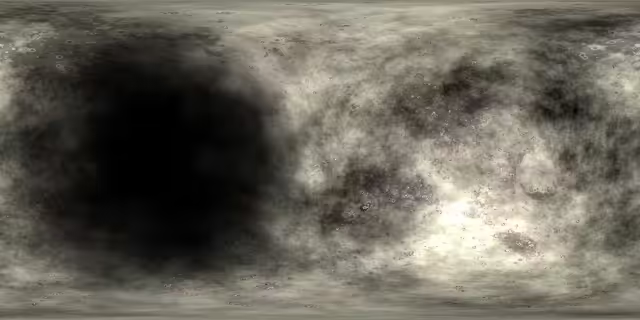 Simud original map. Note the dark patch in the western hemisphere
 -
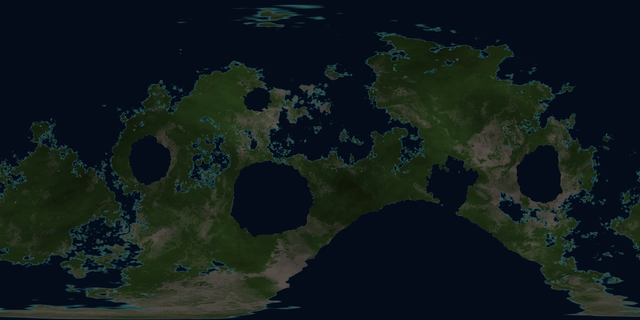 Simud terraformed map
 -
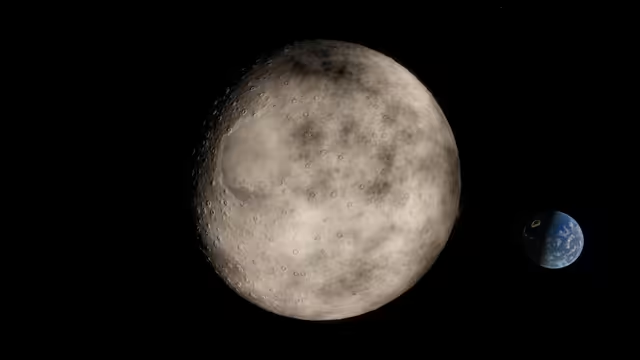 Image of Simud mere days before terraforming began
 -
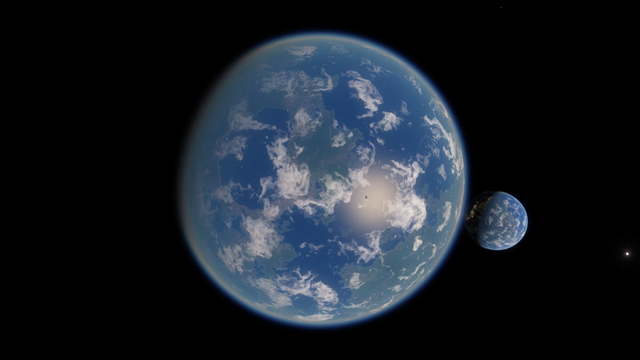 Recreation of that historic image


