Template:InfoboxSpaceshipEgeria was a manned human (Homo sapiens) spacecraft sent to Proxima Centauri. It was the very first human manned spacecraft to enter interstellar space and to reach a foreign star system. It was designed by billionaire Blore Ragner. Its main engine was powered by nuclear fusion and was equipped with an antimatter engine. There were 5 crew members aboard. John Timwall was the commander and pilot of the spacecraft.
Journey
Once all five crew members were aboard, it was launched from New South Wales in Australia in 19 August 2056. It entered the Oort cloud in 21 August 2056 and exited it 2 days later. After a 5-year journey, in 2061, it finally entered the Proxima Centauri system. Since the spacecraft itself couldn't explore all 8 planets, 10 probes were deployed, and each one targeted a specific celestial body. All of the probes were extremely clean and even had nanorobots to kill/remove every single bit of organism, dirt or organic/inorganic matter in order to prevent contamination. Egeria however, targeted the most important planet in the Proxima Centauri system: Proxima 4, a frozen titan because it was the most promising planet for life to thrive. It proceeded to send a lander with 4 of the 5 astronauts, and Timwall stayed aboard the orbiting spacecraft. Because the atmosphere is much lighter and the gravity slightly lower, the lander had a safe landing, but had to use much more fuel to slow down. In September 2061
Tim Greerson standing on Proxima 4
, once the lander landed, it opened, and the 4 crew members proceeded to explore the planet. Tim Greerson, an astronaut and biologist, observed the very first lifeform, which Heinrich Bergmann later named Alienobacterium proximus. It was a microscopic, unicellular and silicon-based organism. Other organisms were later identified by Bergmann and other scientists. Greerson collected samples of the organism. The 4 crew members then went back to the lander and back to the spacecraft. For the next 7 months, they visited the other celestial bodies, but didn't land on them. After the mission was completed, they targeted Sol and went back to Earth. The way back took another 5 years. On the way back, Greerson was able to conduct several experiments on the organism and recorded it. In 20 November 2066 they returned to Earth. Once returned, Greerson met up with astrobiologist Heinrich Bergmann and gave him the samples and records in Fabruary 2067. Bergmann observed, described.and named the organism in 2068.
Technology and design
Early designing began in late 2020's by Blore Ragner of the RPSA with the help of NASA. Construction of Egeria began in the mid 2030's by RPSA, and it was built with the latest technologies. Rather than a spaceship, it was more of a mobile space station with modules. An antimatter engine was built in the mid 2040's. The first module was a central "tube" with zero gravity. Here labs, hubs and pathways were built. Next, solar panels and nuclear reactors for energy were installed and finally 4 arc circle rings which rotate, creating artificial gravity. Resting rooms, toilets, kitchens, gyms and even a swimming pool were also built inside the rotating rings. Shields and artificial magnetic fields were installed for protection against debris, particles and radiation. Construction finished in mid-2050's. The entire spaceship was a staggering 2000 kilometres and took around 4 decades to build.
Crew
John Timwall - commander and pilot
Tim Greerson - biologist and astronaut
Charlie Oldman - technichian and electrician
Sarah Veil - astronaut, botanist and astronomist
Victor Windchester - astronaut and supervision
Trivia
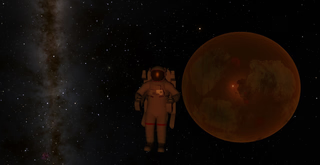
Egeria comes from Roman mythology. She was a water nymph, and exchanged wisdom and knowledge for water and milk. The name was chosen because the crew was giving their time, energy and risk to learn more about the Proxima John Timwall in an extravehicular unit orbiting Proxima 4Centauri.