
Cyroterm

More actions

Cyroterm

Organic unicellular (Marine, Terrestrial)
RS 8474-1389-7-1497965-5298
0.33 AU
90.026 days
0.52533 Earths
10183.94 km
0.82422 g
-11.707 ºC
9.73 Billion years
150.043 days (5:3 resonance)
3º54'26.12
- Rampantarans (now), *Unnamed civilization (formerly)
- Rampantaran Republic
Cyroterm (misspelled "cryos, meaning "ice" " + "thermal") is a quite small earth-like planet with noticable polar glaciers in its current state as well a less prominent ring around it. It is found in Milky Way galaxy, orbiting a star named Brimsoar. In the history surrounding it's star system, it's one of the planets colonized by Rampantaram republic, as well as a planet that for a short period of time had a native intelligent species.
Cyroterm is now gradually being set up for exploration. Here's the world map.
Exogeography
Cyroterm has lower gravity than Earth, which can be attributed to the fact that the former is twice as lighter and a tad smaller than the latter. It orbits its star fast and rotates slow, causing its life to adapt to such circumstances. Despite this Cyroterm's moons and ring still seem to influence things such as both wind and ocean currents on the planet. But the ring also brings misfortune as meteorites from it keep falling on the surface of the planet, disrupting life at certain sites. The fast orbitation of Cyroterm is not much taken into account, since it has low axial tilt and therefore that removes seasons, but vaguely different biomes are still present even though the low axial tilt would otherwise caused a single-biome planet to form.
Litosphere
Cyroterm's surface varies, but it consistantly seems to have a rather rough set of soil particles in areas where the plant analogues haven't sprouted. The tectonic processes keep happening, but they are rather peculiar, because they haven't, throughout the geological history, caused much of the continent drift, but rather caused certain smaller areas on Cyroterm to form canyons and island, regardless if its in the ocean or an inland sea.
Hydrosphere
Water seems rather clear from the space, but its pretty polluted-looking if one considers swimming in it. However, it has been that way for much of history due to how lifeforms and the inorganic particle cycle has influenced it. On some parts of planet, certain waterways or water guiding tunnels get plugged, causing water level to suddenly rise in some other points, only for the plug to dissolve and give way after uncertain amount of time, which is accountable to severly impact several ecosystems.
Atmosphere
Cyroterm's skies are mostly composed of CO2, O2 and N2, the first one being the most abundant, followed by the second and the third gas. Nowadays it doesn't result in complete global Cyroterm warming because of the water and minor gases actually having become strong cooling agents due to their composition, though it's not yet clear how. In fact that makes the average temperature on the planet, overall -11C but, in their own ways, whole biomes have managed to adapt and basically create warm spots around themselves using methods such as attracting atmosphere's CO2.
Biosphere
A lot of creatures are energetic, surface dwellers (whether land or water), which have a tendency to rile themselves up before tackling some kind of problem. At certain level of intelligence, certain animal taxons sometimes try following members that have obvious levels of success, whether to mimic, support or rob them.
Species documented so far:
Channel kryntswisher (Devincerava vadum) - an aquatic, marine waterway dwelling tylosaur-like carnivore that also ingests phosphate containing substances to support the detritivorous symbiotes living in the shell around its torso.
Lightgroove irigafrut (Inripomala lenicanalis) - low growing phytomorph (plant-like) species that grows near rivers and changes local soil via symbiotic intervention.
Shred-bearing squaripto (Muctaruptus segmenti) - A microscopic, parasitic species that inhibits ground layer and steals energy providing molecules from species that come/dig across it.
Civilization
Cyroterm has had about two civilizations, the first one arose a long time ago, but was killed off before advancing into settlement stage when heightened increase of volcanic activity caused extinction of some important keystone species, which, in turn, led to extinction of many other species with more advanced nervous system. The second one were Rampantarans, who started off as explorers and later colonized Cyroterm, yet didn't cause much damage to it, eventually learning to live in larger harmony with nature, even though at some sites, pollution was rather large. It might be that the rather cold environment kept the pollution from quickly expanding further.
History/Culture overview
As noted on the Cyntadder sector's timeline, Cyroterm has had events such as the glacier formations or the origin of gigantic ocean organisms hundred millions of years ago. The ring of Cyroterm formed much earlier than the glaciers. Much later in timeline Rampantaran Republic colonized Cyroterm and creating cities and suburbs on it, which also had monuments in them, such as the statue of Space probe Madgo. In the most recent times, ecosystems formed anew from the previous mass extinction.
Landscape Features
Automaccolo Desert
This large area seems to resemble desert a lot but still there are soils suitable to produce some quite fertile organisms. These organisms there are very focused on all available resources around, especially alien plants due to having access to accumulate lots of energy but not enough resources to efficiently use and afterwards disperse the accumulated energy. In a largely sandy type area, many sessile organisms can grow quite suddenly, whenever there's sufficient precipitation.
The river found in the middle of the desert acts as the barrier separating desert into three ecological zones. Currently only the bottom one is named. Also one branch of the river is extremely dependent on periodical drying, so it mostly appears as lightly colored trench.
Maps
-
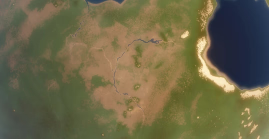 Automacolo desert map unannotated
 -
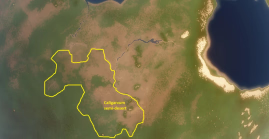 Automacolo desert (roughly) annotated
 -
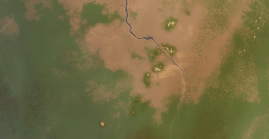 Zoom-in on Caligarvum semidesert
 -
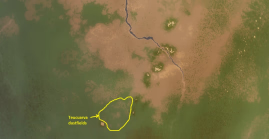 Caligarvum semidesert map with annotations


