
Milky Way

More actions

Milky Way

- Via Lactea
Barred Spiral (SBbc)
Intermediate Barred Spiral
4
52,850 light-years
105,700 light-years
~225–250 million years (solar orbit)
100–400 billion
- Solar System
- Earth
12,410
10,668
Local Group
- Large Magellanic Cloud
- Small Magellanic Cloud
- Sagittarius Dwarf Spheroidal Galaxy
The Milky Way, additionally known as Via Lactea, is a vast galaxy within the Local Group and the second largest galaxy in the aforementioned galactic assemblage. An intermediate-class barred spiral galaxy a hundred thousand light-years in diameter, the Milky Way is home to approximately three hundred billion and over five hundred billion worlds. Furthermore, the Milky Way spreads for tens of thousands of light-years beyond its 'borders,' culminating in a sparse halo with stellar density comparable to extragalactic space.
The Milky Way has given birth to many hundreds of sapient species, many which have fallen and destroyed themselves, whilst the fortunate have propelled themselves toward being the most influential species in the galaxy. From the expansionist Vernha to the fledgling civilization of Humanity, the Milky Way's diversity of life is immense. The variety between the hundreds of forms of life is absolutely immense, ranging from carbon-based to silicon-based to having a solvent of liquid aluminum. Furthermore, the Milky Way is politically divided into several loosely associated groups of systems in which inhabitants work towards similar goals and maintaining the peace between human civilisations.
Nomenclature
History
Prehistory
The Milky Way's formation began around thirteen billion years ago, a period in time during which the galaxies that define the entire Universe were led by a similar fate. Supernovae, intense radiation, and star formation dominated the Milky Way at that time. In many millions of years, the Milky Way started to accumulate into a spiral shape, far different from the semi-irregular galaxy it used to look like during its past, culminating its tale of formation. It was a chaotic period for the Milky Way, littered with the remains from the time of its early formation. Over the course of time, the first planets started to form in the accretion disks of the second generation of stars. Some planets were too small and got captured as moons around larger and more massive planets, and some would even be thrown out of their respective systems by the most massive of planets. These planets would suffer from the same depressing fate as their parent stars, which started getting tinier and tinier by the day, until eventually they became one of the many tiny dots in the uncountable sea of stars on the horizon.
Life, being a true constant in the Universe and capable of extreme adaptation, began evolving from simple organic compounds on many worlds. The very first life in the Milky Way, and the entire Universe itself was purely microbial, being absolutely tiny in size. Most of these lifeforms would be genetically able to replicate themselves into two individuals. Each time when replicated, the individual would have tiny changes, which caused evolution to begin all across the entire Universe. Smaller lifeforms would evolve into bigger ones, which each time they reproduced, started to get more complex. This life would evolve into more and more intelligent organisms, until the infertile time of the Milky Way saw the rise of its first recorded sapient species. Dubbed the Progenitors, this species left behind many strange relics and very little is known of them, even for the most ancient interstellar civilizations. Only the most basic of knowledge has been unlocked, as nearly no knowledge from that era has survived for such an infinitely long time. The Progenitors ruled over a lot of the early galaxy for many millions of years before they mysteriously collapsed.
Structure
The Milky Way has a diameter of a hundred thousand light-years, or ten thousand parsecs. The galaxy's luminous disk contains approximately three hundred billion stars, the bulk of which are uncharted. Sagittarius A*, a supermassive black hole with a mass of almost four million stellar masses, sits in the heart of the galaxy binding it together as a star binds a planetary system. Most stars are within a thousand light-years of the plane of the luminous disk, which includes the inner disk, which spans two thousand light-years. The outer disk stretches for three to five hundred light-years on either side and includes fewer stars than the inner disk, with even fewer housing planetary systems.
The Galactic Centre, a bright sphere, is formed as the galaxy bulges around the galaxy's heart. This region covers approximately five thousand thousand light-years and contains almost fifty billion densely packed stars. The Galactic Centre's stars are only a tenth of a light-year apart in the center, and they have been known to collide and rip out each other's stellar cores. A disk of spiral arms encircle the Galactic Centre, which hold the majority of the galaxy's stars. The Orion–Cygnus Arm, Carina–Sagittarius Arm, Scutum–Centaurus Arm, and the Norma Arm are the Milky Way's four most well-known galactic arms, with a handful of lesser ones in between. The brightest supergiant stars, as well as blazing clouds of gas and dust, are concentrated in the spiral arms, contributing to the apparent gaps between the arms despite the fact that those locations are densely packed with stars.
Satellite Galaxies
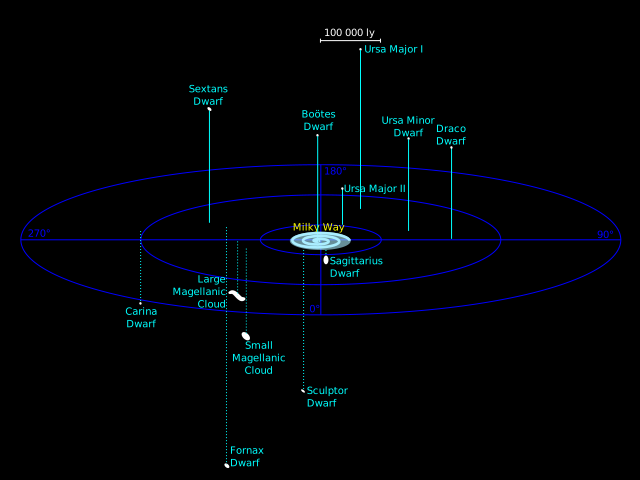
Dozens of miniscule satellite galaxies orbit the Milky Way, further adding to the diversity of the galaxy's surrounding cosmos. There are sixty documented satellite galaxies, with several more theorized to exist in the outer regions, either too dim to observe or concealed by other, larger ones. The Milky Way's satellites expand as far as one and a half million light-years, creating a dynamic web of tiny galaxies. In addition, only two are clearly visible to the naked eye, the twin Magellanic Clouds, all others being far too faint. The Milky Way's satellites are primarily either elliptical or irregular, a phenomenon seen around other spiral galaxies. Furthermore, satellites that orbit from a thousand light-years from the edge of the disc of the Milky Way Galaxy to the edge of the dark matter halo of the Milky Way, a million light-years from the center of the galaxy, are generally depleted in hydrogen gas compared to those that orbit more distantly. This is because of their interactions with the dense hot gas halo of the Milky Way that strips cold gas from the satellites.