
Celestia Class Heavy Shuttle Orbiter: Difference between revisions

More actions
Page created. |
m Hatnote Tag: 2017 source edit |
||
| (15 intermediate revisions by 3 users not shown) | |||
| Line 1: | Line 1: | ||
{{BorealisUniverse}} |
|||
| ⚫ | |||
| ⚫ | The Celestia Class Heavy Shuttle Orbiter is the heavier, bulkier variant of the [http://space-engine.wikia.com/wiki/Starling_Class_Shuttle_Orbiter Starling Class Shuttle]. It carries thirty-two crew members and holds a large storage bay, excellent for carrying lab equipment, medical supplies, communication devices, small vehicles, autonomous rovers, and much else. |
||
Blueprints were drawn out for this spacecraft when humans began exploring worlds too dangerous for the Starling to safely handle. The first operational model of the Celestia was built just before the year 2200 CE. Like the Starling, it has undergone many revisions to become as powerful, advanced, and reliable as its counterpart. |
Blueprints were drawn out for this spacecraft when humans began exploring worlds too dangerous for the Starling to safely handle. The first operational model of the Celestia was built just before the year 2200 CE. Like the Starling, it has undergone many revisions to become as powerful, advanced, and reliable as its counterpart. |
||
It is standard of any FTL craft to possess Starling shuttles for most worlds and Celestia orbiters for large, atmospherically dense, or otherwise hazardous worlds. This is why the only people permitted to fly the Celestia are pilots who have undergone rigorous training. |
It is standard of any FTL craft to possess Starling shuttles for most worlds and Celestia orbiters for large, atmospherically dense, or otherwise hazardous worlds. This is why the only people permitted to fly the Celestia are pilots who have undergone rigorous training.<gallery orientation="landscape" position="center" navigation="true"> |
||
Celestia6.png|The bottom. Note the heat shielding. |
|||
Celestia5.png|The top. The hexagon is an access port for loading supplies and goods for transportation. |
|||
Celestia4.png|The right wing and engine. |
|||
Celestia3.png|The back. This is the end that would dock to a larger spacecraft. |
|||
Celestia2.png|The left wing and engine. |
|||
Celestia1.png|The front. |
|||
scr00006.png|A Mk. 4 Celestia coming in for a landing on Luna.|link=http://space-engine.wikia.com/wiki/Luna |
|||
scr00007.png|A Mk. 4 Celestia orbiting Venus.|link=http://space-engine.wikia.com/wiki/Venus |
|||
</gallery> |
|||
== Stastics and Versions == |
== Stastics and Versions == |
||
=== Prototype Celestia Orbiter "Hercules" === |
=== Prototype Celestia Orbiter "Hercules" === |
||
'''Manufacturer:''' |
'''Manufacturer:''' Orbital Vehicle Designs. |
||
'''Year: '''2189 CE. |
'''Year: '''2189 CE. |
||
| Line 16: | Line 27: | ||
'''Length:''' 35.2 meters. |
'''Length:''' 35.2 meters. |
||
'''Pressure Rating:''' ~250atm. |
'''Pressure Rating:''' ~250atm. |
||
'''Temperature Rating:''' 1100C. |
'''Temperature Rating:''' 1100C. |
||
| Line 27: | Line 38: | ||
=== Mk. 1 Celestia Orbiter "Titan" === |
=== Mk. 1 Celestia Orbiter "Titan" === |
||
'''Manufacturer:''' |
'''Manufacturer:''' Boeing and Orbital Vehicle Designs. |
||
'''Year: '''2191 CE. |
'''Year: '''2191 CE. |
||
| Line 35: | Line 46: | ||
'''Length:''' 38.5 meters. |
'''Length:''' 38.5 meters. |
||
'''Pressure Rating:''' ~280atm. |
'''Pressure Rating:''' ~280atm. |
||
'''Temperature Rating:''' 1200C. |
'''Temperature Rating:''' 1200C. |
||
| Line 54: | Line 65: | ||
'''Length:''' 39.8 meters. |
'''Length:''' 39.8 meters. |
||
'''Pressure Rating:''' ~325atm. |
'''Pressure Rating:''' ~325atm. |
||
'''Temperature Rating:''' 1255C. |
'''Temperature Rating:''' 1255C. |
||
| Line 73: | Line 84: | ||
'''Length:''' 40.2 meters. |
'''Length:''' 40.2 meters. |
||
'''Pressure Rating:''' ~390atm. |
'''Pressure Rating:''' ~390atm. |
||
'''Temperature Rating:''' 1330C. |
'''Temperature Rating:''' 1330C. |
||
| Line 83: | Line 94: | ||
'''Warp Capabilities:''' None |
'''Warp Capabilities:''' None |
||
=== Mk. |
=== Mk. 4 Celestia Orbiter "Tethys" === |
||
'''Manufacturer:''' Orbital Vehicle Designs. |
'''Manufacturer:''' Orbital Vehicle Designs. |
||
| Line 92: | Line 103: | ||
'''Length:''' 40.279 meters. |
'''Length:''' 40.279 meters. |
||
'''Pressure Rating:''' ~415atm. |
'''Pressure Rating:''' ~415atm. |
||
'''Temperature Rating:''' 1340C. |
'''Temperature Rating:''' 1340C. |
||
| Line 101: | Line 112: | ||
'''Warp Capabilities:''' None |
'''Warp Capabilities:''' None |
||
[[Category:Technology]] |
|||
[[Category:Spacecraft]] |
|||
Latest revision as of 21:03, March 11, 2025

The Celestia Class Heavy Shuttle Orbiter is the heavier, bulkier variant of the Starling Class Shuttle. It carries thirty-two crew members and holds a large storage bay, excellent for carrying lab equipment, medical supplies, communication devices, small vehicles, autonomous rovers, and much else.
Blueprints were drawn out for this spacecraft when humans began exploring worlds too dangerous for the Starling to safely handle. The first operational model of the Celestia was built just before the year 2200 CE. Like the Starling, it has undergone many revisions to become as powerful, advanced, and reliable as its counterpart.
It is standard of any FTL craft to possess Starling shuttles for most worlds and Celestia orbiters for large, atmospherically dense, or otherwise hazardous worlds. This is why the only people permitted to fly the Celestia are pilots who have undergone rigorous training.
-
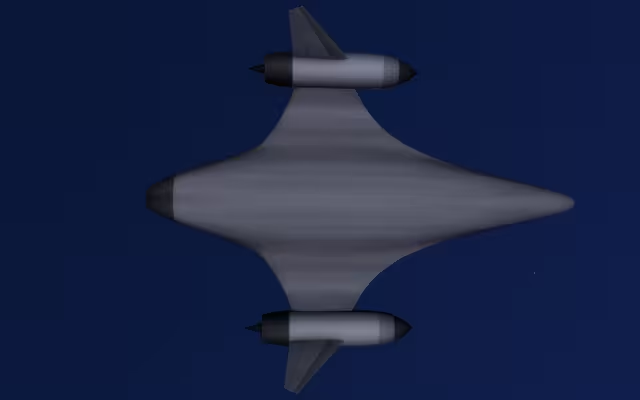 The bottom. Note the heat shielding.
 -
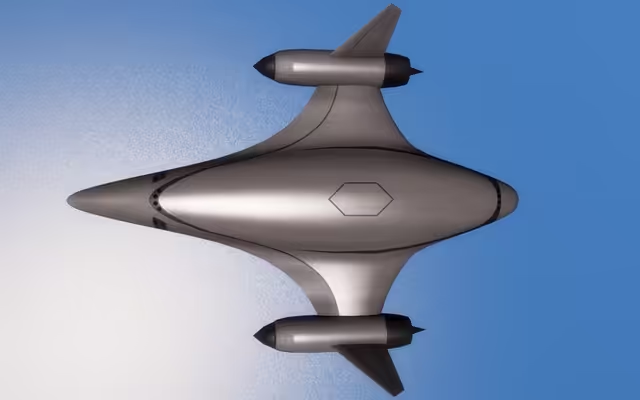 The top. The hexagon is an access port for loading supplies and goods for transportation.
 -
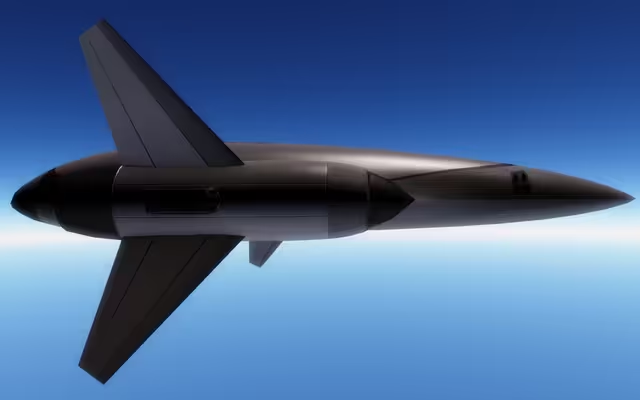 The right wing and engine.
 -
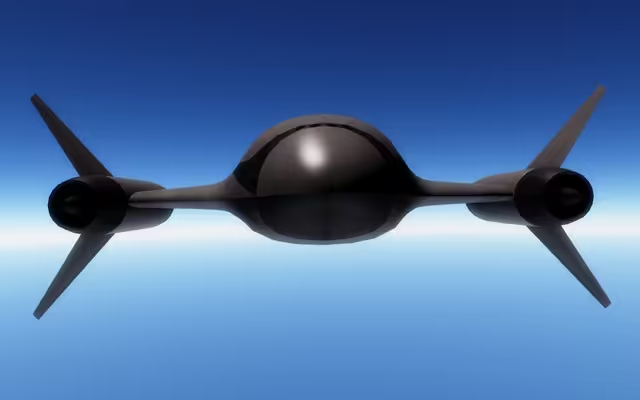 The back. This is the end that would dock to a larger spacecraft.
 -
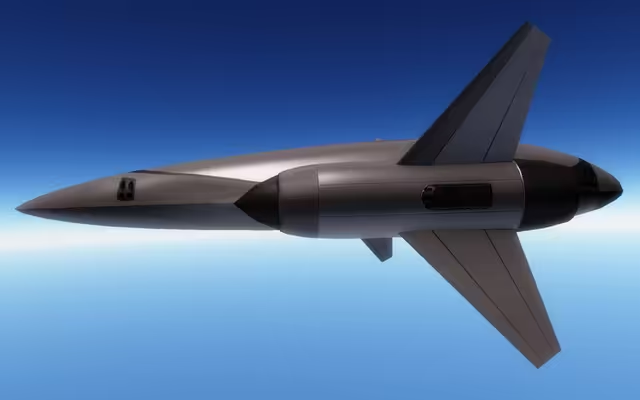 The left wing and engine.
 -
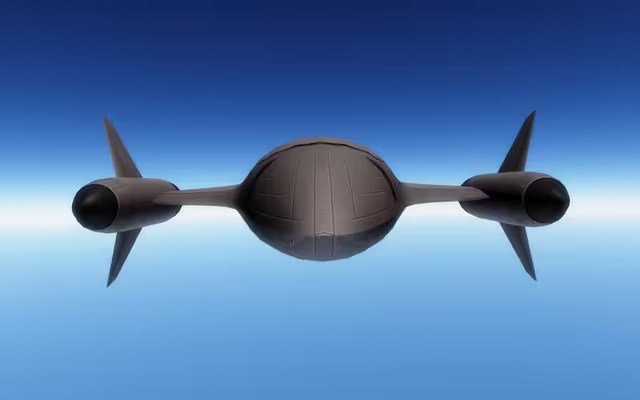 The front.
 -
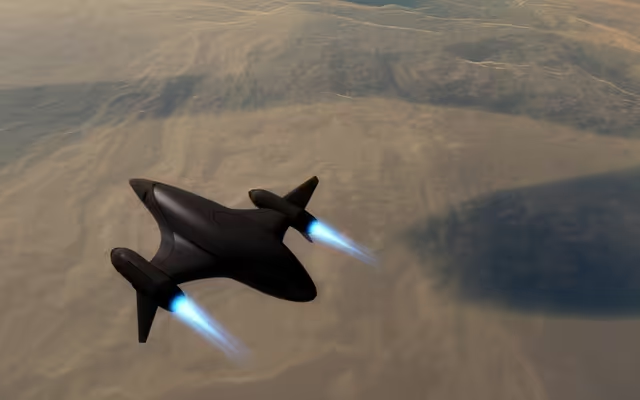 A Mk. 4 Celestia coming in for a landing on Luna.
 -
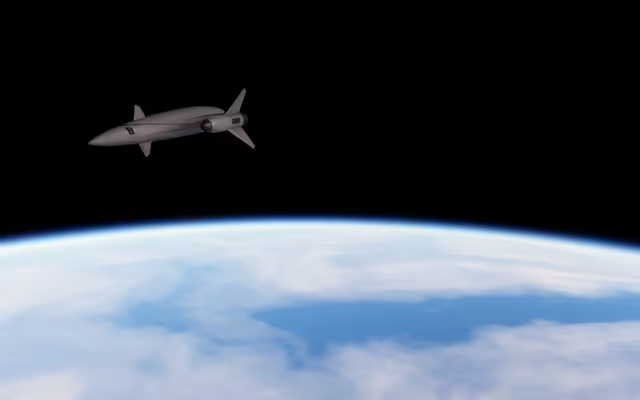 A Mk. 4 Celestia orbiting Venus.


Stastics and Versions
Prototype Celestia Orbiter "Hercules"
Manufacturer: Orbital Vehicle Designs.
Year: 2189 CE.
Mass: 24.6 tons.
Length: 35.2 meters.
Pressure Rating: ~250atm.
Temperature Rating: 1100C.
Earth TwR: 2.2
DeltaV: 85 Km/s
Warp Capabilities: None
Mk. 1 Celestia Orbiter "Titan"
Manufacturer: Boeing and Orbital Vehicle Designs.
Year: 2191 CE.
Mass: 23.1 tons.
Length: 38.5 meters.
Pressure Rating: ~280atm.
Temperature Rating: 1200C.
Earth TwR: 2.37
DeltaV: 95 Km/s
Warp Capabilities: None
Mk. 2 Celestia Orbiter "Eros"
Manufacturer: Boeing and Orbital Vehicle Designs.
Year: 2198 CE.
Mass: 21.4 tons.
Length: 39.8 meters.
Pressure Rating: ~325atm.
Temperature Rating: 1255C.
Earth TwR: 2.41
DeltaV: 97.5 Km/s
Warp Capabilities: None
Mk. 3 Celestia Orbiter "Hyperion"
Manufacturer: Orbital Vehicle Designs.
Year: 2207 CE.
Mass: 19.3 tons.
Length: 40.2 meters.
Pressure Rating: ~390atm.
Temperature Rating: 1330C.
Earth TwR: 2.45
DeltaV: 100.25 Km/s
Warp Capabilities: None
Mk. 4 Celestia Orbiter "Tethys"
Manufacturer: Orbital Vehicle Designs.
Year: 2215 CE.
Mass: 18.0 tons.
Length: 40.279 meters.
Pressure Rating: ~415atm.
Temperature Rating: 1340C.
Earth TwR: 2.3
DeltaV: 98.9 Km/s
Warp Capabilities: None