
Hephaestus (Planet) (Borealis Universe): Difference between revisions

More actions
mNo edit summary |
m Text replacement - "Category: Borealis Universe" to "Category:Scope: Borealis Universe" |
||
| (47 intermediate revisions by 3 users not shown) | |||
| Line 1: | Line 1: | ||
{{BorealisUniverse}}[[Category:Scope: Borealis Universe]] |
|||
| ⚫ | |||
{{InfoboxPlanet|name = Hephaestus|parent = |
{{InfoboxPlanet|name = Hephaestus|code = 71 Tauri 2 (version 0.980)|parent = Adephaga (71 Tauri)|image = Hephaestus Gas Giant.jpg|caption = First view of Hephaestus|moons = Hell'OBen, 60 captured asteroids|sma = 1.34 AU|orbperiod = 357 days|inclination = 2°|argper = 316°10'03"|meananomaly = 297°26'13"|mass = 8.3928 M♃|diameter = 148,968.3 km|rotperiod = 8 hours|axialtilt = 46°|avgtemp = 205 °C|atm = 80×10<sup>6</sup> atm|gravity = 19.56 g|age = 159,137,000 years|naturallife = None|controller = [[United Federation of Star Systems]]}}'''Hephaestus''' (catalogued as 71 Tauri c) is a searing gas planet orbiting the star [[Adephaga]] 146 light-years from [[Aegyn]]. Its most notable moon is the D-Class [[Hell'OBen]], similar to [[Tyche]], the first planet from its system. |
||
== |
==Discovery== |
||
Hephaestus is thought to have formed around a particularly violent star that would eventually throw the planet and its moon out of its parent star system. Tracebacks have determined that Vulcan originated from RS8409-1353-8-11843423-10, a white dwarf 11.843 light years from [[Sol]]. |
|||
Hephaestus was discovered in 2296 CE by [[Humans|human]] exoplanet telescopes, the gas giant was mostly written off as not really worth too much study, as it is an average gas giant. However, it became more well known after the [[Warp Drive]] was invented, and missions to the world came into the limelight. |
|||
Hephaestus is thought also to have become Vulcan's moon after it wandered into Vulcan's orbit early in the history of its parent star system. |
|||
Discovery of a hellish object named Hell'OBen sparked even more colonization and tourism to the Adephaga System and colonies were built on nearby moons in 2407 CE. |
|||
Hephaestus was first detected by the Extrasolar Body Tracking System, or EBTraS. on January 26, 7011. The EBTraS AI initially determined that its parent planets trajectory would cause it to pass through [[Jupiter|Jupiter's]] orbit. Upon further extrapolation, EBTraS determined Hephaestus would initially pass harmlessly through Jupiter's orbit before being caught in an orbit that would cause it to strike Jupiter. |
|||
[[File:HephMap.jpg|left|thumb|220x220px|Map of Hephaestus (Rodrigo's Mod)]] |
|||
However, due to Vulcan's orbit predicted to strike [[Europa]], the planetary government hired [[Terragen Co.|Terragen]] to help alter Vulcan's orbit, which would cause Hephaestus to move with its parent planet. As the moon approached Sol, the increasing heat from the sun melted long frozen gases on Hephaestus, creating atmospheres on both worlds and turning both into hot [[Planet Class|Ae-Class]] worlds. |
|||
==History== |
|||
Hephaestus immediately became a popular destination for tourists as well as a popular place for certain eccentric people to retire. |
|||
There isn't much to say about how this planet formed, as it did the same way as any other typical gas giant. However, it's important to say that 120 million years ago, its gravitational pull made it gain much more mass as three former planets & dwarf planets came so close that they collided and then were “swallowed” Hephaestus. Hell'OBen was captured in 92 million BCE, leaving the binary pair with Tyche. The [[United Federation of Star Systems|UFSS]] would later claim the system in late 24th Century CE. |
|||
== Population == |
|||
Most of the moon's population are eccentric retirees who live in very heavily shielded domed habitats with robotic help. The low gravity helps keep them limber and living longer. Others who live there are owners of popular recreational centers. |
|||
== |
==Physical Properties== |
||
Unlike its parent, '''Hephaestus''' has a substantially more Earthlike day despite it being nearly twice as long as Earth's own. This means that the entire surface is more equally bathed in heat and radiation, keeping |
|||
the surface constantly boiling. |
|||
There is not much worthy of note about this gas giant, other than its massive electrical storms throughout the atmosphere. Lightning the size of multiple planets can be sometimes seen by the research station in orbit around Hell'OBen. Interestingly enough, a full year on Hephaestus is only 8 days shorter than an Earth year. |
|||
The moon, like its parent has a strong magnetic field that |
|||
deflects much of the incoming solar radiation. |
|||
| ⚫ | |||
[[Category:Sol System]] |
|||
[[Category:Moons]] |
|||
=== A/3016 H 1 (71 Tauri 2.D16) === |
|||
[[Category:Deserts]] |
|||
[[File:A3.jpg|left|thumb|280x280px|A/3016 H 1 (71 Tauri 2.D16)]] |
|||
[[Category:Milky Way]] |
|||
A/3016 H 1 (71 Tauri 2.D16) is a nameless and captured asteroid dwarf moon of Hephaestus. |
|||
[[File:Adrios.jpg|thumb|280x280px|Aridos]] |
|||
=== Aridos === |
|||
Aridos (71 Tauri 2.D17) is a captured asteroid dwarf moon of Hephaestus. |
|||
=== Duna === |
|||
[[File:Duna.jpg|left|thumb|280x280px]] |
|||
Duna AKA 71 tauri 2.15 is a captured asteroid dwarf moon of Hephaestus. |
|||
=== Hunter'n === |
|||
[[File:Hunter'n.jpg|thumb|280x280px|Hunter'n]] |
|||
Hunter'n (71 Tauri 2.D5) is a captured asteroid dwarf moon of Hephaestus. |
|||
=== Ma'Bor K === |
|||
[[File:Ma'Bor K.jpg|left|thumb|280x280px|Ma'Bor K]] |
|||
Ma'Bor K (71 Tauri 2.D14) is a captured asteroid dwarf moon of Hephaestus. |
|||
[[File:Minior.jpg|thumb|280x280px|Minior]] |
|||
=== Minior === |
|||
Minior (71 tauri 2.D9) is a captured asteroid dwarf moon of Hephaestus. |
|||
==Dwarf moons gallery== |
|||
<gallery> |
|||
Totec.jpg|Topec (71 Tauri 2.D2) |
|||
Clio.jpg|Clio (71 Tauri 2.D3) |
|||
Valdeer.jpg|Valdeer (71 Tauri 2.D4) |
|||
Hunter'n.jpg|Hunter'n (71 Tauri 2.D5) |
|||
Uboa.jpg|Uboa (71 Tauri 2.D6) |
|||
TON 7.jpg|GNK (71 Tauri 2.D7) |
|||
Momos.jpg|Momos (71 Tauri 2.D8) |
|||
Minior.jpg|Minior (71 Tauri 2.D9) |
|||
Obi.jpg|Obi (71 Tauri 2.D10) |
|||
CT-Echo.jpg|Chengvot (71 Tauri 2.D11) |
|||
Zec.jpg|Zec (71 Tauri 2.D12) |
|||
Rhodnite.jpg|Rhodnite (71 Tauri 2.D13) |
|||
Ma'Bor K.jpg|Ma'Bor K (71 Tauri 2.D14) |
|||
Duna.jpg|Duna (71 Tauri 2.D15) |
|||
A3.jpg|A/3016 H 1 (71 Tauri 2.D16) |
|||
Adrios.jpg|Aridos (71 Tauri 2.D17) |
|||
Vaum.jpg|Vaum (71 Tauri 2.D18) |
|||
</gallery> |
|||
[[Category:Planets]] |
[[Category:Planets]] |
||
[[Category:Morbiusgreen's Articles]] |
|||
[[Category:Scope: Borealis Universe - Milky Way]][[Category:Scope: Borealis Universe]] |
|||
[[Category:Colonies]] |
|||
Latest revision as of 17:43, July 24, 2025

Template:InfoboxPlanetHephaestus (catalogued as 71 Tauri c) is a searing gas planet orbiting the star Adephaga 146 light-years from Aegyn. Its most notable moon is the D-Class Hell'OBen, similar to Tyche, the first planet from its system.
Discovery
Hephaestus was discovered in 2296 CE by human exoplanet telescopes, the gas giant was mostly written off as not really worth too much study, as it is an average gas giant. However, it became more well known after the Warp Drive was invented, and missions to the world came into the limelight.
Discovery of a hellish object named Hell'OBen sparked even more colonization and tourism to the Adephaga System and colonies were built on nearby moons in 2407 CE.
History
There isn't much to say about how this planet formed, as it did the same way as any other typical gas giant. However, it's important to say that 120 million years ago, its gravitational pull made it gain much more mass as three former planets & dwarf planets came so close that they collided and then were “swallowed” Hephaestus. Hell'OBen was captured in 92 million BCE, leaving the binary pair with Tyche. The UFSS would later claim the system in late 24th Century CE.
Physical Properties
There is not much worthy of note about this gas giant, other than its massive electrical storms throughout the atmosphere. Lightning the size of multiple planets can be sometimes seen by the research station in orbit around Hell'OBen. Interestingly enough, a full year on Hephaestus is only 8 days shorter than an Earth year.
Moons
A/3016 H 1 (71 Tauri 2.D16)

A/3016 H 1 (71 Tauri 2.D16) is a nameless and captured asteroid dwarf moon of Hephaestus.

Aridos
Aridos (71 Tauri 2.D17) is a captured asteroid dwarf moon of Hephaestus.
Duna

Duna AKA 71 tauri 2.15 is a captured asteroid dwarf moon of Hephaestus.
Hunter'n

Hunter'n (71 Tauri 2.D5) is a captured asteroid dwarf moon of Hephaestus.
Ma'Bor K

Ma'Bor K (71 Tauri 2.D14) is a captured asteroid dwarf moon of Hephaestus.

Minior
Minior (71 tauri 2.D9) is a captured asteroid dwarf moon of Hephaestus.
Dwarf moons gallery
-
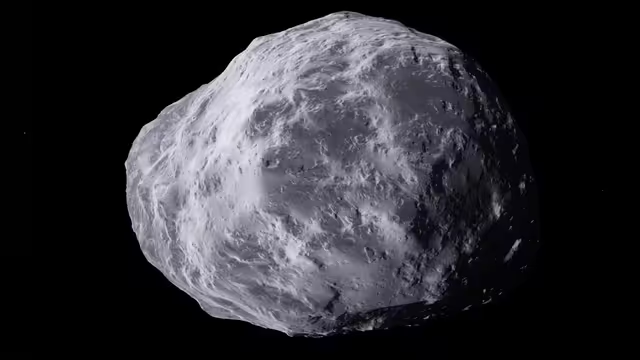 Topec (71 Tauri 2.D2)
 -
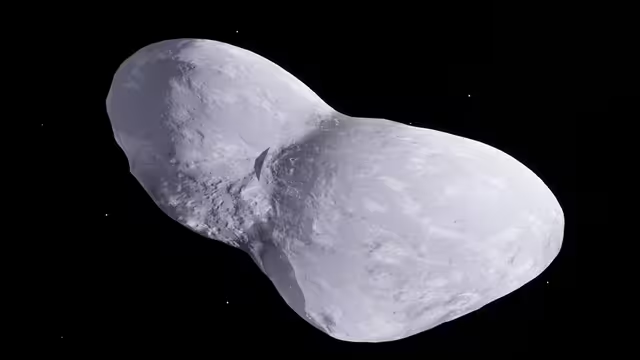 Clio (71 Tauri 2.D3)
 -
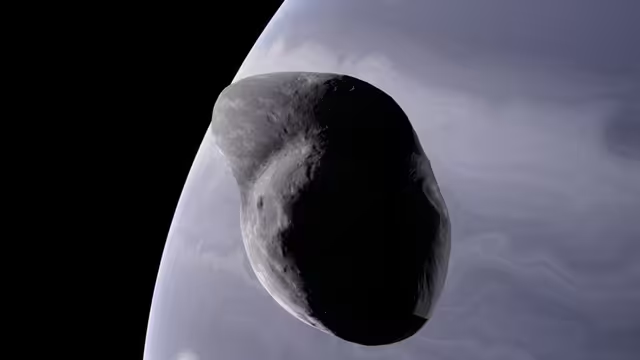 Valdeer (71 Tauri 2.D4)
 -
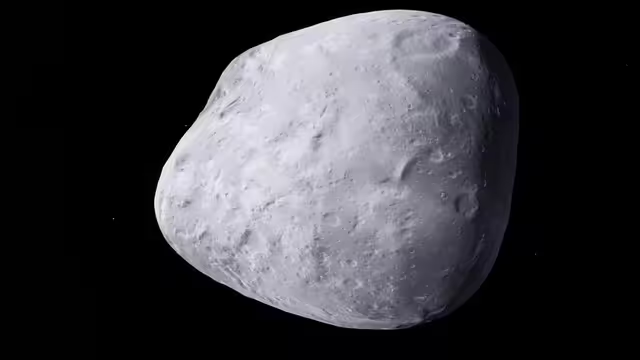 Hunter'n (71 Tauri 2.D5)
 -
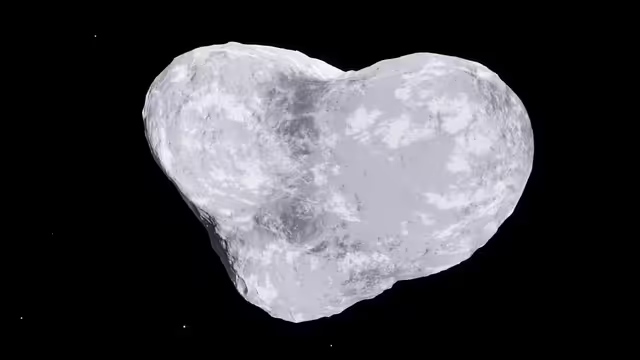 Uboa (71 Tauri 2.D6)
 -
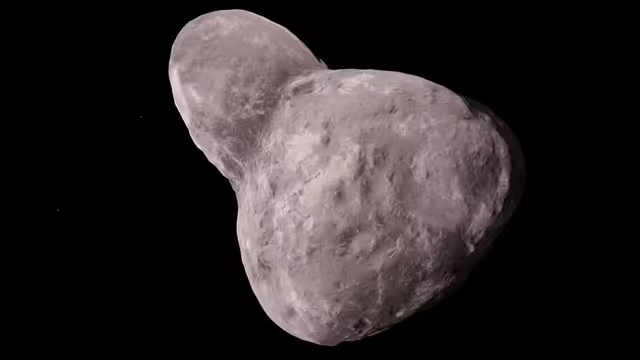 GNK (71 Tauri 2.D7)
 -
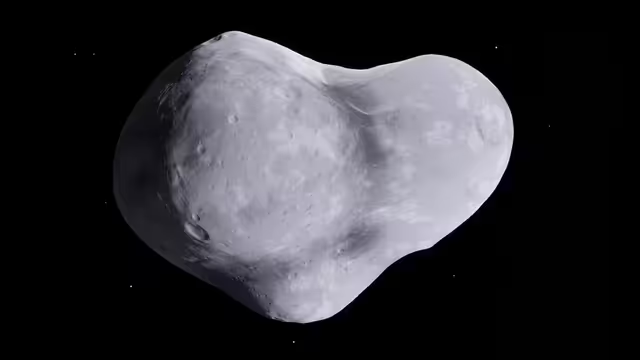 Momos (71 Tauri 2.D8)
 -
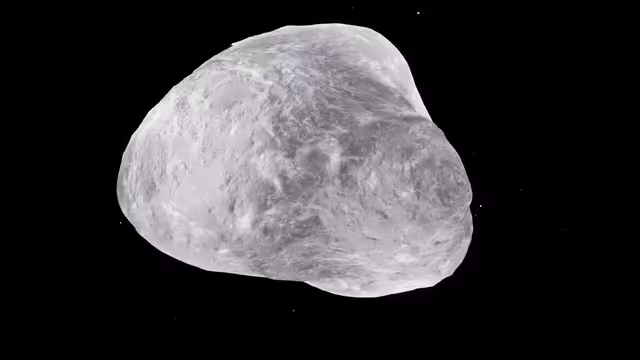 Minior (71 Tauri 2.D9)
 -
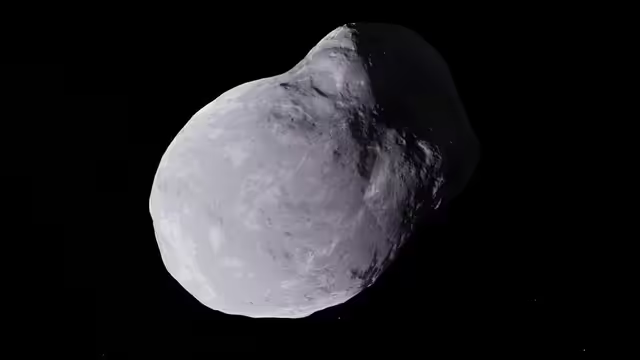 Obi (71 Tauri 2.D10)
 -
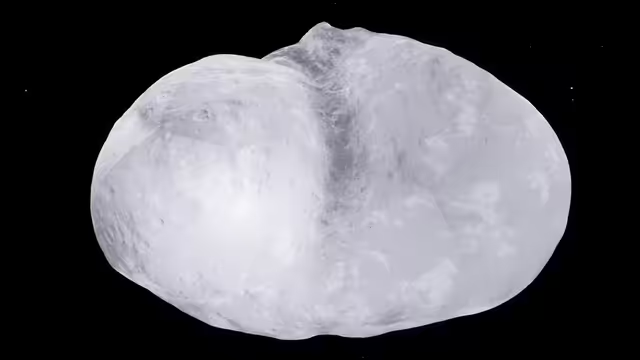 Chengvot (71 Tauri 2.D11)
 -
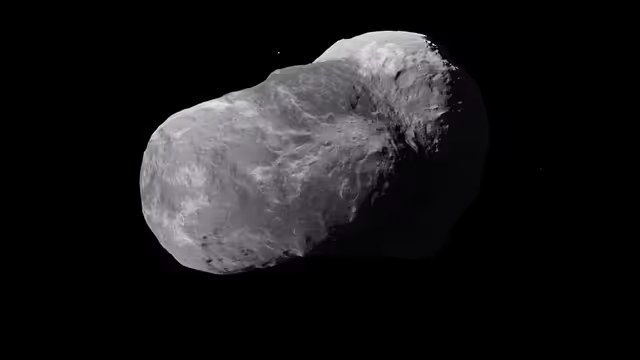 Zec (71 Tauri 2.D12)
 -
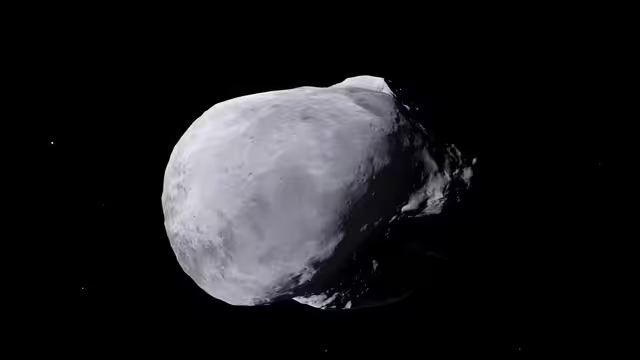 Rhodnite (71 Tauri 2.D13)
 -
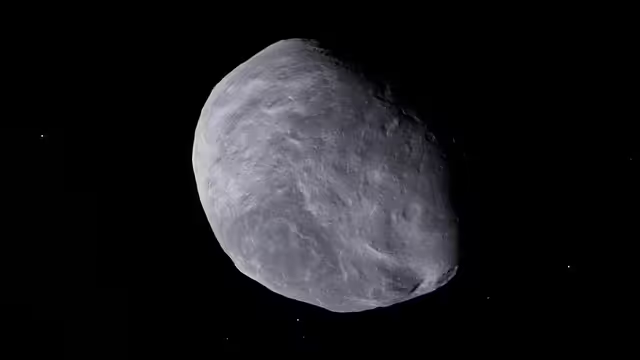 Ma'Bor K (71 Tauri 2.D14)
 -
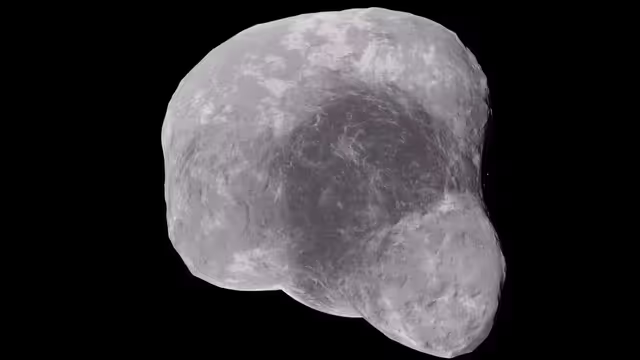 Duna (71 Tauri 2.D15)
 -
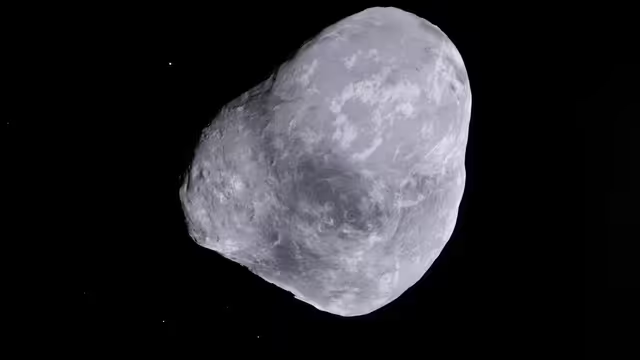 A/3016 H 1 (71 Tauri 2.D16)
 -
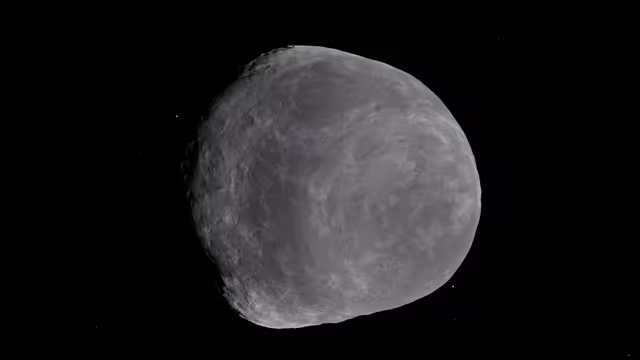 Aridos (71 Tauri 2.D17)
 -
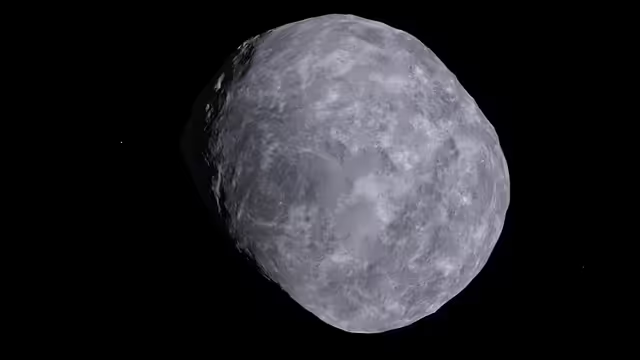 Vaum (71 Tauri 2.D18)


