
Hadrian: Difference between revisions

From Amaranth Legacy, available at amaranth-legacy.community
More actions
Content deleted Content added
mNo edit summary |
m Text replacement - "Category: Borealis Universe" to "Category:Scope: Borealis Universe" |
||
| (6 intermediate revisions by 2 users not shown) | |||
| Line 1: | Line 1: | ||
{{BorealisUniverse}}[[Category: |
{{BorealisUniverse}}[[Category:Scope: Borealis Universe]]{{InfoboxPlanet|name = Hadrian|code = RS 8474-1792-7-1075489-590 9|parent = [[Suquina]]|image = Hadrian.jpg|altnames = RS 8474-1792-7-1075489-590 9, Suquina 9|moons = 4|sma = 15.62 AU|eccentricity = 0.215|orbperiod = 60.969 years|inclination = 0°49'20".75|mass = 1.7744 M|diameter = 19287.79 km|rotperiod = 12.808 days|axialtilt = 1°17'05".78|avgtemp = -209.15 °C|atm = 3.9.10-⁵ atm|gravity = 0.77612 g|albedo = 0.3 / 0.36|age = 5.455.10⁹|naturallife = None|caption = Hadrian is in a binary orbit with its biggest moon Badra}}Hadrian is an ice world with 4 moons. Much like its next-door-neighbors [[Serkis]] and [[Pike]], most of its moons are large enough to be considered dwarf planets by themselves. It orbits [[Suquina]], a star located within the [[Milky Way Galaxy ]]. |
||
== Hadrian's Moons == |
== Hadrian's Moons == |
||
| Line 37: | Line 37: | ||
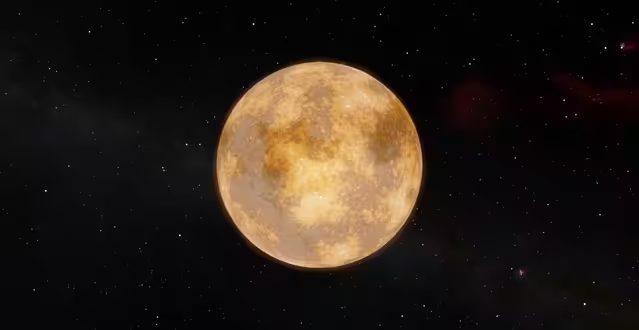
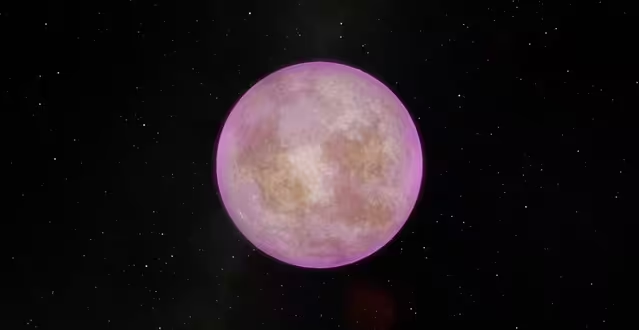
Badra.jpg|Badra |
Badra.jpg|Badra |
||
</gallery> |
</gallery> |
||
[[Category:Suquina]] |
|||
[[Category:Suquin[[Category:*Scope: Borealis Universe - Milky Way]]] |
|||
[[Category:Planets]] |
[[Category:Planets]] |
||
[[Category: |
[[Category:Ice World]] |
||
[[Category: |
[[Category:Scope: Borealis Universe - Milky Way]] |
||
[[Category: |
[[Category:Scope: Borealis Universe]][[Category:Scope: Borealis Universe]] |
||
Latest revision as of 17:43, July 24, 2025

Template:InfoboxPlanetHadrian is an ice world with 4 moons. Much like its next-door-neighbors Serkis and Pike, most of its moons are large enough to be considered dwarf planets by themselves. It orbits Suquina, a star located within the Milky Way Galaxy .
Hadrian's Moons
| Ordered in closest to farthest | Orbital Period | Diameter | Type Moon |
|---|---|---|---|
| Badra | 12.808 days | 16721.62 km | Moon |
| Juan | 2.981 years | 359.63 km | Dwarf |
| Ming Ue | 3.019 years | 392.2 km | Moon |
| Konane | 3.08 years | 530.27 km | Moon |
Badra
Hadrian's biggest moon is Badra, which Hadrian is in binary orbit with, Badra is actually almost the same size as Hadrian
Gallery
-
-
 Badra
Badra

