The Department of AntiMatter Production is a government-funded branch of the Scientific Assembly that rose to prominence during the early 25th century. Its primary purpose was to integrate and mass-produce antimatter systems for industrial applications, most notably in the development of antimatter-matter energy production—the cleanest form of energy humanity had yet achieved. This effort aimed to replicate the efficiency of the supersymmetric reactors created by the Archangels.
The Department of AntiMatter Production is a government-funded branch of the Scientific Assembly that rose to prominence during the early 25th century. Its primary purpose was to integrate and mass-produce antimatter systems for industrial applications, most notably in the development of antimatter-matter energy production—the cleanest form of energy humanity had yet achieved. This effort aimed to replicate the efficiency of the supersymmetric reactors created by the Archangels.
Line 8:
Line 8:
The department oversees and regulates all private and governmental entities licensed in antimatter production. It also plays a key role in the Bridge Regulations program, working in collaboration with the Scientific Assembly. The Department of AntiMatter Production was founded and initially headed by Electrochemical Secretary Zahm Absatz, who reported directly to the Prime Minister of United LunaTerra (now the United Sol Command). The current Electrochemical Secretary, Ahram Sionidze, serves from the department’s headquarters in the Citadel system.
The department oversees and regulates all private and governmental entities licensed in antimatter production. It also plays a key role in the Bridge Regulations program, working in collaboration with the Scientific Assembly. The Department of AntiMatter Production was founded and initially headed by Electrochemical Secretary Zahm Absatz, who reported directly to the Prime Minister of United LunaTerra (now the United Sol Command). The current Electrochemical Secretary, Ahram Sionidze, serves from the department’s headquarters in the Citadel system.
==History of AntiMatter==
==History of AntiMatter==
The history of antimatter traces back to the early 20th century, with pivotal milestones in physics that laid the foundation for its discovery:
The history of antimatter traces back to the early 20th century, with pivotal milestones in physics that laid the foundation for its discovery:
* '''June 30, 1905''': The German physics journal *Annalen der Physik* published a paper by patent clerk Albert Einstein that introduced the Theory of Special Relativity. The paper established the famous equation <font size=0.1%><math>E=mc^2</math></font>, demonstrating the relationship between energy, mass, space, and time. Einstein utilized Planck's concept of energy quanta to describe how light moves through space.
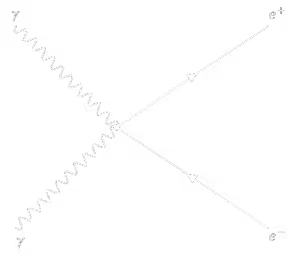
*[[File:Pair-production.png|thumb|293x293px|Pair Production process of Positron and Electron from two Gamma Quantas (Photons)]]'''June 30, 1905''': The German physics journal *Annalen der Physik* published a paper by patent clerk Albert Einstein that introduced the Theory of Special Relativity. The paper established the famous equation <font size="0.1%"><math>E=mc^2</math></font>, demonstrating the relationship between energy, mass, space, and time. Einstein utilized Planck's concept of energy quanta to describe how light moves through space.
*'''January 27, 1926''': Physicists Erwin Schrödinger and Werner Heisenberg advanced quantum theory by applying Planck's energy quanta to atomic structures. However, the theory was not relativistic and failed to describe particles moving at velocities near the speed of light.
*'''January 27, 1926''': Physicists Erwin Schrödinger and Werner Heisenberg advanced quantum theory by applying Planck's energy quanta to atomic structures. However, the theory was not relativistic and failed to describe particles moving at velocities near the speed of light.
*'''1928''': British physicist Paul Dirac combined quantum theory with special relativity, exploring the behavior of spinors when time was included as a dimension. Dirac's equations revealed that spinors, much like square roots of vectors, could have two possible behaviors—one positive and one negative. This mathematically predicted the existence of antimatter.
*'''1928''': British physicist Paul Dirac combined quantum theory with special relativity, exploring the behavior of spinors when time was included as a dimension. Dirac's equations revealed that spinors, much like square roots of vectors, could have two possible behaviors—one positive and one negative. This mathematically predicted the existence of antimatter.
[[File:Positron Discovery.jpeg|thumb|Real Imaged Discovery of Positron particle]]
*'''1932''': Carl Anderson discovered the positron while studying cosmic rays in a cloud chamber. Observing a positively charged particle with the same mass as an electron, Anderson identified it as the antielectron and coined the term "positron."
*'''1995''': At CERN’s Low Energy Antiproton Ring (LEAR) facility, a team led by Walter Oelert created atoms of antihydrogen for the first time. These atoms existed for mere billionths of a second before annihilating with ordinary matter, marking a significant milestone in antimatter research.
*'''1932''': Carl Anderson discovered the positron while studying cosmic rays in a cloud chamber. Observing a positively charged particle with the same mass as an electron, Anderson identified it as the antielectron and coined the term "positron."
*'''1995''': At CERN’s Low Energy Antiproton Ring (LEAR) facility, a team led by Walter Oelert created atoms of antihydrogen for the first time. These atoms existed for mere billionths of a second before annihilating with ordinary matter, marking a significant milestone in antimatter research.
During the 24th century’s historic ''Distant Worlds Expedition'', the crew of the CRS ''Graviton'' discovered groundbreaking Archangel technology on the planet DSO 10045-6495, also known as Citona. Among these findings was a contaminated antimatter energy release device, humanly referred to as the "positron grenade."
During the 24th century’s historic ''Distant Worlds Expedition'', the crew of the CRS ''Graviton'' discovered groundbreaking Archangel technology on the planet DSO 10045-6495, also known as Citona. Among these findings was a contaminated antimatter energy release device, humanly referred to as the "positron grenade."
Line 30:
Line 30:
The grenade was later transferred to ''Crusader's Temple'', a militarized research facility built within the Trojan asteroid 3753 Cruithne under the United LunaTerra government. With authorization from Prime Minister Anders Arashi and oversight by the Scientific Assembly, the facility was tasked with reverse-engineering the grenade to harness its potential for clean energy production.
The grenade was later transferred to ''Crusader's Temple'', a militarized research facility built within the Trojan asteroid 3753 Cruithne under the United LunaTerra government. With authorization from Prime Minister Anders Arashi and oversight by the Scientific Assembly, the facility was tasked with reverse-engineering the grenade to harness its potential for clean energy production.
This article takes place in the 24 & 26 centuries of Distant Worlds.
Department of AntiMatter
The Department of AntiMatter Production is a government-funded branch of the Scientific Assembly that rose to prominence during the early 25th century. Its primary purpose was to integrate and mass-produce antimatter systems for industrial applications, most notably in the development of antimatter-matter energy production—the cleanest form of energy humanity had yet achieved. This effort aimed to replicate the efficiency of the supersymmetric reactors created by the Archangels.
The department oversees and regulates all private and governmental entities licensed in antimatter production. It also plays a key role in the Bridge Regulations program, working in collaboration with the Scientific Assembly. The Department of AntiMatter Production was founded and initially headed by Electrochemical Secretary Zahm Absatz, who reported directly to the Prime Minister of United LunaTerra (now the United Sol Command). The current Electrochemical Secretary, Ahram Sionidze, serves from the department’s headquarters in the Citadel system.
History of AntiMatter
The history of antimatter traces back to the early 20th century, with pivotal milestones in physics that laid the foundation for its discovery:
Pair Production process of Positron and Electron from two Gamma Quantas (Photons)June 30, 1905: The German physics journal *Annalen der Physik* published a paper by patent clerk Albert Einstein that introduced the Theory of Special Relativity. The paper established the famous equation E=mc^2, demonstrating the relationship between energy, mass, space, and time. Einstein utilized Planck's concept of energy quanta to describe how light moves through space.
January 27, 1926: Physicists Erwin Schrödinger and Werner Heisenberg advanced quantum theory by applying Planck's energy quanta to atomic structures. However, the theory was not relativistic and failed to describe particles moving at velocities near the speed of light.
1928: British physicist Paul Dirac combined quantum theory with special relativity, exploring the behavior of spinors when time was included as a dimension. Dirac's equations revealed that spinors, much like square roots of vectors, could have two possible behaviors—one positive and one negative. This mathematically predicted the existence of antimatter.
Real Imaged Discovery of Positron particle
1932: Carl Anderson discovered the positron while studying cosmic rays in a cloud chamber. Observing a positively charged particle with the same mass as an electron, Anderson identified it as the antielectron and coined the term "positron."
1995: At CERN’s Low Energy Antiproton Ring (LEAR) facility, a team led by Walter Oelert created atoms of antihydrogen for the first time. These atoms existed for mere billionths of a second before annihilating with ordinary matter, marking a significant milestone in antimatter research.
Discovery of the Antimatter Grenade
During the 24th century’s historic Distant Worlds Expedition, the crew of the CRS Graviton discovered groundbreaking Archangel technology on the planet DSO 10045-6495, also known as Citona. Among these findings was a contaminated antimatter energy release device, humanly referred to as the "positron grenade."
Initially believed to be a reagent device for catalyzing reactions in large-scale energy production machinery, the grenade was stored aboard the CRS Graviton and returned to the Stellar Neighborhood for analysis by the Scientific Assembly. Handling the device was likened to managing a slow-ticking bomb due to its unstable properties.
The grenade was later transferred to Crusader's Temple, a militarized research facility built within the Trojan asteroid 3753 Cruithne under the United LunaTerra government. With authorization from Prime Minister Anders Arashi and oversight by the Scientific Assembly, the facility was tasked with reverse-engineering the grenade to harness its potential for clean energy production.