
Xeikon: Difference between revisions
More actions
Finished main text and added gallery. Any ideas welcome. |
No edit summary |
||
| Line 30: | Line 30: | ||
Xeikonland.jpg|A typical landscape on Xeikon. |
Xeikonland.jpg|A typical landscape on Xeikon. |
||
Xeikonmap.png|Surface map of Xeikon. |
Xeikonmap.png|Surface map of Xeikon. |
||
Aviary Photo 130797021547164804.png |
|||
Aviary Photo 130797020831349733.png |
|||
Aviary Photo 130797020369159023.png |
|||
Aviary Photo 130797019955301929.png |
|||
Aviary Photo 130797019488275354.png |
|||
Aviary Photo 130797018512704638.png |
|||
Aviary Photo 130797017432353897.png |
|||
Aviary Photo 130797015808943769.png |
|||
Aviary Photo 130797014358154231.png |
|||
</gallery> |
</gallery> |
||
[[Category:Alien Homeworlds]] |
[[Category:Alien Homeworlds]] |
||
Revision as of 23:16, June 25, 2015
Background
Discovered shortly after mankind's first leap into deep intergalatic space (made possible thanks to the development of Wormhole Drives), this unassuming planet came under the Confederacy's radar following the detection of artifacts and a small ruin on what is otherwise a barren surface. With no civilization capable of communication in the vicinity, it was assumed to be unnamed. Its current name was randomly generated by the human AI inside the pioneering ship.
Physical Description
Xeikon (RS 5310-1-7-1796375-429 6, 9.7.3) is located in a system home to 10 planets (of which 3 are life-bearing) orbiting a typical orange dwarf. The parent star is part of M110, one of Andromeda's satellite galaxies. The planet is a large Cold Desert planet with a diameter of 19 072km, orbiting its parent star at a distance of 1.47 AU. The planet possesses a single natural satellite (as of yet unnamed), orbiting Xeikon at a distance of 68 000 km. Lifeless, the moon presents no sign of previous exploration.
Artifacts Information

While of unknown origins, the artifacts discovered (over 300 small, bronze-colored rings) are speculated to have been self-replicating probes sent by an advanced civilization (potentially late Type II). The ruins of a small outpost (built of a similar material) points toward the subsequent exploration of Xeikon by this civilization for reasons unknown.
Contemporary dating methods have determined the age of those artifacts at roughly 70 million years (Late Cretaceous period on Earth). The lack of similar finds anywhere else in M110 seem to indicate the Andromeda Galaxy as a likely origin. No information has been found on the physical characteristics of the species, if only that the outpost's remains showed no signs of any means to control its Equipment (not a single switch or button was found).
Life Information

If one does not take into account the artifacts mentioned above, Xeikon's endemic life seems limited to the large-scale proliferation of a variety of simple, unicellular organisms. Interestingly, the planet's lifeforms appear to share numerous genetic traits with those of other unicellular organisms discovered on 2 other planets of the same system. Their resemblance, coupled with a shared structure hint towards artificial insemination by this unknown civilization.
Analyzed and sequenced by human scientists, the organisms appear mostly harmless asides from mild side-effects such as itching when in contact with the skin. For safety reasons, none have been injected or inhaled.
Gallery
-
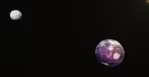 Discovery photo of Xeikon and it's moon.
 -
 A typical landscape on Xeikon.
 -
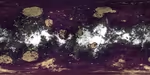 Surface map of Xeikon.
 -

-

-

-

-

-

-

-
-