
Synont

More actions

Synont

RS 8474-1389-7-1497965-5298 A5
RS 8474-1389-7-1497965-5298
0.69 AU
269.167 days
2.5029 Earth masses
21306.48 km (1.6703 Earth diameters)
0.80715 g
- -96.076°C (general)
- -10°C to 25°C (terraformed and biodome areas)
0.307 atm
9.73 billion years
17h 41m 37.08s
22°12'44.59"
Unknown (non-sapient lifeforms)
Template:Infobox PlanetSynont is the 5th planet in the Brimsoar A sub-system and houses both Rampantarans and Opyrites, though the Opyrites have also taken residence on the 7th planet's moon Seyun. It has a generally quite the extreme planet, but the scattered moisture is still used up by the local wildlife. Much of the planet has architecture made in the likeness of Opyrites due to Rampantarans agreeing to let them largely run the planet.
Exogeography
Synont's axial tilt is near 22 degrees, which allows it to support a variety of climatic zone, each taking up a similarly large slice of the planet. This, though, is only possible due to the locals, mainly Rampantarans, performing a semi-terraforming process on the whole planet. Synont also have a plethora of satellites though only one of them, Pumicarv, is large enough to leave any sort of lasting effect of Synony. Appaarently, Synont weighs twice as much as Earth and also is bigger, which has clued Rampantarans that there probably are something in the Synont's crust worth investigating, because it may be what's making Synont heavier. But they don't carry out large excavations, because it would make the Opyrites mad.
Litosphere
Synont has a lot of moisture spread over it's crust which allows it to be accessible to local lifeforms, but true wetlands haven't really occured much (outside biodomes) due to the simple fact that, despite terraforming, many places are still quite too cold to allow moisture to congregate as uniform liquid at a larger scale. The cold also seems to prevent erosion from being more prevalent since melting isn't all the common, which results in some of the planet's areas being borderline hard to walk on.
Hydrosphere
Outside manufactured biodomes (trademarked by Rampantarans until another biodomes manufacturing civilization appears), water isn't widespread, at least not enough to be observable from space. But, in truth, it is found every now and then, mostly coming from the glaciers and the white glacier-like craters found elsewhere on Synont. These areas seem to contain mist and vaguely frozen ground, but also contain enough moisture that it may condensate around them, despite the crater being lower than points of the condensating moisture.
Atmosphere
The local atmosphere used to contain dual oxygen molecules until a chain of disaster caused it to drop. Rampantarans, which had returned from their "Rise of Technological Proficiency Quest" (when it really was them just being chickens), managed to get in time, to carry out a large scale terraforming program from space and thus restore the oxygen to Synont. It also caused red algae-like vegetation to spread rampant across the planet's surface. Otherwise, the atmosphere is relatively bearable but part of the lifeforms, including Opyrites have to seek warmth otherwise they suffer from cold-induced stress.
Biosphere
Due to a lot of lifeforms gone extinct in the middle, the general consensus of Synont's lifeform diversity is rather hard to describe. Behavior-wise lots of organisms share similarities in their need to store rations, mostly food (which makes sense as even though digestion consumes energy, a larger amount is recovered after the cells have metabolized the digested food). Since there is not much snow around, a lot of the animals don't really boast any kind of white camouflaging coat. Social behavior seems to be the other factor to withstand the occasional surges of frost but for the local civilizations it doesn't seem to be the case, seeing as they already had evolved when the cold wasn't as extreme as it is today. Lastly, the lifeforms living in biodome biomes exhibit the least amount of similarities, thus the research of what kind of thing might they have in common still goes on.
Civilization
Rampantarans and Opyrites share the planet Synont, with Opyrites being in considerable majority. They share the common governmental model of technocracy though Rampantarans swerve towards atheism while Opyrites are more religious. They get along, despite this difference, appreciating that each of them can be successful while having different ways of living. Rampantarans support the technology that allows the terraforming structures to stay stable, while Opyrites work on technology and science which is generally more useful for the sapient civilizations themselves. Opyrites also seem to have a larger sense of wonder about the life around them, while Rampantarans are more matter-of-fact, but their actions, mainly construction of nature-emulating robots, show that they still find principles of nature fascinating.
Gallery
-
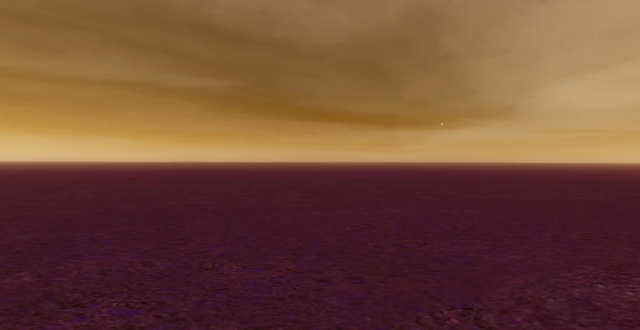 A generally flat field on planet Synont. Usually used as construction sites by either Rampantarans or Opyrites.
 -
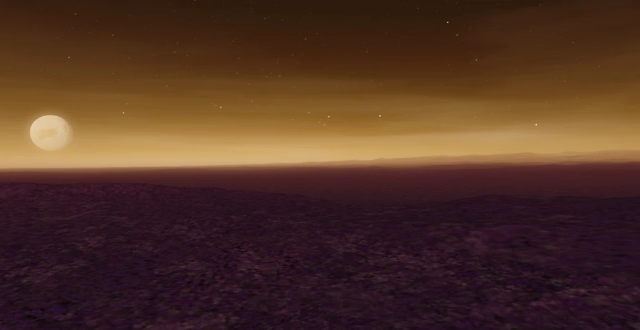 The Far South Cap is a illustrious, but dangerous region, containing weird creatures resembling crosses between stereotypical herbivores and carnivores. The preserve of the Pumicarv grants some of the extra light.
 -
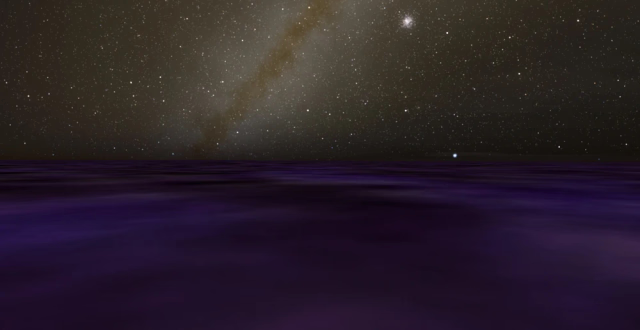 Synont's "Middle Belt" is where lots of research is being made. A rumor has been made that, one of Opyrites saw a floating cube out here, but Rampantarans deny it saying that it was just a normal rock falling down, but the Opyrite got dizzy somehow and thus perceived the cube falling in extreme slow motion.
 -
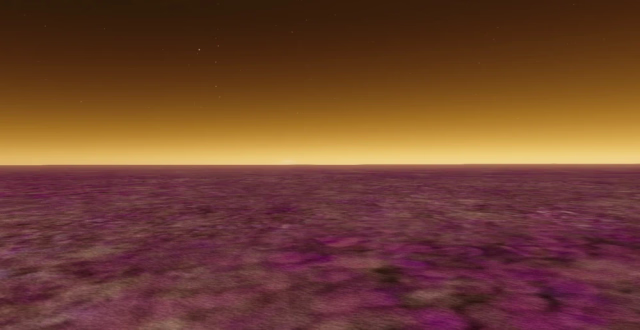 In, possibly, this place, an Opyrite was given "The Medalbadge" of honor for being the first to reach the supposed magnetic south pole. Also, worth mentioning is the fact that here, even though it's not visible for the first glance, the land is dotted by small rhombic spikes, thus necessitating locals to wear boots with hard soles or have armored feet as an adaptation.
 -
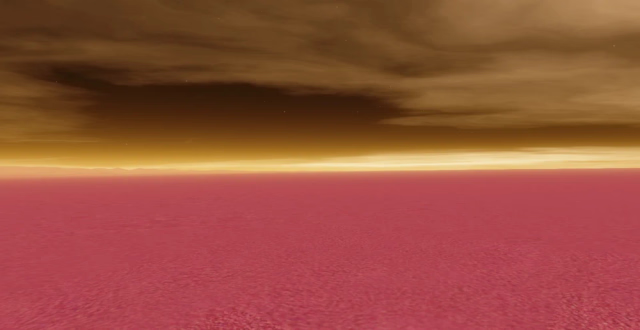 This area is actually quite damp underneath that all pink stuff. The color also shows where large quantity of life is found. Despite water being unconveniently being located in both land and air in portions that are not perceivable from air, local life has managed to adapt to gathering that water, due to having evolved when the water was accessible as it was on more earth-like planets.
 -
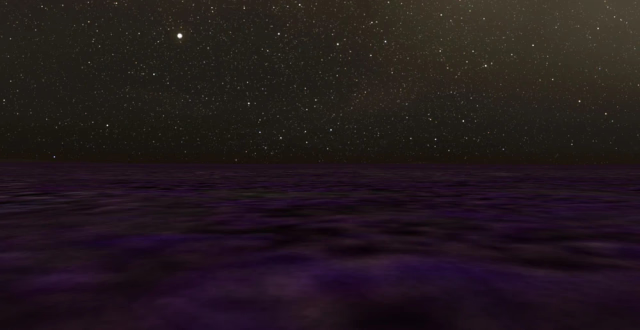 Another fragment of the middle-belt. There's a larger abundance of high plant grove nearby, but it isn't seen (the out-universe reason being that SE doesn't simulate visible vegetation and this being an actually empty planet). The ground contains large rocks hidden within, which is a nasty surprise to local diggers since they may hurt their claws on them.
 -
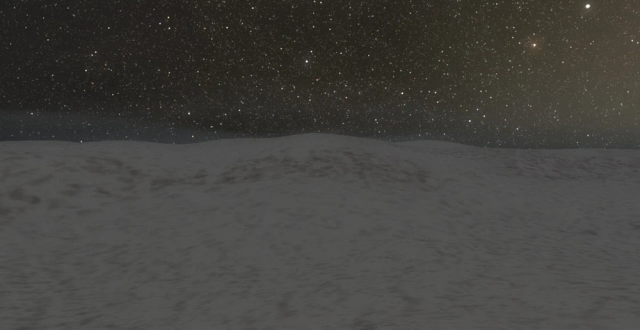 This icy area looks a bit welcoming, but there off-screen is an abandoned facility which had some Rampantarans living in it. They thought they can handle the cold, but a sudden change in the next decade's weather froze them all up.


