
Eta Carinae

More actions

Description
Eta Carinae
-
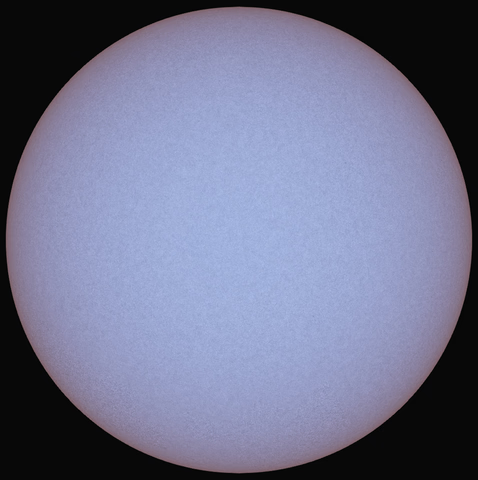 Pre-Supernova
 -
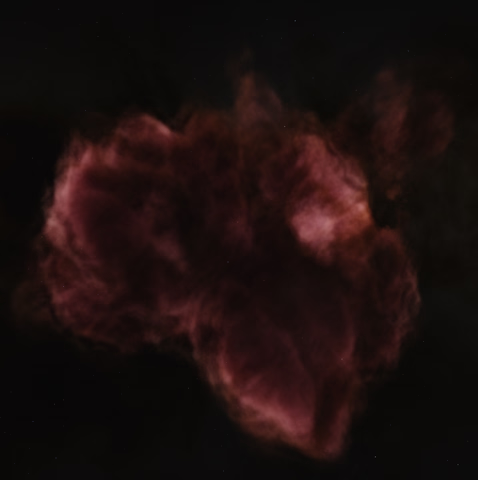 Post-Supernova


120 Solar Masses
3 Million years old
- Trotecury
- Ihines
- Ulnoinus
- Poseidon
Eta Carinae (Formerly known as Eta Argus) was a Luminous Blue Variable, which was located in the Homonculus Nebula. It was further nested inside the Yggdrasil Nebula, and used to be visible to the naked eye before the Great Eruption, an event documented in the 19th Century.
Eta Carinae was in a binary pair before its destruction, housing one star named Eta Carinae B, an O-Class star. These two stars orbited each other in a stable system, and even housed four planets far from the barycenter. Eta Carinae was also a high-priority target during the midst of Human colonization of the Via Lactea, with various science and colonization teams arriving in the 5000s.
Ever since it exploded in a violent supernova, Eta Carinae has become a rather massive black hole, holding the weight of 100 Stellar Masses. A Penrose Sphere was then placed around it, making the system flush full of people once again. The backdrop of Eta Carinae's bright nebula was also attractive to tourists.
History
As colonists arrived in the Eta Carinae System, they searched for primary habitation areas, and settled in the outskirts. The inner planets were exploited for their metal-rich internals, while regular colonization and development was happening farther out. Many important science bases and space stations were built in orbit around Eta Carinae as well. These include housing areas, industrial and commercial centers, and a variety of employment areas, which usually tasked people to observe Eta Carinae. Eta Carinae B was also thoroughly researched, and a small selection of stations was placed around it.
Not long after arrival, telescopes and eyewitnesses detected an odd structure, pertaining to two opposite sides of the star. On closer inspection, it is known that these structures were some kind of mining devices. Other theories suggested that it was a kind of solar energy harvester. Only when Sedrua was discovered, did officials of the nation reveal that it was a device which was capible of sending large levels of energy. This device was meant to carry out energy to distant Intergalactic Gateways, but it has since decayed in Sedrua's absence. Wear and tear caused by stellar erosion made this almost unusable. However, this would uncover a large system of these deivces, which were all used by Sedrua in the past. Ranging in quality, some of these beams still power the old Intergalactic Gateway Network.
Back in the colonization times, UFSS forces cornered off the area near Eta Carinae, and closely observed the technology, to find its enigmatic internals still recognizable. Other than that major discovery, nothing else happened save for heavy colonization, tourism, and revenue gains for the system. Further colonization allowed for extensive mining, and a small array of solar panels was being set up. This would soon culminate over many years to form a Dyson Swarm, which gave the system countless amounts of energy for its existence.
Things when as per usual, until the 6000s, when an odd amount of eruptions were detected on the surface of Eta Carinae. Further inspection suggested that a supernova was imminent, and evacuation happened immediately. It happened perfectly on time, since the last of the population scattered away only weeks before the supernova. This was also the first supernova to be documented live, which gave scientists a deep insight on the appearance and operations of a supernova. The colonies around Eta Carinae only lasted about 1 millennia, giving rise and fall to some of the most cherished planets in the Milky Way Galaxy.
Not too long after this catastrophe, Eta Carinae B was set on an elliptical orbit, and it eventually struck the black hole in a brilliant fury of light. This is known to be the last high-energy event to ever happen in the system. This also made the black hole of Eta Carinae a bit bigger in size, which disturbed some of the nebula that was expanding. Other than that, the black hole rested for a long time.
Penrose Sphere
Since its untimely demise, Eta Carinae has become an intermediate-class black hole. A Penrose Sphere was constructed around it in the 27000s, not too long after the Confederacy of Borealis formed from the ashes of old. The population potential and energy potential from this was massive, making Eta Carinae a valuable system once again. Tourism flooded the system as soon as the Penrose Sphere was constructed, and there now exists a thriving community inside its many layers.
Planets
The Eta Carinae System held four planets, which have been disintegrated from the supernova. None of these planets remain, and neither do many in a certain radius around the explosion site.
| Name | Description | Population |
| Trotecury | Trotecury was a small and boiling ice giant, which was fairly close to the barycenter of the Eta Carinae System. It held a plethora of dwarf moons, and it helped with early colonization with its supply of hydrogen and metal-rich moons. Trotecury was hot to the point that there was a magnificent comet tail, which was a big attraction in the inner Eta Carinae System.
In modern-day, the supernova completely vaporized Trotecury, as well as any trace of its moons. Only a fine mist of hydrogen, helium, and metals were detected, which soon faded into the vast nebulous cloud. |
46,000,000,000 (Former) |
| Ihines | Ihines was a barren and hot rocky planet, used for the extraction of ores and resources. This planet happened to be very rich in metals, concrete materials, and was useful for other industrial purposes. Ihines had one major moon, which was tidally locked and rich with water-ice in the poles. It aided colonization in the Eta Carinae System by supplying the area with a rich and booming industry. It is known that it lasted for many millennia. Much of its metal would be used for a dyson swarm, used in colonization efforts.
In modern-day, Ihines is also disintegrated, much like the rest of the system. No remnants belonging directly to Ihines have been found, and it is thought to be apart of the now dissipated nebula. |
26,000,000,000 (Former) |
| Ulnoinus | Ulnoinus was a rather hot and humid planet, which was heated up by its large amount of greenhouse gas. There used to be a multitude of floating cities, sustained by the heavy winds. This planet was often used as a trading hub, since it was a fair distance away from Eta Carinae, and getting resources to all planets from here was easy. There was no moons around this planet, though it was still rich in minerals. The materials for corrosive acid were also easily harvested in Ulnionus's atmosphere.
In modern-day, only trace particles and warped rock was found linked to Ulnionus. It is still unknown if it these are actually a part of Ulnoinus, but extensive testing shows that they could be. |
38,000,000,000 (Former) |
| Poseidon | Poseidon (Named after the Greek God of the sea and storms) was a warm oceanic planet, and was the most prominent planet in the Eta Carinae System. Consisting of many temperate raft cities and orbital constructs, Poseidon was clearly the most important planet in a significant area. Trade from other star systems were common, and it generated a lot of the system's much-needed tourism revenue. The atmosphere was filled with nitrogen and carbon dioxide, which made breathing impossible for Humans. Filters and domed structures were needed to live on the surface. However, oceans were rather clean, but lifeless. Water was not an issue, and Poseidon became the number one water exporter in the Eta Carinae System.
In modern-day, Poseidon has been reduced to mere vapor particles and charred rock. The strategic importance of Poseidon was lost for a massive amount of time, until Eta Carinae's black hole gained a small Penrose Sphere. Many people mourned the loss of their home, unstoppable by any means of their time. |
71,000,000,000 (Former) |