
Etiamteamo

More actions

Etiamteamo

LordSkorne7
LordSkorne7 (December 19th 2018)
Solum
2 Standard Days
0.34182 Earth Masses
0.45995 G
-16°C
4.97 atm
4,127,010,000 years
2 Standard Days
None
Ugnara
15,000,000
- **Ugnara Kingdom** (10465 CE – 10466 CE)
- **Ambrosia Alliance of United Systems** (10466 CE – Present)
Overview
Etiamteamo is a temperate Terra world, its dynamic landscape is covered with mountains, canyons, rivers, lakes, and oceans. It is the only body in the system temperate enough for common organic life to inhabit it without using complex means. This is because the moon orbits in very close proximity to its sister world, Oblivio as it emits constant heat due to its extreme volcanic activity.
Etiamteamo doesn't have any native life, however the chemical makeup of its oceans suggests that life is beginning to arise. Because of this, the Ambrosia Alliance puts many protective measures to insure that this up-and-coming life is not contaminated.
It is the only body in its home system that has tectonic plates, giving the moon two continents, Tequoqueamo and Amanseteamo respectfully.
The moon serves as the capital of the Solum System for these reasons as its the only moon that can naturally support large cites and colonies. So much so that when someone mentions that they are going to visit the Solum System, they usually mean Etiamteamo specifically.
History
Etiamteamo formed shortly after its parent planet Solum, and its sister moon Oblivio. In its original orbit, it was at a safe distance from its parent gas giant where surface water could be present on the surface. With this, multi cellular life developed on its surface, dense foliage dominated large expanses of the moon for millions of years.
However on 3,999,666,333 BCE, Solum would be ejected from its home system and become a rogue planet of the Mid Arm. This caused the moon's oceans to freeze over, turning it into a frozen ice world. After this, Oblivio would be subjected to extreme tidal forces from Solum, causing the moon to emit massive amounts of heat. With this, Etiamteamo would have its surface heated, melting the frozen oceans, turning the world back into a temperate Terra. Though all native life died once the moon was frozen over.
Etiamteamo was unknown to any Ambrosian civilization until the Ugnara discovered it while radar mapping stars around the capital of their enemy, the Hope System, during the Ugnara wars in 10465 CE. Once it was discovered, a small fleet of robotic probes were launched to map out the system, after this it was discovered that Etiamteamo was very hospitably. The Ugnara began to construct a small colony on the moon's surface in order to stage an eventual invasion of the Hope System, however these plans fell through after the Ugnara's defeat later in the year.
After the Ugnara joined the Ambrosia Alliance of United Systems, Etiamteamo would have towering cites populated by millions of people constructed throughout the 10500 CEs. The moon would also became a very popular tourist destination due to its strange relationship with its sister worlds.
Gallery
-
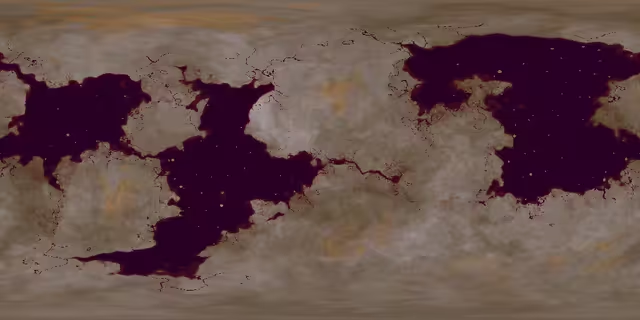 Map of Etiamteamo.
 -
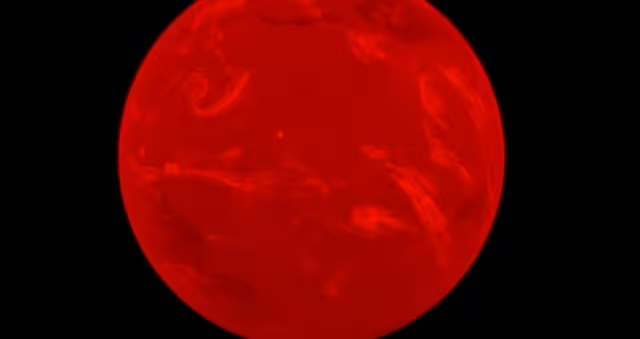 The Tequoqueamo continent from space.
 -
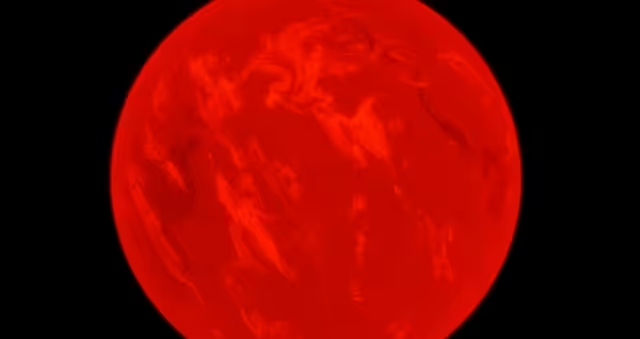 The Amanseteamo continent from space.
 -
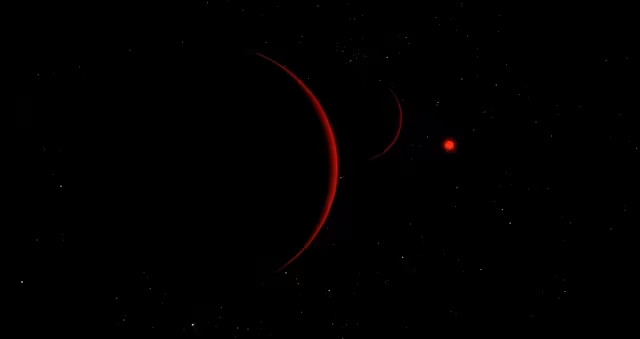 Etiamteamo and Solum's dark sides set against the darkness of space.


