
Index:Distant Worlds

More actions




- Inspired by Index:Silky Way
- Proofreading by ASmallerMolecule
Terminology
Fermions are matter particles and are split into two families:
- Quarks (Up, Down, Strange, Charm, Top, Bottom)
- Leptons (Electron, Muon, Tau, and their corresponding Neutrinos)
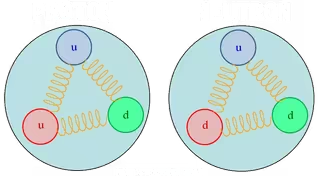
Simplified model of nucleons

Quarks bond via gluons to form larger particles like protons and neutrons, which combine with electrons to create atoms.
Bosons mediate the fundamental forces of the universe:
- Photons carry electromagnetic force.
- Gluons mediate the strong nuclear force, which binds quarks together.
- W and Z bosons govern the weak nuclear force, responsible for certain types of decay.
- The Graviton (hypothetical) mediates gravity, propagating through higher dimensions.
 |
 |
 |
 |
 |
 |
|---|

 |
 |
 |
 |
|---|
 |
 |
 |
 |
|---|
 |
 |
 |
 |
|---|
A spacetime geometry with constant negative curvature, often used in theoretical physics and string theory. Unlike flat or positively curved spaces, AdS has a boundary at infinity and allows for unique gravitational effects, such as holographic dualities. In Distant Worlds, Anti-de Sitter space takes a more subspace approach; a pocket space in-between the spatial dimensions of universe, connecting them together with the Anti-de Sitter curvature. For the Anti-de Sitter Drive in Distant Worlds, see this page.
In Distant Worlds, M-theory is adapted to describe a larger, more complex geometric hyperstructure in which the familiar three spatial dimensions exist as a subset. While traditional M-theory postulates 11 dimensions - 10 being spatial and 1 temporal - these dimensions in Distant Worlds are not merely compacted but instead form a intricate, higher-dimensional framework governing the interactions of matter, energy, and spacetime. The additional dimensions play a crucial role in shaping the universe’s deeper physical laws, influencing phenomena such as gravitational electromagnetism, interdimensional couplings, and the stability of Bridges.
Subspace
A transitional realm existing between conventional spatial dimensions. Unlike fully realized higher dimensions, subspace is a lower-energy, partially accessible layer that facilitates interstellar travel, information transfer, and exotic physics interactions. In Distant Worlds, Anti-De Sitter space functions as a form of subspace, bridging spatial dimensions.
Holographic Principles
The holographic principle is a property of string theories and a supposed property of quantum gravity that states that the description of a volume of space can be thought of as encoded on a lower-dimensional boundary to the region – such as a light-like boundary like a gravitational horizon. First proposed by Gerard 't Hooft, it was given a precise string theoretic interpretation by Leonard Susskind, who combined his ideas with previous ones of 't Hooft and Charles Thorn. Susskind said, "The three-dimensional world of ordinary experience—the universe filled with galaxies, stars, planets, houses, boulders, and people—is a hologram, an image of reality coded on a distant two-dimensional surface." As pointed out by Raphael Bousso, Thorn observed in 1978, that string theory admits a lower-dimensional description in which gravity emerges from it in what would now be called a holographic way. The prime example of holography is the Anti-de Sitter/Conformal Field Theory Correspondence. In Distant Worlds, AdS/CFT Correspondence is a framework used to explain holographic "shadows" of objects in higher spatial dimensions visible in three-dimensional space, prime example is: AdS Hologram
Dimensional Particles
Hybrid Computation
The Bridges
Internet Protocol Version 6
Magnetic Repulsion
Fractals
Fractals are self-similar geometric structures that exhibit patterns repeating at different scales. Unlike smooth Euclidean shapes, fractals possess fractional dimensions, meaning their complexity increases with magnification. In physics, fractals appear in diverse areas such as turbulence, quantum field theory, and spacetime structure, higher spatial dimensions, and key feature of Fracton D-Particle.
Orbital Angel
The Orbital Angel refers to the defensive infrastructure of the Archangels, stationed in orbit around specific celestial bodies. These structures serve as both protective barriers against potential threats and as enforcers of quarantine protocols when necessary. Their appearance resemble biblical Angels, thus the name.
Lotus
Lotus is the unofficial name given by Harrison Wells to the Archangels’ vast research and observation archive located on the planet Nova. The facility is named for its resemblance of a lotus flower.
Gravitational Wells (Not to confuse with Gravitational Well Black Holes) usually on L4 or L5, is concentration of chemical diversity causing creation of simple single or more complex celled organisms around binary neutron stars releasing enormous wind of neutrons to interact with free protons, decayed neutrons create electrons which bind with new atomic cores.
The term "Lagrangian Conflux" was introduced during the Scientific Assembly in the early 25th century, encompassing three distinct cosmological phenomena: Lagrangian Clouds, Lagrangian Storm Clouds, and Lagrangian Lullabies.
Gravitational Well is rename of previous model of "black holes" which indicate a class of celestial body with core consisting of extremely dense gravitino concentration.
A civilization is a complex society characterized by a shared culture, social structure, technological advancement, and often a central governing system. Civilizations arise when groups of native species develop sustainable settlements, economic systems, and collective identities. They are shaped by geography, history, and interactions with other societies.
Celestial bodies in Distant Worlds include diverse stars, such as main sequence, neutron stars, and black holes, each influencing nearby star systems (binary, multiple, or exotic). Star systems contain planets ranging from habitable worlds and gas giants to desolate or more exotic planets with unique environmental conditions and effects, all contributing to a list of stars that catalogs their type, system details, and cultural or scientific significance in the galaxy.