
Euria (Vela): Difference between revisions
More actions
No edit summary Tag: 2017 source edit |
No edit summary Tag: 2017 source edit |
||
| (One intermediate revision by the same user not shown) | |||
| Line 60: | Line 60: | ||
54.2 Ma |
54.2 Ma |
||
}} |
}} |
||
'''Euria''' is a desolate, frozen planet in the outlying regions of [[Midonia]], encircling a [[Eleres|blazing white-blue main-sequence star]] at a great distance. Nearly dismissed as a standard icy body, the unusual energy readings of the planet prompted a deeper mapping survey, leading to the discovery of [[Index:Astralis/Resources#tabber-Kachiro|kryzelite]]. Hidden deep in the ice as tiny flakes, the material has abnormal heat-absorbing properties, possessing the potential to enhance everyday technology. [[Erva Stardrives]] subsequently constructed '''site Evile''' beneath the frozen crust in order to extract and research the element in the hopes of enhancing [[Seraph Drive|Seraph drive]] cooling systems. |
'''Euria''' is a desolate, frozen planet in the outlying regions of [[Midonia]], encircling a [[Eleres|blazing white-blue main-sequence star]] at a great distance. Nearly dismissed as a standard icy body, the unusual energy readings of the planet prompted a deeper mapping survey, leading to the discovery of [[Index:Astralis/Resources#tabber-Kachiro|kryzelite]]. Hidden deep in the ice as tiny flakes, the material has abnormal heat-absorbing properties, possessing the potential to enhance everyday technology. [[Erva Stardrives]] subsequently constructed '''site Evile''' beneath the frozen crust in order to extract and research the element in the hopes of enhancing [[Intergalactic Aerospace Compendium#Seraph Drive|Seraph drive]] cooling systems. |
||
The entirety of the planet is covered by ice and is blanketed by a tenuous atmosphere made of nitrogen and neon, resulting in a spectacular show of color during twilight. A chilly ocean used to lie beneath the ice of Euria in ages past, yet has now entirely frozen into an incredibly durable layer of water ice. Well-preserved skeletal structures indicate that the subglacial ocean used to be home to a great variety of life, thriving in the dark and hostile environment. The leading hypothesis for the great ice age is the introduction of kryzelite in the waters, though it is, as of the present day, unknown as to, how exactly it took place. |
The entirety of the planet is covered by ice and is blanketed by a tenuous atmosphere made of nitrogen and neon, resulting in a spectacular show of color during twilight. A chilly ocean used to lie beneath the ice of Euria in ages past, yet has now entirely frozen into an incredibly durable layer of water ice. Well-preserved skeletal structures indicate that the subglacial ocean used to be home to a great variety of life, thriving in the dark and hostile environment. The leading hypothesis for the great ice age is the introduction of kryzelite in the waters, though it is, as of the present day, unknown as to, how exactly it took place. |
||
| Line 70: | Line 70: | ||
== Gallery == |
== Gallery == |
||
=== Planetary === |
|||
<gallery widths="230" heights="230" mode="nolines"> |
|||
File:Euria3 (Vela).png|Aerial shot of Euria's landscapes |
|||
File:Euria4 (Vela).png|Rings of Euria from above the surface |
|||
</gallery> |
|||
=== Lunar === |
|||
<gallery widths="170" heights="150" mode="nolines"> |
<gallery widths="170" heights="150" mode="nolines"> |
||
Euria-I (Vela).png|Euria I |
Euria-I (Vela).png|Euria I |
||
Latest revision as of 15:46, March 4, 2026

"The extinction of the beautiful creatures of Euria was a great tragedy, in spite of what they keep telling us. A rich ecosystem used to thrive in these the dark seas, and now we pillage their icy tombs, eager to harvest the catalyst to their demise. Oh well, I suppose that's making the best of it..."
Euria
.png)
Eurian
527.18 astronomical units
6,695 years
0.014
0.30 Me
10,322 kilometers
0.46 G
-234 °C
0.0000014 atmospheres
97.12% Nitrogen
2.84% Neon
54.2 Ma
22h 28m
60°
6:
Euria I
Euria II
Euria III
Euria IV
Euria V
Euria VI
7618
Euria is a desolate, frozen planet in the outlying regions of Midonia, encircling a blazing white-blue main-sequence star at a great distance. Nearly dismissed as a standard icy body, the unusual energy readings of the planet prompted a deeper mapping survey, leading to the discovery of kryzelite. Hidden deep in the ice as tiny flakes, the material has abnormal heat-absorbing properties, possessing the potential to enhance everyday technology. Erva Stardrives subsequently constructed site Evile beneath the frozen crust in order to extract and research the element in the hopes of enhancing Seraph drive cooling systems.
The entirety of the planet is covered by ice and is blanketed by a tenuous atmosphere made of nitrogen and neon, resulting in a spectacular show of color during twilight. A chilly ocean used to lie beneath the ice of Euria in ages past, yet has now entirely frozen into an incredibly durable layer of water ice. Well-preserved skeletal structures indicate that the subglacial ocean used to be home to a great variety of life, thriving in the dark and hostile environment. The leading hypothesis for the great ice age is the introduction of kryzelite in the waters, though it is, as of the present day, unknown as to, how exactly it took place.
Miscellaneous
Trivia
- Euria was inspired by Pantaleon in Distant Worlds, originally written in the Borealis Universe. Both were written by TheStellarExplorer.
Gallery
Planetary
-
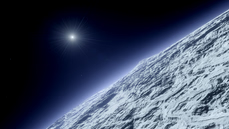 Aerial shot of Euria's landscapes
 -
 Rings of Euria from above the surface
.png)
.png)
Lunar
-
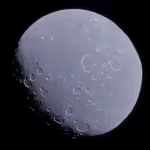 Euria I
 -
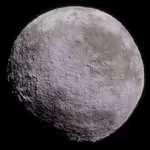 Euria II
 -
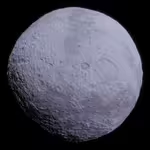 Euria III
 -
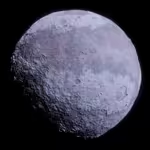 Euria IV
 -
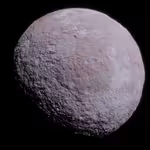 Euria V
 -
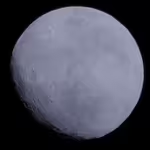 Euria VI
.png)
.png)
.png)
.png)
.png)
.png)