
Darvikus: Difference between revisions

More actions
more H I S T O R Y |
No edit summary Tag: 2017 source edit |
||
| (47 intermediate revisions by 5 users not shown) | |||
| Line 1: | Line 1: | ||
{{Cosmoria}} |
|||
{{Ambrosia:_World|title1=Darvikus|image1=[[File:Darvikus.png]]|caption1=Darvikus with its beautiful rings|name:=Darvikus|world_type:=Planet|world_class:=E-class|region:=Cnara Cluster|sector:=Frealee Sector|system=[[Frealee System]]|parent_star(s):=[[Frealee]]|orbital_posistion:=4|age:=1.75 billion years|moons:=*Arnena |
|||
{{Infobox World|title1=Darvikus|image1=[[File:Darvikus.png]]|caption1=Darvikus with its beautiful rings|system=[[Frealee System]]|parent_body=[[Frealee]]|orbital_position=4|moons={{Collapsible text |
|||
*Ronelis |
|||
|title =<big>Major Moons:</big> |
|||
*Frar|distance_from_true_galatic_center:=4595 ly from [[The Heart of Providence]]|orbital_peroid:=2.882734 years|rotation_peroid:=28.28527332 hours|semi-major_axis:=2.882734 AU|axial_tilt:=29.2682346|roche_limit:=30000 km from the center of the planet|atmospheric_composition:=Similar to earth's|atmospheric_pressure:=4.81 atm|average_cloud_coverage:=45%|average_windspeeds:=28 km/h|average_rainfall:=150 centimeters|diameter:=12609.018 km|mass:=0.995 earths|surface_gravity:=0.878 gees|primary_terrain:=Highlands|average_temperature:=279 K|climate:=Temperate|aquatic_surface:=W A T E R|notable_locations:=Darvikus Prime|native_intellgient_species:=Darvikans|main_immigrated_intelligent_species:=Carlean (27.5% population)|name_of_ring_system:=Darvikus Ring A, B, C, D, E, F|ring_system_length:=23000 km|number_of_individual_plantary_rings:=6|ring_composstiion:=*Rock |
|||
|content = |
|||
*Dust |
|||
<br> |
|||
*Ice|origin_of_ring_system_creation:=Naturally created by moon crossing roche limit|overall_function:=Second capital of the Cnara-Frealee Federation and homeworld of the Darvikans|population:=5.9 trillion|dominant_intellgient_species:=Darvikans|population_strata:=*72.5% Darvikan |
|||
*[[File:Arnena.png|30px]]Arnena |
|||
*27.5% [[Carlean]]|affiliation:=Cnara-Frealee Federation|government:=Democratic Republic|military_occupation:=Medium|corporate_presence:=High|language(s):=*Darvikan Standard |
|||
*[[File:Ronelis.png|30px]]Ronelis |
|||
*Carlean Standard |
|||
*[[File:Frar.png|30px]]Frar |
|||
*Darvikan (Tarbla dialect)|denomination:=Darvikan|currency:=Cnara-Frealee Unit|major_cites:=*Darvikus Prime |
|||
}}|orbital_period=2.8827 years (~1052 days)|rotation_period=28.285 hours|diameter=12609.018 km|primary_terrain=Highlands|climate=Temperate|native_sapient_species=Inilar|ring_system_origin=Naturally created by moon crossing roche limit|overall_function=Second capital of the Illuin Federation and homeworld of the Inilar|population=57.322 billion|native_intelligent_species=Inilar|population_strata=*72.5% Inilar*27.5% [[Kalar]]|affiliation=[[Illuin]]|government=Democratic Republic|military_occupation:=<font color="gold">Medium</font>|corporate_presence:=<font color="green">High</font>|languages=*Darvikan Standard |
|||
*Kagala|major_imports:=*Resources |
|||
*Kalar Standard |
|||
*Foodstuffs |
|||
*Darvikan (Tarbla dialect)|denomination=Darvikan|currency=[[United Nations of the Florathel#Protea|Protea]]|major_settlements=*Darvikus Prime |
|||
*Water |
|||
*Kagala}}Darvikus is the fourth planet in the [[Frealee System]] and the homeworld of the [[Inilar]]. Darvikus has three major moons, Arnena, Ronelis, and Frar. Darvikus is most associated with the [[Cnara-Frealee Federation]], as it is the homeworld of the federation's second most powerful species and the legislative capital of the federation. The planet houses several bureaus which help run the [[United Nations of Florathel]], but is not one of the official capitals. Even so, Darvikus is one of the most important worlds in Cosmoria's history, as it served as the birthplace of the Inilar, one of the most powerful species in history. Due to its importance in galactic history, Darvikus is one of the most well-known planets in the galaxy. |
|||
*Flora |
|||
*Fauna|major_exports:=*Flora |
|||
*Fauna |
|||
*Artifacts |
|||
*Information}} |
|||
As of today, Darvikus is a superhabitable residential world, one of the top tourist destinations in [[Florathel]], and a very busy trading hub. Many arcologies are barely visible from orbit scattered across the continents. Some are even underwater in the planet's oceans. |
|||
== Overview == |
|||
Darvikus is the fourth planet in the [[Frealee System]] and the homeworld of the Darvikans. Darvikus has three major moons, Arnena, Ronelis, and Frar. Darvikus is most associated with the Cnara-Frealee Federation, as it is the homeworld of the federation's second most powerful species and the legislative capital of the federation. The planet houses several bureaus which help run the United Nations of the Flower Galaxy, but is not one of the official capitals. Even so, Darvikus is one of the most important worlds in the galaxy's history, as it served as the birthplace of the Darvikans, the second most powerful species in said galaxy. Due to its importance in galactic history, Darvikus is one of the most well-known planets in the galaxy. |
|||
As of today, Darvikus is a paradise residential world, one of the top tourist destinations in the [[Flower Galaxy]], and a very busy trading hub. Many arcologies are barely visible from orbit splattered across the continents. Some are even underwater in the planet's oceans. |
|||
Most farming on the planet is done by self-sufficient arcologies. Usually, only luxuries need to be brought in, meaning that the planet can and has weathered many a siege. |
Most farming on the planet is done by self-sufficient arcologies. Usually, only luxuries need to be brought in, meaning that the planet can and has weathered many a siege. |
||
| Line 27: | Line 20: | ||
Most energy on Darvikus comes from beamed power from the Frealee Dyson Swarm and other renewable energy sources like solar and wind. Some also comes from recently developed forms of nuclear fusion that are clean and safe. A tiny percentage comes from geothermal processes in Darvikus' mantle and outer core, while the rest comes from power plants in the Arcologies. |
Most energy on Darvikus comes from beamed power from the Frealee Dyson Swarm and other renewable energy sources like solar and wind. Some also comes from recently developed forms of nuclear fusion that are clean and safe. A tiny percentage comes from geothermal processes in Darvikus' mantle and outer core, while the rest comes from power plants in the Arcologies. |
||
== |
==Population== |
||
Being the homeworld of the Darvikans, it would be expected to have a large population. It actually does have a large population, over 57 billion people. This is far over the natural holding capacity, but this is sustained by large networks of self-sufficient Arcologies where most of the population lives. |
|||
Darvikus has seven continents, North Narvea, South Narvea, Atarra, Eria, Asar, Ranvia, and Astrella. Each of these holds a population of at least a trillion, rivaling entire colony systems. Separating these continents are the four distinct oceans: The East and West Corvucadic, Norric, and Rhethys oceans. |
|||
Darvikus is quite culturally diverse, as it still contains fragments of every single extant Darvikan culture, some of which still follow state borders. |
|||
==Geography == |
|||
Darvikus has seven continents, North Narvea, South Narvea, Atarra, Eria, Asar, Ranvia, and Astrella. Each of these holds a population of at least five billion, rivaling many star systems. Separating these continents are the four distinct oceans: The East and West Corvucadic, Norric, and Rhethys oceans. |
|||
Across these continents are a fair amount of different landscapes, including forests, savannahs, tundras, badlands and so on. However, there has always been a complete lack of deserts. Thanks to this quite varied geography, Darvikus is relatively famous for the diversity of its landmasses. |
Across these continents are a fair amount of different landscapes, including forests, savannahs, tundras, badlands and so on. However, there has always been a complete lack of deserts. Thanks to this quite varied geography, Darvikus is relatively famous for the diversity of its landmasses. |
||
== |
==Climate== |
||
Darvikus' climate is very varied. Its climate changes depending on the latitude, with areas warm enough to create vast horrendously buggy swamps and cold enough to create vast plates of ice sheathing the poles of the planet. Temperatures also range from being cold enough to freeze water at the poles to being warm enough to be mildly annoying at the equator. Each region of the planet supports a unique biosphere able to support a huge variety of flora and fauna. |
Darvikus' climate is very varied. Its climate changes depending on the latitude, with areas warm enough to create vast horrendously buggy swamps and cold enough to create vast plates of ice sheathing the poles of the planet. Temperatures also range from being cold enough to freeze water at the poles to being warm enough to be mildly annoying at the equator. Each region of the planet supports a unique biosphere able to support a huge variety of flora and fauna. |
||
Darvikus' overall climate is very |
Darvikus' overall climate is a very temperate planet. Its position in the system allows carbon-based life to thrive across the planet, orbiting in the "habitable zone" of its parent star. |
||
This perfect climate is also kept in check by the planet's inhabitants, using various structures to carefully manipulate the temperature and climate of various areas of the planet. These structures have actually allowed the planet to become even more habitable to its native life than it originally was. |
This perfect climate is also kept in check by the planet's inhabitants, using various structures to carefully manipulate the temperature and climate of various areas of the planet. These structures have actually allowed the planet to become even more habitable to its native life than it originally was. |
||
== |
==Major Moons== |
||
[[File:Drelisan.png|thumb|alt=|100x100px|Artist's impression]] |
|||
Being the homeworld of the Darvikans, it would be expected to have a large population. It actually does have a large population, over 5.9 trillion people. This is far over the natural holding capacity, but this is sustained by large networks of self-sufficient Arcologies where most of the population lives. |
|||
===Drelisan=== |
|||
Drelisan was the innermost moon of Darvikus created by the impact of Darvikus and another Frealeean planet. Not much is known about Drelisan, aside from the fact that it was destroyed when it passed beneath Darvikus' roche limit roughly 23 million years ago. However, it was likely the smallest of the original four Darvikan moons, and a selena similar to the others. |
|||
[[File:Arnena.png|left|thumb|100x100px]] |
|||
===Arnena === |
|||
Darvikus is quite culturally diverse, as it still contains fragments of every single extant human culture, some of which still follow state borders. |
|||
Arnena is the innermost major moon of Darvikus. Like the other two moons, it formed from the impact of Darvikus and another Frealeean planet. Arnena itself is a small selena world, with no atmosphere and various crater fields and mountains spreading across the entire surface, and obviously does not hold any native life. Arnena, appearing as the largest object in the Darvikan sky aside from the rings, was held in great reverence by both the Old Inilar over two billion years ago and modern Inilar when they first evolved. |
|||
[[File:Ronelis.png|thumb|100x100px]] |
|||
== |
=== Ronelis === |
||
Ronelis is the second major moon of Darvikus, and the second largest. It is a selena world, and contains many massive craters and ejecta lines, the largest ones being visible from the surface of its parent planet. Ever since the Inilar took their first steps on another world, this moon was one of the prime candidates for a first colony, which came to pass in roughly 4900 CE. Today, Ronelis is covered in various cities, and there are plans to terraform the moon or turn it into an ecumenopolis. |
|||
Roughly three million years ago, one of the planets moons crossed the roche limit and broke up into billions of pieces of varying size, from dust grains to city-sized rocks carving gaps in the beautiful ring system. Some of the bigger asteroids have been colonized, building up large populations and even larger tourism industries. The system has remained stable to this day. |
|||
[[File:Frar.png|left|thumb|100x100px]] |
|||
== |
=== Frar === |
||
Frar is the most distant and largest moon of Darvikus. Like the other major moons, it is airless and contains large craters. Unlike the others, it may have been captured into orbit around Darvikus after the formation of the system, due to its notably differing composition to the other two moons and the rings. Frar is also notably monotone and is widely considered to be the most boring major moon. |
|||
However, because of its large size, Frar is the most likely to be terraformed soon, which will allow it to support a much higher population. |
|||
=== Formation === |
|||
Darvikus formed from the accretion disk which surrounded its parent star, [[Frealee]], in its early history. As it was forming, the planet was a volcanic, moonless hellworld. However, in 1,800,000,000ish BCE, an unnamed rocky protoplanet roughly the size of venus smashed into the forming Darvikus and caused over half of the planet's mass to escape into orbit and form a huge disk. This debris would gradually coalesce to form the four moons of Darvikus. This event also caused the planet to tilt on its rotational axis roughly 30 degrees, giving it relatively extreme seasons compared to planets with less tilt like [[Haven]] and [[Earth]]. |
|||
== Rings of Drelisan == |
|||
[[File:DarvikusRings.png|center|480x480px]] |
|||
Darvikus has a vast, dramatic ring system circling the planet, officially named the Rings of Drelisan, but most call it "Darvikus' Rings". The Rings of Drelisan were formed when the original innermost major moon of Darvikus, known as Drelisan to scientists, passed beneath the roche limit due to gravitational interactions from the other three moons. It was torn apart after this, thus forming the majestic rings we see today. The rings themselves are mostly made of silicates, as Drelisan likely had practically no iron core, giving them their bright white color. |
|||
Countless small outposts have been established on various objects in the rings, with the largest functioning as colonies in their own right, having their own cultures and laws. The vast majority of them however have populations of at most twenty people, and are often used as communication satellites and weather pattern thingies. |
|||
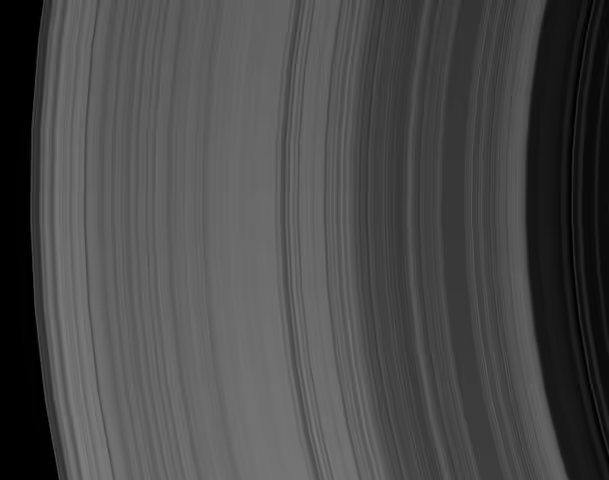
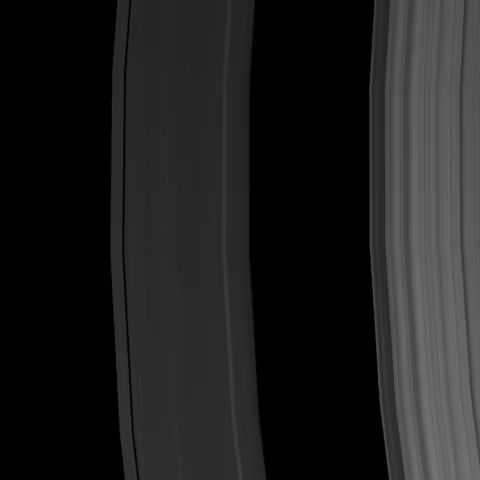
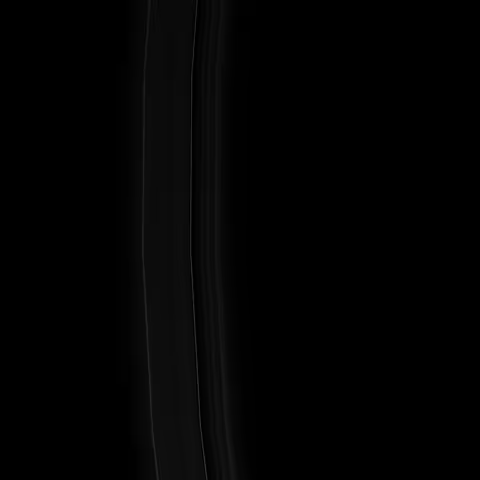
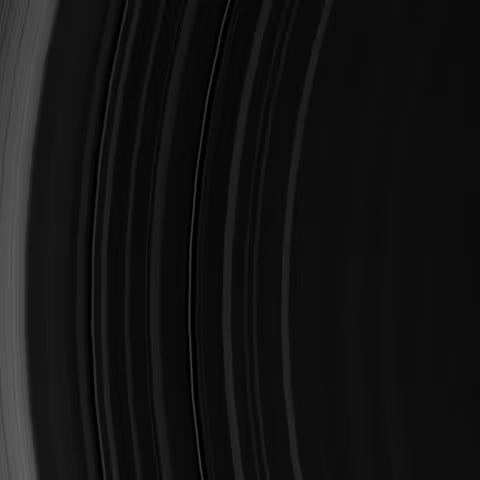
Each ring (a collection of ring material occupying a band of space in the ring system) is given a letter, ordered by the amount of material in it. |
|||
<gallery> |
|||
Darvikus A Ring.png|A Ring |
|||
Darvikus B Ring.png|B Ring |
|||
Darvikus C Ring.png|C Ring |
|||
Darvikus D Ring.png|D Ring |
|||
Darvikus E Ring.png|E Ring |
|||
</gallery> |
|||
==History== |
|||
===Formation=== |
|||
Darvikus formed from the accretion disk which surrounded its parent star, [[Frealee]], in its early history. As it was forming, the planet was a volcanic, moonless hellworld. However, in 1,800,000,000ish BCE, an unnamed rocky protoplanet roughly 0.5 terrestrial planet masses smashed into the forming Darvikus and caused over half of the planet's mass to escape into orbit and form a huge disk. This debris would gradually coalesce to form the four moons of Darvikus. This event also caused the planet to tilt on its rotational axis roughly 30 degrees, giving it relatively extreme seasons compared to planets with less tilt. |
|||
Darvikus would enjoy the company of the four moons until one of them crossed the roche limit in roughly 4,000,000 BCE, broke up, and formed Darvikus' beautiful rings. The other three moons were slowly drifting outwards during this time period, and while they started with quite tight-knit orbits, they ended up drawing apart. |
Darvikus would enjoy the company of the four moons until one of them crossed the roche limit in roughly 4,000,000 BCE, broke up, and formed Darvikus' beautiful rings. The other three moons were slowly drifting outwards during this time period, and while they started with quite tight-knit orbits, they ended up drawing apart. |
||
From its formation to around 1,500,000,000 BCE, many asteroids and comets collided with the planet, slowly cooling it down and filling the atmosphere with vast amounts of water vapor, which would form thick clouds. These clouds would begin to rain. A lot. The immense amount of rain transformed Darvikus into a hot ocean planet. However, a few million years later, volcanoes belched out a tremendous amount of material, which formed the planet's continents and islands, changing the planet from an |
From its formation to around 1,500,000,000 BCE, many asteroids and comets collided with the planet, slowly cooling it down and filling the atmosphere with vast amounts of water vapor, which would form thick clouds. These clouds would begin to rain. A lot. The immense amount of rain transformed Darvikus into a hot ocean planet. However, a few million years later, volcanoes belched out a tremendous amount of material, which formed the planet's continents and islands, changing the planet from an oceanic world to one of land and seas. |
||
=== |
===Evolution of Life=== |
||
In roughly 1,400,000,000 BCE, life appeared near the hydrothermal vents of Darvikus. This life was simple and single-celled, but it would rapidly evolve into multicellular creatures, with a notable spike at the Arbian Explosion where the diversity of life on Darvikus went to absolutely insane levels compared to before. |
In roughly 1,400,000,000 BCE, life appeared near the hydrothermal vents of Darvikus. This life was simple and single-celled, but it would rapidly evolve into multicellular creatures, with a notable spike at the Arbian Explosion where the diversity of life on Darvikus went to absolutely insane levels compared to before. |
||
Life would continue to evolve into even more forms of increasingly complex life, with it first climbing onto land at roughly 400,000,000 BCE. The planet was absolutely teeming with life, everywhere, until what is known as The Terminan Extinction, or the |
Life would continue to evolve into even more forms of increasingly complex life, with it first climbing onto land at roughly 400,000,000 BCE. The planet was absolutely teeming with life, everywhere, until what is known as The Terminan Extinction, or the Great Blight, which wiped out almost 94% of species on the planet. This was the worst extinction in the planet's history. |
||
One of the few remaining families of fauna would gradually evolve into many species which would take over the planet after the extinction. One of these species would become intelligent, and become the Inilar. This species would gradually take over the other species in its family to become the sole rulers of the planet. |
|||
===Early Inilar History=== |
|||
The Inilar would begin to spread across the planet, inhabiting all of Darvikus' continents by 1900 CE in larger and larger groups. These groups would eventually grow into the first examples of Darvikan society. Some groups would learn how to farm, while others learned how to domesticate animals and make ''them'' farm. By the year 2300 CE, sailing was a common technology, which allowed the Inilar to spread even further. |
|||
After thousands of years of advancement, the first space launch occurred, launching a small cubic satellite into orbit around the planet. This satellite was destroyed hours later by passage through the ring particles, but it was nonetheless heralded as an amazing scientific advancement. |
|||
=== Darvikan Colonization of Space === |
|||
More launches followed this launch, sending more and more spacecraft into space, eventually exploring every single planet, moon and dwarf planet in the Frealee System. During the later period of this exploration, the first colonization of Arnena and Ronelis occurred, their population growing to almost 200 million each. A large communications network was set up throughout the system, which generated a significant amount of radio emission, which quickly set the star apart from others. |
|||
The [[Providence Union]] noted this, and attempted to make contact with the native Inilar, and hopefully enter a mutually beneficial alliance with them. As communication broke down, the Providence Union used its overwhelming naval power to crush Darvikus, cutting off many of its nascent colonies. Without imports from the home world, they starved, which made governing the system much easier. Technology regressed substantially under the Providence Union as corruption and a zealous defense of the status quo gripped Darvikus. |
|||
=== Independence === |
|||
While their oppressors collapsed in 7300 CE, thousands of years of colonization virtually erased any notion of an independent Darvikus. The first rulers of the planet continued the old ways in culture, custom, and even architecture. Over time, however, a distinct Inilar identity emerged once again. The [[Nerae]] lords and ladies, managed to stay in power for some decades, but they soon fell out of power. Nerae and [[Relata]] settlers from the Providence Union were, at best, confined to cramped cities or made to work the fields for crops they could not even eat. |
|||
By 8000 CE, partial democracy had been established. While slavery of minority species had long fallen out of fashion, only land-owning Inilar had any say in governance. The resulting system-spanning state was called the '''Darvikan Federation'''. Its name reflected both the share of political power and population—over 99% of the population and 98% of voting power was held by Darvikans. |
|||
=== Galactic Politics === |
|||
The collapse of the [[Triumvirate Civilization]] killed the largest reason why Darvikus was even in space—trading with the resource-hungry Triumvirate. With space-dwelling Inilar, then five percent of the population, began descending to the home world in droves, the planet destablized. They stopped maintaining orbital infrastructure and left the planet wide open to attack. The government had no choice but to spend a great deal on keeping space settlements afloat, angering the planet-side population. |
|||
With the situation continuing to deteriorate, it aggravated existing divides in society—in particular class divides. Resources were not the only thing shipped to and from the Triumvirate. The ideology of '''communitarianism''' took hold. A bloody revolution took place, seizing factories, farms, universities, and the military. In 8101 CE, the '''Darvikan Communitarian Republic''' took power and spent its first decades purging society of all who previously held power. The change was so absolute that the population declined by over ten percent during this period. Their lust for blood did not end with the Darvikans, but soon turned outward. |
|||
Its neighbor went under a similar revolution. In 8107, [[Carlea|Carlea's]] military couped its civilian government and created the '''Glorious Kalar Restoration'''. Unlike Darvikus, Carlea maintained most of its old elite. When the [[Poreltids|Poreltid]] homeworld of [[Artaclate]], previously ignored but now a major power, entered the scene, war was inevitable. The [[Tripartite War]] between these three sides saw the first use of the [[Marceum|Marceum Bomb]] in a large scale. All three sides restored and fired as many of Providence's [[Lexica:Cosmoria/Technology#Atomic Weapons|atomic weapons]] as they could. Darvikus fared the worst out of all three worlds and fell into deep economic decline. |
|||
===Contemporary History=== |
|||
One of the few remaining families of fauna would gradually evolve into many species which would take over the planet after the extinction. One of these species would become intelligent, and become the Darvikans. This species would gradually take over the other species in its family to become the sole rulers of the planet. |
|||
For millennia, Darvikus was a comparatively poor backwater. Its fertile fields kept the population high despite this, but millions of them faced crushing poverty. They had to wait centuries for the debris from the Tripartite War to clear up on its own. Immediately following the war, the orbit of Darvikus was so cluttered with debris that it made space travel effectively impossible. |
|||
In 9000 CE, the planet's government had become somewhat democratic once more and its poverty was lessening. It entered into trade talks with its former enemies that would eventually blossom into the federation of [[Illuin]]. Darvikus retains some devolved powers from Illuin, making the nation a ''federacy'' rather than a proper federation, but these powers are minor. |
|||
=== Early Darvikan History === |
|||
Darvikans would begin to spread across the planet, inhabiting all of Darvikus' continents by 19000 CE in larger and larger groups. These groups would eventually grow into the first examples of Darvikan society. Some groups would learn how to farm, while others learned how to domesticate animals and make ''them'' farm. By the year 23000 CE, sailing was a common technology, which allowed Darvikans to spread even further. |
|||
== Gallery == |
|||
I honestly don't really know what other information to add sorry |
|||
<gallery> |
|||
DarvikusFromArnena.png|Darvikus from Arnena. |
|||
DarvikusMoons.png|Orbits of Darvikus' moons. |
|||
DarvikusSunrise.png|Sunrise on Darvikus. |
|||
</gallery> |
|||
[[Category:Planets]] |
[[Category:Planets]] |
||
[[Category: |
[[Category:Author: The Minmus Derp]] |
||
[[Category:Frealee System]] |
|||
[[Category:Flower Galaxy]] |
|||
[[Category:Minmus' Articles]] |
|||
Latest revision as of 20:08, March 24, 2026

Darvikus

12609.018 km
28.285 hours
Highlands
Naturally created by moon crossing roche limit
Inilar
Democratic Republic
57.322 billion
- Darvikus Prime
- Kagala
Darvikus is the fourth planet in the Frealee System and the homeworld of the Inilar. Darvikus has three major moons, Arnena, Ronelis, and Frar. Darvikus is most associated with the Cnara-Frealee Federation, as it is the homeworld of the federation's second most powerful species and the legislative capital of the federation. The planet houses several bureaus which help run the United Nations of Florathel, but is not one of the official capitals. Even so, Darvikus is one of the most important worlds in Cosmoria's history, as it served as the birthplace of the Inilar, one of the most powerful species in history. Due to its importance in galactic history, Darvikus is one of the most well-known planets in the galaxy.
As of today, Darvikus is a superhabitable residential world, one of the top tourist destinations in Florathel, and a very busy trading hub. Many arcologies are barely visible from orbit scattered across the continents. Some are even underwater in the planet's oceans.
Most farming on the planet is done by self-sufficient arcologies. Usually, only luxuries need to be brought in, meaning that the planet can and has weathered many a siege.
Darvikus is much greener than it was in ages past, as almost the entire population lives in self-sufficient buildings called Arcologies, leaving most of the surface area to turn to wild, including the abandoned and disassembled cities.
Most energy on Darvikus comes from beamed power from the Frealee Dyson Swarm and other renewable energy sources like solar and wind. Some also comes from recently developed forms of nuclear fusion that are clean and safe. A tiny percentage comes from geothermal processes in Darvikus' mantle and outer core, while the rest comes from power plants in the Arcologies.
Population
Being the homeworld of the Darvikans, it would be expected to have a large population. It actually does have a large population, over 57 billion people. This is far over the natural holding capacity, but this is sustained by large networks of self-sufficient Arcologies where most of the population lives.
Darvikus is quite culturally diverse, as it still contains fragments of every single extant Darvikan culture, some of which still follow state borders.
Geography
Darvikus has seven continents, North Narvea, South Narvea, Atarra, Eria, Asar, Ranvia, and Astrella. Each of these holds a population of at least five billion, rivaling many star systems. Separating these continents are the four distinct oceans: The East and West Corvucadic, Norric, and Rhethys oceans.
Across these continents are a fair amount of different landscapes, including forests, savannahs, tundras, badlands and so on. However, there has always been a complete lack of deserts. Thanks to this quite varied geography, Darvikus is relatively famous for the diversity of its landmasses.
Climate
Darvikus' climate is very varied. Its climate changes depending on the latitude, with areas warm enough to create vast horrendously buggy swamps and cold enough to create vast plates of ice sheathing the poles of the planet. Temperatures also range from being cold enough to freeze water at the poles to being warm enough to be mildly annoying at the equator. Each region of the planet supports a unique biosphere able to support a huge variety of flora and fauna.
Darvikus' overall climate is a very temperate planet. Its position in the system allows carbon-based life to thrive across the planet, orbiting in the "habitable zone" of its parent star.
This perfect climate is also kept in check by the planet's inhabitants, using various structures to carefully manipulate the temperature and climate of various areas of the planet. These structures have actually allowed the planet to become even more habitable to its native life than it originally was.
Major Moons

Drelisan
Drelisan was the innermost moon of Darvikus created by the impact of Darvikus and another Frealeean planet. Not much is known about Drelisan, aside from the fact that it was destroyed when it passed beneath Darvikus' roche limit roughly 23 million years ago. However, it was likely the smallest of the original four Darvikan moons, and a selena similar to the others.

Arnena
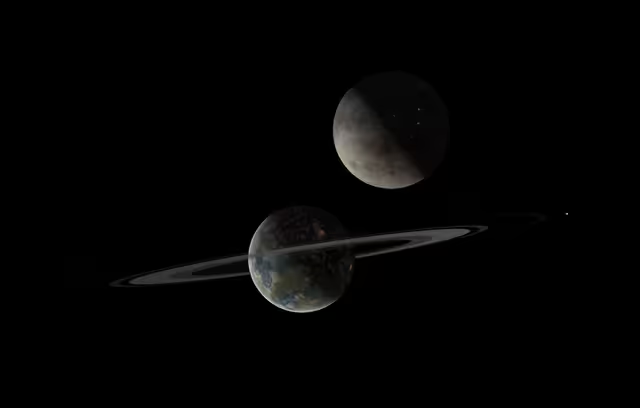
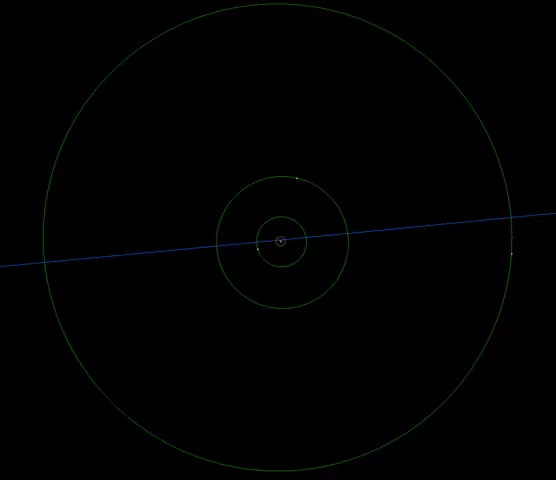
Arnena is the innermost major moon of Darvikus. Like the other two moons, it formed from the impact of Darvikus and another Frealeean planet. Arnena itself is a small selena world, with no atmosphere and various crater fields and mountains spreading across the entire surface, and obviously does not hold any native life. Arnena, appearing as the largest object in the Darvikan sky aside from the rings, was held in great reverence by both the Old Inilar over two billion years ago and modern Inilar when they first evolved.

Ronelis
Ronelis is the second major moon of Darvikus, and the second largest. It is a selena world, and contains many massive craters and ejecta lines, the largest ones being visible from the surface of its parent planet. Ever since the Inilar took their first steps on another world, this moon was one of the prime candidates for a first colony, which came to pass in roughly 4900 CE. Today, Ronelis is covered in various cities, and there are plans to terraform the moon or turn it into an ecumenopolis.

Frar
Frar is the most distant and largest moon of Darvikus. Like the other major moons, it is airless and contains large craters. Unlike the others, it may have been captured into orbit around Darvikus after the formation of the system, due to its notably differing composition to the other two moons and the rings. Frar is also notably monotone and is widely considered to be the most boring major moon.
However, because of its large size, Frar is the most likely to be terraformed soon, which will allow it to support a much higher population.
Rings of Drelisan

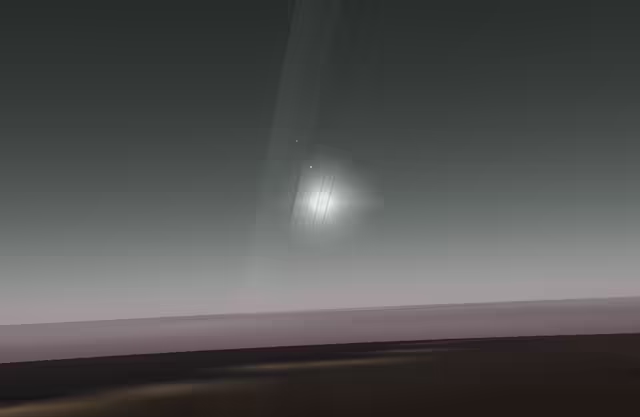
Darvikus has a vast, dramatic ring system circling the planet, officially named the Rings of Drelisan, but most call it "Darvikus' Rings". The Rings of Drelisan were formed when the original innermost major moon of Darvikus, known as Drelisan to scientists, passed beneath the roche limit due to gravitational interactions from the other three moons. It was torn apart after this, thus forming the majestic rings we see today. The rings themselves are mostly made of silicates, as Drelisan likely had practically no iron core, giving them their bright white color.
Countless small outposts have been established on various objects in the rings, with the largest functioning as colonies in their own right, having their own cultures and laws. The vast majority of them however have populations of at most twenty people, and are often used as communication satellites and weather pattern thingies.
Each ring (a collection of ring material occupying a band of space in the ring system) is given a letter, ordered by the amount of material in it.
-
 A Ring
 -
 B Ring
 -
 C Ring
 -
 D Ring
 -
 E Ring


History
Formation
Darvikus formed from the accretion disk which surrounded its parent star, Frealee, in its early history. As it was forming, the planet was a volcanic, moonless hellworld. However, in 1,800,000,000ish BCE, an unnamed rocky protoplanet roughly 0.5 terrestrial planet masses smashed into the forming Darvikus and caused over half of the planet's mass to escape into orbit and form a huge disk. This debris would gradually coalesce to form the four moons of Darvikus. This event also caused the planet to tilt on its rotational axis roughly 30 degrees, giving it relatively extreme seasons compared to planets with less tilt.
Darvikus would enjoy the company of the four moons until one of them crossed the roche limit in roughly 4,000,000 BCE, broke up, and formed Darvikus' beautiful rings. The other three moons were slowly drifting outwards during this time period, and while they started with quite tight-knit orbits, they ended up drawing apart.
From its formation to around 1,500,000,000 BCE, many asteroids and comets collided with the planet, slowly cooling it down and filling the atmosphere with vast amounts of water vapor, which would form thick clouds. These clouds would begin to rain. A lot. The immense amount of rain transformed Darvikus into a hot ocean planet. However, a few million years later, volcanoes belched out a tremendous amount of material, which formed the planet's continents and islands, changing the planet from an oceanic world to one of land and seas.
Evolution of Life
In roughly 1,400,000,000 BCE, life appeared near the hydrothermal vents of Darvikus. This life was simple and single-celled, but it would rapidly evolve into multicellular creatures, with a notable spike at the Arbian Explosion where the diversity of life on Darvikus went to absolutely insane levels compared to before.
Life would continue to evolve into even more forms of increasingly complex life, with it first climbing onto land at roughly 400,000,000 BCE. The planet was absolutely teeming with life, everywhere, until what is known as The Terminan Extinction, or the Great Blight, which wiped out almost 94% of species on the planet. This was the worst extinction in the planet's history.
One of the few remaining families of fauna would gradually evolve into many species which would take over the planet after the extinction. One of these species would become intelligent, and become the Inilar. This species would gradually take over the other species in its family to become the sole rulers of the planet.
Early Inilar History
The Inilar would begin to spread across the planet, inhabiting all of Darvikus' continents by 1900 CE in larger and larger groups. These groups would eventually grow into the first examples of Darvikan society. Some groups would learn how to farm, while others learned how to domesticate animals and make them farm. By the year 2300 CE, sailing was a common technology, which allowed the Inilar to spread even further.
After thousands of years of advancement, the first space launch occurred, launching a small cubic satellite into orbit around the planet. This satellite was destroyed hours later by passage through the ring particles, but it was nonetheless heralded as an amazing scientific advancement.
Darvikan Colonization of Space
More launches followed this launch, sending more and more spacecraft into space, eventually exploring every single planet, moon and dwarf planet in the Frealee System. During the later period of this exploration, the first colonization of Arnena and Ronelis occurred, their population growing to almost 200 million each. A large communications network was set up throughout the system, which generated a significant amount of radio emission, which quickly set the star apart from others.
The Providence Union noted this, and attempted to make contact with the native Inilar, and hopefully enter a mutually beneficial alliance with them. As communication broke down, the Providence Union used its overwhelming naval power to crush Darvikus, cutting off many of its nascent colonies. Without imports from the home world, they starved, which made governing the system much easier. Technology regressed substantially under the Providence Union as corruption and a zealous defense of the status quo gripped Darvikus.
Independence
While their oppressors collapsed in 7300 CE, thousands of years of colonization virtually erased any notion of an independent Darvikus. The first rulers of the planet continued the old ways in culture, custom, and even architecture. Over time, however, a distinct Inilar identity emerged once again. The Nerae lords and ladies, managed to stay in power for some decades, but they soon fell out of power. Nerae and Relata settlers from the Providence Union were, at best, confined to cramped cities or made to work the fields for crops they could not even eat.
By 8000 CE, partial democracy had been established. While slavery of minority species had long fallen out of fashion, only land-owning Inilar had any say in governance. The resulting system-spanning state was called the Darvikan Federation. Its name reflected both the share of political power and population—over 99% of the population and 98% of voting power was held by Darvikans.
Galactic Politics
The collapse of the Triumvirate Civilization killed the largest reason why Darvikus was even in space—trading with the resource-hungry Triumvirate. With space-dwelling Inilar, then five percent of the population, began descending to the home world in droves, the planet destablized. They stopped maintaining orbital infrastructure and left the planet wide open to attack. The government had no choice but to spend a great deal on keeping space settlements afloat, angering the planet-side population.
With the situation continuing to deteriorate, it aggravated existing divides in society—in particular class divides. Resources were not the only thing shipped to and from the Triumvirate. The ideology of communitarianism took hold. A bloody revolution took place, seizing factories, farms, universities, and the military. In 8101 CE, the Darvikan Communitarian Republic took power and spent its first decades purging society of all who previously held power. The change was so absolute that the population declined by over ten percent during this period. Their lust for blood did not end with the Darvikans, but soon turned outward.
Its neighbor went under a similar revolution. In 8107, Carlea's military couped its civilian government and created the Glorious Kalar Restoration. Unlike Darvikus, Carlea maintained most of its old elite. When the Poreltid homeworld of Artaclate, previously ignored but now a major power, entered the scene, war was inevitable. The Tripartite War between these three sides saw the first use of the Marceum Bomb in a large scale. All three sides restored and fired as many of Providence's atomic weapons as they could. Darvikus fared the worst out of all three worlds and fell into deep economic decline.
Contemporary History
For millennia, Darvikus was a comparatively poor backwater. Its fertile fields kept the population high despite this, but millions of them faced crushing poverty. They had to wait centuries for the debris from the Tripartite War to clear up on its own. Immediately following the war, the orbit of Darvikus was so cluttered with debris that it made space travel effectively impossible.
In 9000 CE, the planet's government had become somewhat democratic once more and its poverty was lessening. It entered into trade talks with its former enemies that would eventually blossom into the federation of Illuin. Darvikus retains some devolved powers from Illuin, making the nation a federacy rather than a proper federation, but these powers are minor.
Gallery
-
 Darvikus from Arnena.
 -
 Orbits of Darvikus' moons.
 -
 Sunrise on Darvikus.


