
Aurora - (Tarmalyula)

More actions


Template:Ambrosia: WorldAurora is a temperate habitable planet orbiting an orange dwarf star in the Tarmalyula Galaxy. It is the capital of the Democratic Commonwealth of Aurora, as well as its most important planet.
Geography
To be added, once I get a map
History
Aurora formed 6 billion years ago, along with the rest of the Aurora System. It originally formed with half of its current mass, but since has accreted the rest through interactions with dwarf planets, planetesimals, and asteroids.
As it formed, a rogue protoplanet was drawn too close to it. It fell into orbit around the molten hell that was Aurora at the time, and became its largest moon. This was Cloud, but it was vastly different. At the time, Cloud had seas, an atmosphere, a magnetic field. Some predictions even think that it may have had life, and then accidentally sprinkled it onto the surface of Aurora. Whichever is correct, this moon is now a barren craterscape with almost no signs of flowing water on its surface. So what happened?
It is now widely believed that the Troeimyl Civilization was founded and spread off this moon. When they fell, the moon was so heavily bombarded with weapons (most likely asteroids) that it blew the atmosphere away and destroyed all evidence of life on the surface. Luckily, the carbon-based life it had spawned continued on its Aegyn-like orbital parent and still does today.
Around 34 700, a group of refugee humans fled from Via Aylathiya and arrived here, settling the planet. It was only slightly different from Aegyn, so they had little trouble adapting. The oxygen content was slightly higher, and the atmosphere was slightly less pressurized, but they survived through a process of genetic engineering and selective breeding. As they progressed on the planet, they eventually regressed into savages, living as hunter-gatherers of the land. They evolved slightly, and are now sufficiently diverse from other humans to have their own sub-species; Auroran Humans.
Eventually, they rediscovered technology and re-wrote their past, and finally figured out why there was a two-kilometre high pyramid on a deserted peninsula, many thousands of kilometres away from civilization.
Locations
A series of locations on Aurora's surface is seen below. Take note that some ruins and buildings can be seen.


Emola Desert
-
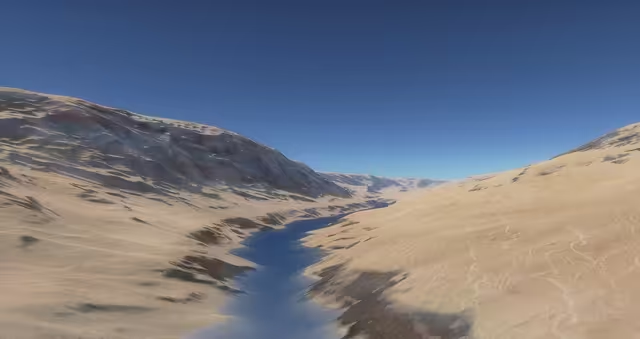 A river flowing through the Desert
 -
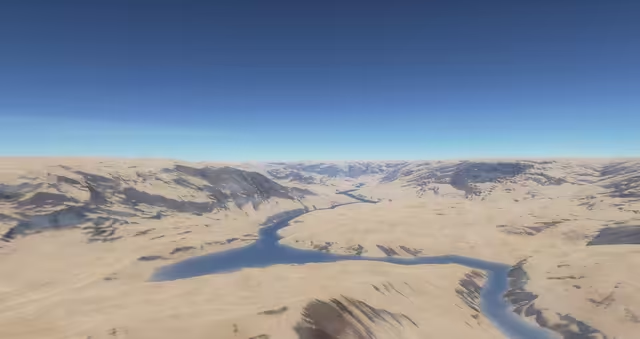 The same river, farther down stream
 -
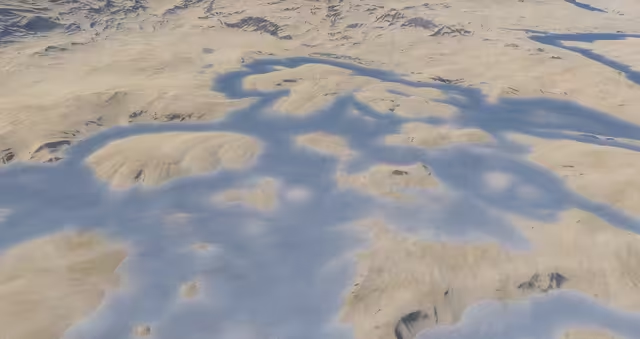 Were the river meets the Ocean is a large plain of deltas and sandbanks
The Emola Desert is a large desert located in the centre of the largest continent. It has a multitude of rivers flowing through it, sustaining life on their narrow banks.
Otockami Alpine Region
-
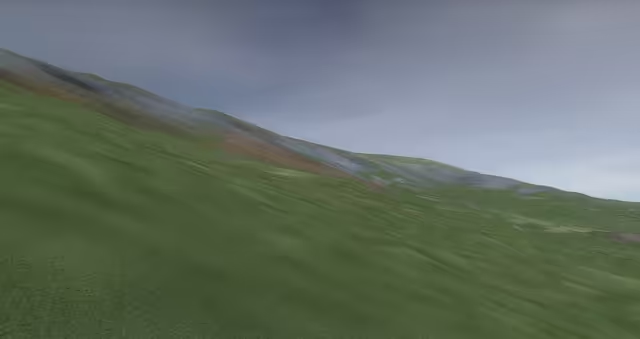 The overcast skies and steep hills of the Otockami Alpine Region
The Otoockami Alpine Region is a series of hills and mountains, covered in grass and trees. It is rather cold here, even by Auroran standards. These are the least populated regions and are found near the ice cliffs of the northern and southern ice caps.
Pyramid Country
-
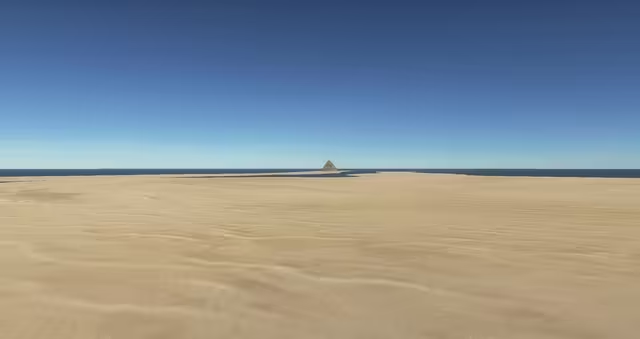 The Pyramid from a distance
 -
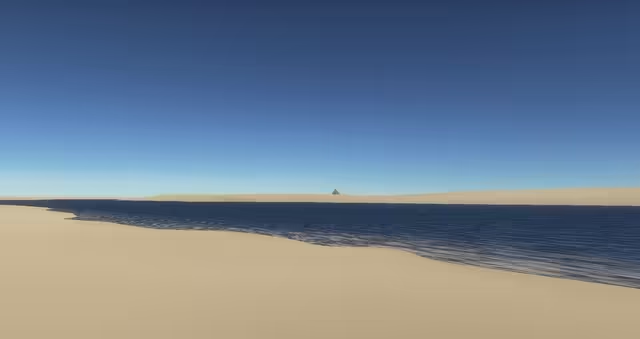 The Pyramid again
 -
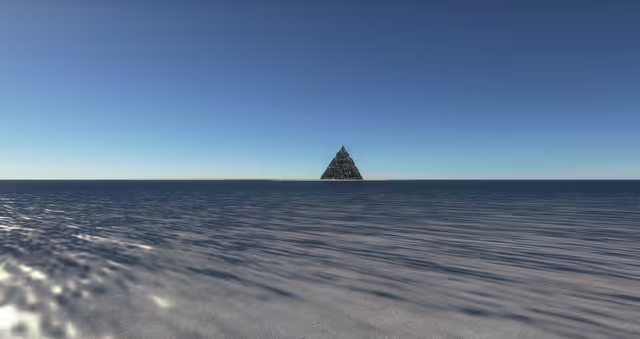 Closer up
Pyramid Country is the smallest of the regions of Aurora, but one of the most well-known. It constitutes a ten-kilometre long peninsula into the sea, mainly sand and gravel, but towards the end, there is an immense sandstone pyramid, two kilometres in height. It is thought that it was constructed by the Troeimyl Civilization, as a monument to their civilization.
Repo Grasslands
-
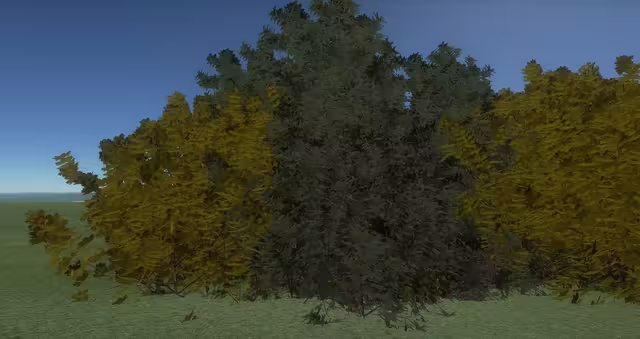 The trees of the Grasslands
 -
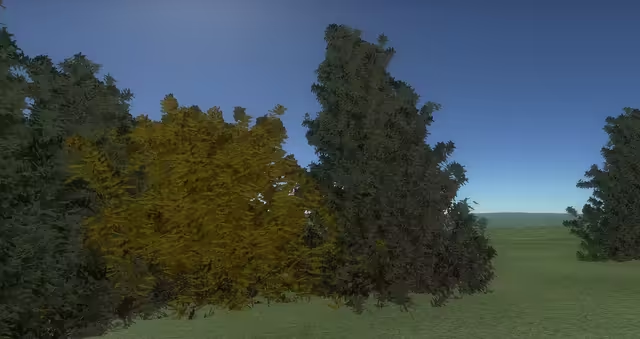 The Same trees
 -
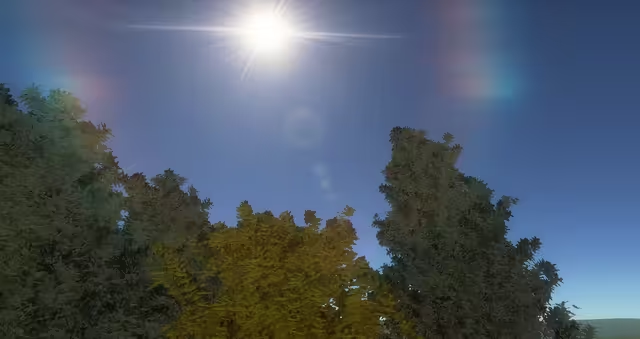 The trees again, with Auroran Star at the top
 -
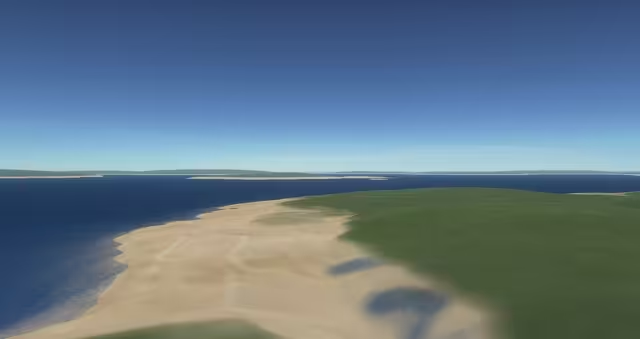 The western boundary
 -
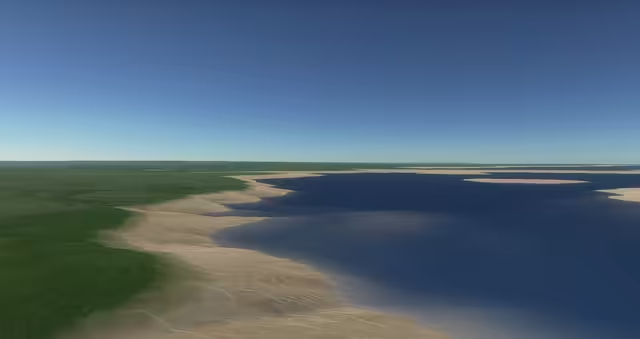 The Eastern Boundary
 -
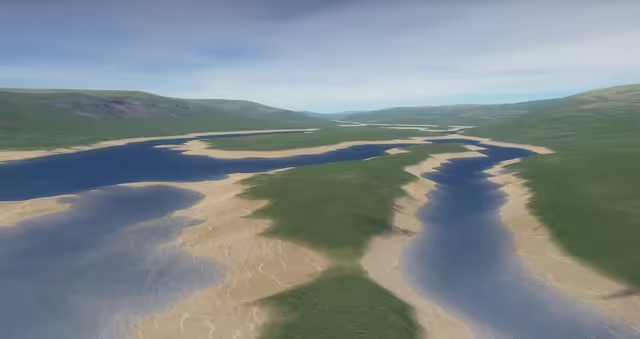 A river running through the grasslands
The Repo Grasslands are the largest area of Aurora - so large, that they take up 60% of one of the largest continents. It is here where the dense megacities are located, huge pyramid stacks of levels hundreds of kilometres in area, on top of each other.
Governance
The government of Aurora is a democracy, with each of the 128 regions electing two representatives, a male, and a female, to join in a world court with 256 representatives. Of these, they then elect a world two world leaders, again a male and a female, to represent Aurora in the Democratic Commonwealth of Aurora's government.
Population
The population of Aurora is mainly located in huge dense megacities, each with the land area of a decent-sized continent, scattered across the planet. They are about ten kilometres in height, and there are 6 928 of them. A few are free-floating on the sea, but most are anchored straight into the crust of the planet.
The culture in each of these cities varies as if you have traveled to a different planet - in one, there would be top-of-the-notch street art decorating every intersection, in another, loud rock music blaring from every speaker. It is these cities and their combined average culture that gives Aurora such a diverse mix of ethics, culture, and religions.
Orbit
In orbit around Aurora, there are several hundred large-scale structures, most visible from the surface, and many thousands of space stations, most just a tiny asteroid hollowed out and used as a living space for a few families. However, in orbit around Aurora are a few major megastructures, which dominate the day and night sky.
Megastructures
Below is a compilation of artificial megastructures orbiting Aurora.
Evilee Circumplanetary Ring
The Evilee Circumplanetary Ring, or just Evilee, is a humungous ring ten times the diameter of Aurora. Despite this, it is a prominent feature in the Auroran sky, visible both at day and night as a bright band of light circling the sky. It is located 160 thousand kilometres away from Aurora, making it sit between Sky and Cloud. It spins very fast, but even this is not enough to generate gravity. Its days and nights are very long, lasting over a week, but there is plenty of reflected light from Aurora, Sky, and Cloud. Gravity Generators are strategically placed on the bottom to make up for the fast spin but huge size, bringing the gravity up to par with Aurora.
Defense Matrix
The Defense Matrix is a large space-time warping machine, when activated, separates Aurora, Sky, Cloud, and all associated megastructures from the Universe, and moves it to the Palioxis Starfield. This technology has yet to be used, but tests on useless planets in collaboration with the United Terran Federation have shown that it is possible.
The actual hardware is located at the core of Aurora, generating a gravitational wave so strong that it physically warps space-time so much as to make one plank length the size of the universe, breaking the laws of physics and separating the most powerful area from the rest of the universe. Due to the position of the Palioxis Starfield compared to our Universe, it latches on to it and appears to blink into existence, in a flash of the opposite of a gravitational wave.
Polar Towers
The Polar Towers are really just one tower, tunneling straight through the planet, from the north to south pole, and then extending some million kilometres high. They are the ports of almost all cargo going in and out of Aurora. The tower itself is consistently 100 kilometres in diameter, meaning that it can ferry mountains worth of material every second.
Asteroidal Defence System
The Asteroidal Defence System (or ADS) is a ring of 100 asteroids orbiting in a rough sphere surrounding Aurora, at a distance of 1.5 million kilometres. They constantly broadcast radio signals to prevent a collision.
When an enemy approaches, lasers powerful enough to render a continent into slag fire upon it after three warnings, situated a minute apart. These lasers are just a precaution - nowadays, most enemies are jumping straight into orbit. And that leads us into the next one.
Jump Drive Destabiliser
The Jump Drive Destabiliser destabilizes the delicate machinery inside Jump Drives, rendering it highly risky to attempt to jump near the machinery, or just plain impossible. This means that any would-be invaders would have to pass through the ADS, and therefore get vaporized.
The Great Aurora Sphere
The Aurora Sphere is located near Aurora - just a quarter of a light-year away. This means that with virtually no delay, the Aurora Sphere can shoot down any major craft (ie. craft the size of small moons) and in the direst of cases, vaporize Aurora itself. Thankfully, it has never had to be used defensively.
Moons
Aurora has two moons, a larger one which is farther out, and a smaller one which is close in.

Sky
Sky is the smaller of the two, though it looks about the same size as Cloud, from the surface, due to its proximity to Aurora. It was never really worth colonizing in the early days of Auroran Space Travel, but now it is a bustling ecumenopolis shuttling the 1% of people coming in and out of Aurora that don't go in the Polar Towers down to the ground, It is a wealthy place, being paraterraformed with a shield 10 metres thick of glass made in such a way so as it distorts the outside world as little as possible, and an atmosphere pumped underneath it. Due to its low gravity, its skyscrapers often go outside of the dome, and give the appearance that sky "has a little beard."

Cloud
Cloud is a strange moon, with evidence of a lost civilization arising on it, and then falling as their moon was resurfaced and changed. Currently, it is a nature paradise with only a few billion living on its surface, and those in one of the three arcologies on the moon. The rest is a nature reserve, set up to protect and nurture the increasingly rare Auroran species that are being driven to extinction by the urbanizing of Aurora.