
Uranus

More actions

Uranus

Morbiusgreen (May 31st 2015)
Morbiusgreen (April 24th 2020)
19.21 AU
84.190 standard years
0.04720
0°46'11.64"
14.536 M⊕
0.91725 G
-197.17°C
5.74 million ATM
4.570 billion years
17ʰ14ᵐ23.99ˢ
-11°07'26.18"
27
No native life
38,100,000,000,000
Overview
Uranus is composed primarily of volatile materials heavier than hydrogen and helium, such as methane, water, and ammonia. It has no solid surface, instead having a steadily thickening atmosphere composed of hydrogen, helium, and methane, which gives way to a thick, liquid, ice-rich mantle as depth increases, ending eventually in a solid rocky core.
Unusual Axis

Uranus is an unusual world in that its axis of rotation is almost parallel to the Sol System's natural orbital plane. Due to this anomaly, the planetary poles receive more light from the sun than the equator. The cause of this unusual tilt is thought to be from an impact between Uranus and another protoplanet early in the Solar System's history. The Uranian magnetic field is dramatically offset from the planet's center of mass and not aligned with its rotational axis.
History
Uranus formed as most of the gas giants in the Sol System did. Gases near one of the larger rocky bodies began to coalesce and form a large gas giant planet. At some point during its history, Uranus was impacted by another body in such a way that the planet was completely tilted off of its orbital axis. Thus, all moons that orbit Uranus now orbit within its current rotational axis.
There is a possibility that it was discovered early in human history, being misidentified as a star possibly by Hipparchus of Nicaea in 178 BCE.
The earliest confirmed sighting of Uranus took place in 1690 when English astronomer John Flamsteed observed it at least six times, cataloging it as a star he named **34 Tauri**. The French astronomer Pierre Charles Le Monnier observed Uranus at least twelve times between 1750 and 1769.
However, it wasn't until **March 13, 1781**, that an official discovery was made by Sir William Herschel. He too, however, misidentified it as a comet and for two years continued to identify it as such despite his colleagues describing it as a primary planet. However, in 1783, he eventually admitted that it was a planet.
In **1986**, NASA's *Voyager 2* interplanetary probe flew by Uranus. This **flyby** remained the only investigation of Uranus carried out from a short distance until the Great Solar System Tour, where humans actually visited the planet.
With the discovery of **Warp Drive technology**, more and more researchers moved to Uranus' moons in order to study the unique planet up close.
With the advances in **dirigible cities**, it was inevitable that Uranus would eventually have one constructed. *Kronos 1*, named after the mythical son of Uranus from myth, was initially a research station set in orbit to study the atmosphere in greater detail. From there, many other floating cities began to be built.
Today, much like the rest of the gas giants, **massive floating continents and cities** exist within the clouds.
Gallery
-
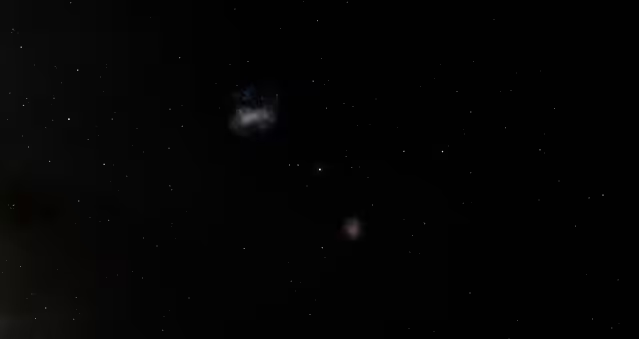 Oberon seen from Uranus
 -
 Titania seen from Uranus
 -
 Umbriel seen from Uranus
 -
 Ariel seen from Uranus
 -
 Miranda seen from Uranus


