
Index:Distant Worlds: Difference between revisions

More actions
No edit summary Tag: 2017 source edit |
No edit summary Tag: 2017 source edit |
||
| Line 275: | Line 275: | ||
*[[Index:Distant_Worlds/Space_Fleets|List of Space Fleets]] |
*[[Index:Distant_Worlds/Space_Fleets|List of Space Fleets]] |
||
Space Stations are permanent or semi-permanent human-made structures orbiting a planet or celestial body, designed to support long-term human habitation, research, and operational activity in space; small outposts, like the International Space Station (ISS), serve as early platforms for microgravity experimentation, life support testing, and international collaboration, often functioning as precursors to larger orbital cities, deep-space gateways, or staging hubs for interplanetary missions. |
|||
*[[Index:Distant Worlds/Space Stations|List of Space Stations]] |
|||
{{Simple Index list |
{{Simple Index list |
||
Revision as of 14:46, April 25, 2025




- Inspired by Index:Silky Way and Index:Cosmoria
- Proofreading by ASmallerMolecule
 Terminology

Fermions are matter particles and are split into two families:
- Quarks (Up, Down, Strange, Charm, Top, Bottom)
- Leptons (Electron, Muon, Tau, and their corresponding Neutrinos)
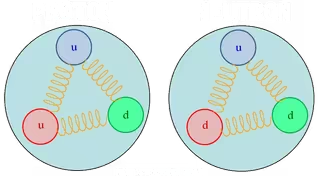
Simplified model of nucleons

Quarks bond via gluons to form larger particles like protons and neutrons, which combine with electrons to create atoms.
Bosons mediate the fundamental forces of the universe:
- Photons carry electromagnetic force.
- Gluons mediate the strong nuclear force, which binds quarks together.
- W and Z bosons govern the weak nuclear force, responsible for certain types of decay.
- The Graviton (hypothetical) mediates gravity, propagating through higher dimensions.
 |
 |
 |
 |
 |
 |
|---|

 |
 |
 |
 |
|---|
 |
 |
 |
 |
|---|
 |
 |
 |
 |
|---|
The Action (S) in physics is a fundamental quantity that determines the evolution of a system by integrating the Lagrangian over time, forming the basis of the Principle of Least Action, which governs classical mechanics, quantum mechanics, and field theories, where classical paths minimize action, quantum systems sum over possible histories using Feynman’s Path Integral, and in General Relativity, the Einstein-Hilbert action defines how spacetime curvature interacts with energy, together allowing for extensions in higher-dimensional physics, such as modified action principles for Bridges, D>5 interactions, and Gravitational phenomenas.
S = \int L \, dt
The Lagrangian is a mathematical function that describes the dynamics of a physical system by encoding its energy through the difference between kinetic and potential energy. In particle physics, the Lagrangian density defines the fundamental interactions of fields and particles, including their motion and symmetries, serving as the foundation for quantum field theories like the Standard Model. In Distant Worlds, Lagrangians define the behavior of Particles, governing their interactions, dimensional properties, and roles within Bridges and phenomena.
A spacetime geometry with constant negative curvature, often used in theoretical physics and string theory. Unlike flat or positively curved spaces, AdS has a boundary at infinity and allows for unique gravitational effects, such as holographic dualities. In Distant Worlds, Anti-de Sitter space takes a more subspace approach; a pocket space in-between the spatial dimensions of universe, connecting them together with the Anti-de Sitter curvature. For the Anti-de Sitter Drive in Distant Worlds, see this page.
In Distant Worlds, M-theory is adapted to describe a larger, more complex geometric hyperstructure in which the familiar three spatial dimensions exist as a subset. While traditional M-theory postulates 11 dimensions - 10 being spatial and 1 temporal - these dimensions in Distant Worlds are not merely compacted but instead form a intricate, higher-dimensional framework governing the interactions of matter, energy, and spacetime. The additional dimensions play a crucial role in shaping the universe’s deeper physical laws, influencing phenomena such as gravitational electromagnetism, interdimensional couplings, and the stability of Bridges.
In string theory and its extended frameworks, such as supergravity and M-theory, a brane (short for "membrane") is a multidimensional physical object that generalizes the notion of a point particle. A point particle is considered a 0-brane, a string is a 1-brane, and higher-dimensional analogues are labeled accordingly as p-branes. Each p-brane propagates through spacetime, sweeping out a (p+1)-dimensional volume called its worldvolume, and can possess mass, charge, and other quantum attributes. Fields—similar to the electromagnetic field—can exist on these branes and define interactions restricted to their surfaces.
Within Distant Worlds, branes are more than theoretical constructs. They are known, observable hyperspatial slices—foundations of higher-dimensional reality, referred to by their respective brane classification. These branes collectively form a hyperspatial lattice, through which dimensional forces propagate and evolve. Each brane is treated as a semi-space or hyperslice, with its own unique energetic and geometric properties.
Importantly, in this framework, there is no concept of zero-dimensional (0-brane) particles. The lowest-dimensional fundamental objects are the F1-Type Branes, or one-dimensional strings. These structures form the base layer of all matter-energy interactions.
Brane Classification in Distant Worlds Brane Name Dimensionality Designation Properties F1-Type Brane 1D String Fundamental one-dimensional strings; the basis of all higher structures. Dirichlet Membrane 2D D2 Two-dimensional semi-space; a hosting field for confined strings. Normal Space (NS-3) 3D Stable Brane Standard three-dimensional space; energetically stable and widely inhabited. Archangels Membrane (AM-4) 4D Hyperspace Core Entry point into higher-dimensional branes; supports limited interaction with 3D space. Neveu–Schwarz Field (NS-5) 5D Electromagnetic Hypervolume The native habitat of Photinos; generates complex EM field structures in higher dimensions. Marks the threshold of brane energetic stability. Victor-Badzovik Membrane (VB-6) 6D Exotic Geometry Realm Contains complex topologies used by Archangels for mass manipulation. Wells-Mikail F-Field (WM-7) 7D Fractal Symmetry Layer Region where the fractal nature of the universe begins to break down. Raymond Conjure (RC-8) 8D Collapse Lattice Domain of dimensional slicing and symmetry shattering; branes begin to fracture into semi-independent domains. Shadow Realm (SR-9) 9D Brane Entropy Zone Little is understood; the name appears to reflect conceptual fatigue among early theorists. Gravikingdom (GK-10) 10D Graviton Apex Layer The highest-dimensional brane accessible to Gravitons; a realm of intense gravitational field flux. Temporal Kingdom (M-11) 11D Master Brane Source of all lower brane behavior; controls the flow of time and underpins causality across all other dimensions.
Color Charge
|
 |
|---|
In Linear Algebra, a subspace is a subset of a vector space that is closed under addition and scalar multiplication, meaning that any linear combination of vectors in the subspace remains within it. Subspaces can be thought of as lower-dimensional "slices" of a larger space, such as planes within three-dimensional space or hyperplanes in higher dimensions.
In Physics, especially in M-Theory and higher-dimensional models, "subspace" often refers to lower-energy, lower-dimensional regions embedded within a higher-dimensional spacetime, such as brane worlds or compactified extra dimensions.
in Distant Worlds, Anti-de Sitter acts as a subspace warping between higher dimensions connecting them, Between Three Dimensions and Fourth Perpendicular Axis geometrical structure of the subspace is called Rhombic Dodecahedron.
Metric Tensor
The Metric Tensor is a fundamental mathematical object in differential geometry and physics that defines the way distances and angles are measured in a given space. In General Relativity (GR), the metric tensor g_{\mu\nu} describes the curvature of spacetime due to gravity, determining how matter and energy shape the geometry of the universe through Einstein’s field equations. More generally, in higher-dimensional (4D+) spacetime, the metric tensor extends beyond three spatial and one time dimension, allowing for the definition of distances, causal structure, and coordinate transformations in theories like M-Theory or the Fractal Universe Model in Distant Worlds, where space may have complex topologies influenced by Gravitons, Fractons within Bridge space, and SuperSymmetric partners.
Holographic Principles
The Holographic Principle states that all information within a volume of space can be encoded on its boundary, suggesting that reality may be fundamentally two-dimensional, with the third dimension emerging from quantum interactions. The AdS/CFT Correspondence extends this idea, proposing that gravity in an Anti-de Sitter (AdS) space is mathematically equivalent to a lower-dimensional Conformal Field Theory (CFT) on its boundary, providing a powerful framework for understanding quantum gravity, black holes, and higher-dimensional physics.
In Distant Worlds, the AdS/CFT Correspondence serves as a framework for understanding the manifestation of higher-dimensional objects within three-dimensional space. This principle suggests that holographic "shadows" of entities existing in dimensions beyond our familiar three can be perceived as lower or higher-dimensional projections, much like how a three-dimensional object casts a two-dimensional shadow. One of the applications of this idea is in the interactions of \pu{D > 5} particles, whose complex geometrical structures arise from their higher-dimensional nature. These interactions generate observable effects in lower dimensions, such as exotic gravitational distortions, anomalous energy signatures, or even the fleeting appearance of seemingly impossible shapes.
Prime Example:AdS Hologram, The Library's Appearance
The Asymptotic Safety framework is a theoretical approach in quantum field theory (QFT) and quantum gravity, where a theory remains well-defined and predictive at all energy scales by flowing toward a non-trivial ultraviolet (UV) fixed point under Renormalization Group (RG) evolution. This means that, instead of becoming non-physical at high energies (as happens with perturbatively non-renormalizable theories like Einstein’s General Relativity), an asymptotically safe theory has a finite number of relevant parameters that remain finite and well-behaved under infinite energy extrapolations.
- In Quantum Gravity, Asymptotic Safety offers an alternative to String Theory, suggesting that spacetime itself follows a predictable, scale-invariant structure at Planck energies.
- In Mathematics, it is linked to fixed-point analysis in functional renormalization, ensuring self-consistent formulations of quantum theories.
- In Distant Worlds, Asymptotic Safety serves as a framework for the renormalization of high-energy entities, whether kinetic or potential, ensuring that their behavior remains well-defined at extreme energy scales. This approach prevents the emergence of mathematical singularities, avoiding the otherwise inevitable infinities that plague conventional models. By establishing a finite, self-consistent structure, Asymptotic Safety provides a foundation for understanding exotic physics, from ultra-relativistic gravitational interactions to the stabilization of higher-dimensional phenomena., Prime example: Aurora-Borealis Asymptotic Safety, Asymmetric Unit Rearrangement Of Rapid Asymptote
Causal Dynamics
Causal Dynamics refers to the fundamental principle that physical events unfold in a cause-and-effect sequence, constrained by the structure of spacetime and the laws of physics. In Relativity, causality is governed by light cones, ensuring that no information or influence travels faster than the speed of light, maintaining a well-ordered sequence of events. In Quantum Field Theory (QFT), causality is enforced through commutation relations, ensuring that operators acting at spacelike-separated points do not interfere.
In Distant Worlds, the Causal Dynamical Triangulation (CDT) framework takes a more physically grounded approach to describing the geometrical structure of dimensions from one to eleven. This method allows for a clearer, more intuitive visualization of hyperspaces, making it an invaluable tool for both theoretical physics and artistic representation.
By utilizing advanced mathematical tools such as D-Metric Tensors, precise calculations of an object's position within hyperspace become possible. These calculations take into account not only the object's coordinates but also the curvature and structural topology of the surrounding dimensions. This refined approach enables a more accurate understanding of interdimensional navigation, gravitational interactions, and the intricate architecture of higher-dimensional hyperspace.
Dimensional Particles
D-Particles, also known as Dimensional Particles, represent a newly discovered class of vibrating energy states that exist beyond the known supersymmetric set of the Standard Model. These particles primarily manifest within higher spatial dimensions—fifth and beyond—where their interactions and properties become observable under specific conditions.
Unlike Standard Model particles, D-Particles do not interact through conventional forces such as electromagnetism or the strong nuclear force. Instead, they require exotic spacetime geometries or specific curvatures to generate the precise vibrational patterns necessary for their existence. This makes their study exceptionally challenging, as they remain undetectable in ordinary three plus one-dimensional spacetime.
Prime Example: Fracton
Majorana Fermion
A Majorana Fermion is a hypothetical fermionic particle that is its own antiparticle, meaning that annihilation can occur even between identical particles. Unlike Dirac fermions, which have distinct particles and antiparticles, Majorana fermions obey non-Abelian statistics, leading to unique quantum behaviors such as topological superconductivity and the potential for robust quantum computing applications. Prime example is Fracton, Gravitino
Anti Matter
A Dirac Fermion is a particle that has a distinct antiparticle with the opposite charge, as predicted by Dirac's equation in relativistic quantum mechanics. For example, the electron (e^-) has a corresponding positron (e^+), which annihilate upon interaction, releasing energy in the form of gamma rays. This particle-antiparticle symmetry underlies the concept of antimatter and plays a crucial role in quantum field theory, CP violation, and baryogenesis. Department of AntiMatter is responsible for utilising this matter in practical use.
SuperSymmetric Matter
Supersymmetric Matter is a theoretical form of matter composed entirely of the bosonic superpartners of ordinary fermionic particles, predicted by Supersymmetry (SUSY). Unlike conventional matter, which is constrained by the Pauli Exclusion Principle, Supersymmetric Matter allows its constituent particles to occupy the same quantum state, enabling exotic macroscopic phases such as Bose-Einstein-like condensates, superfluidic plasmas, and non-thermal liquid states. Due to their bosonic nature, these particles can exhibit coherent quantum behavior on large scales, potentially leading to frictionless flow, extreme conductivity, and unique gravitational interactions. Bosonic selectron outer most shell is noticable within Angelic Metal
Spinor
A spinor is a mathematical object used to describe fermions, particles with half-integer spin (e.g., electrons, neutrinos, quarks). Unlike classical vectors, which transform normally under rotations, spinors transform in a unique way, requiring a 360-degree rotation to return to their original state, rather than the usual 180 degrees. This property arises from their representation in Spin Groups, which are double covers of rotation groups (SO(n)), defining the fundamental structure of spin space.
Mathematically, spinors can be thought of as the square root of vectors, meaning that applying two spinor transformations recovers the expected vector transformation. This is analogous to how taking the square of a square root returns the original number. The positive and negative components of a spinor naturally correspond to matter and antimatter in the Dirac equation, which governs relativistic fermions. The Dirac spinor incorporates both particle and antiparticle solutions, elegantly explaining antimatter as an intrinsic feature of spinor fields.
Dirac Field equation: (i \gamma^\mu \partial_\mu - m) \psi = 0, \quad \bar{\psi} (i \gamma^\mu \overleftarrow{\partial}_\mu + m) = 0
Fracton Has Spin of 5/2!, requiring nearly 720 degree spin to return to original state!
Hybrid Computation
Hybrid Computation refers to the process of integrating both traditional transistor-based processors and quantum qubit processors to perform calculations, leveraging the strengths of both computational paradigms. This approach allows for enhanced processing power, with classical computing handling deterministic tasks while quantum computing tackles complex probabilistic problems.
The most notable example of this technology is the QuantaTransistor Computers, which utilizes the Volex Kernel as a bridging framework between classical and quantum hardware. This system operates using Q-Language, a foundational machine language designed to be understood by both processing architectures.
By current standards, QuantaTransistor Computers represent the pinnacle of computational achievement in human history, offering unprecedented processing capabilities that drive advancements in artificial intelligence, cryptography, and interstellar navigation.
The Bridge is a universal phenomenon discovered by the crew of the Graviton deep within the database of the Hyperborea planet
These Bridges are remnants of a greater ancient civilization. Judging by the Archangels' research, this civilization was not native to our Mandelbrot Universe. Through the Bridge network, their primary method of travel, these unknowns escaped a dying, collapsing ancient fractal universe into a newly forming young fractal universe.
Internet Protocol Version 6
Internet Protocol Version 6 (IPv6) is the most widely utilized version of the Internet Protocol (IP), serving as the foundation for device identification and traffic routing across networks and the broader Internet. Originally developed by the Internet Engineering Task Force (IETF) on Old Earth, IPv6 was designed to address the long-anticipated exhaustion of IPv4 addresses, ultimately replacing its predecessor.
In December 1998, IPv6 was introduced as a Draft Standard, and on July 14, 2017, it was officially ratified as an Internet Standard by the IETF. To this day, IPv6's nearly limitless address space—exceeding 360 undecillion unique addresses—serves as the backbone of global communication networks, including the Global Galactic Web.
Difference examples:
IPv4 ➡ 192.168.10.15/24 (32 Bit | 4 * 8 )
IPv6 ➡ \texttt{2001:AB38:43D1:ABC4:0000:0000:AFFF:0001/64}
➡ Leading Zero Omission: \texttt{2001:AB38:43D1:ABC4:0:0:AFFF:1/64}
➡ Zero Compression: \texttt{2001:AB38:43D1:ABC4::AFFF:1/64} (128 Bit | 16 * 8 )
Over time, IPv6 has inspired several subbranches and adaptations based on the same architectural principles. A prime example is:Galactic Numerical Designation System
Magnetic Repulsion
Magnetic Repulsion is a technology developed in the mid-26th century, leveraging the quantum mechanical foundation of the Pauli Exclusion Principle. This principle, which prevents identical fermions from occupying the same quantum state, is harnessed to generate powerful repulsive forces at a macroscopic scale.
The most notable application of Magnetic Repulsion is in protective shielding for advanced starships. Electromagnetic Field Electron Contamination Shielding, commonly referred to as Magnetic Shielding, creates a dynamic repulsion field composed of continuously flowing electrons guided along precise, enclosed pathways—similar to a tightly packed conductive lattice. This controlled flow forms an impenetrable barrier against objects composed of ordinary atomic matter, effectively preventing collisions and external interference.
As a result, Magnetic Shielding technology has revolutionized defensive systems, offering an alternative to traditional armor plating while significantly enhancing a ship’s resilience against high-velocity impacts and hostile kinetic energy-based attacks.
Fractals
Fractals are self-similar geometric structures that exhibit patterns repeating at different scales. Unlike smooth Euclidean shapes, fractals possess fractional dimensions, meaning their complexity increases with magnification. In physics, fractals appear in diverse areas such as turbulence, quantum field theory, and spacetime structure, higher spatial dimensions, and key feature of Fracton D-Particle.
Orbital Angel
The Orbital Angel refers to the defensive infrastructure of the Archangels, stationed in orbit around specific celestial bodies. These structures serve as both protective barriers against potential threats and as enforcers of quarantine protocols when necessary. Their appearance resemble biblical Angels, thus the name.
Lotus
Lotus is the unofficial name given by Harrison Wells to the Archangels’ vast research and observation archive located on the planet Nova. The facility is named for its resemblance of a lotus flower.
Gravitational Wells (Not to confuse with Gravitational Well Black Holes) usually on L4 or L5, is concentration of chemical diversity causing creation of simple single or more complex celled organisms around binary neutron stars releasing enormous wind of neutrons to interact with free protons, decayed neutrons create electrons which bind with new atomic cores.
The term "Lagrangian Conflux" was introduced during the Scientific Assembly in the early 25th century, encompassing three distinct cosmological phenomena: Lagrangian Clouds, Lagrangian Storm Clouds, and Lagrangian Lullabies.
Gravitational Well is rename of previous model of "black holes" which indicate a class of celestial body with core consisting of extremely dense gravitino concentration.
Black Thunder
The "Black Thunder of Heaven", known to the native inhabitants ("Dragon people") of Vishapakar as K'har Ayang (Хар аянга), is a severe weather phenomenon characterized by the sudden onset of a mild dust storm accompanied by electrically charged dust clouds. Following this event, the weather shifts to a period of dirty, intoxicated rain. During the Black Thunder, the dust storm and accumulated clouds completely obscure the sun, plunging the surface of the planet into darkness. The name "Black Thunder" was coined to the Martian Invasion of Vishapakar, which led to the catastrophic destruction of the planet's second-largest settlement by a nuclear warhead (Novella 2, Dragon's Fall). The name is a reference to a song by The Hu - Black Thunder featuring Serj Tankian and DL of Bad Wolves
Winds of Fujin
Winds of Fujin is a symbolic name given by the colonists of the Royal Colony on planet Amaranth. It honors the journey of The Palace Megaship, a monumental vessel that traversed the Fujin Galaxy. Its voyage carried it nineteen thousand eight hundred light-years away, toward a neighboring dwarf galaxy, where it fulfilled its predestined purpose—a journey between galaxies like the celestial winds that guided it.
Onion Routing
 Listing

A civilization is a complex society characterized by a shared culture, social structure, technological advancement, and often a central governing system. Civilizations arise when groups of native species develop sustainable settlements, economic systems, and collective identities. They are shaped by geography, history, and interactions with other societies.
Celestial bodies in Distant Worlds include diverse stars, such as main sequence, neutron stars, and black holes, each influencing nearby star systems (binary, multiple, or exotic). Star systems contain planets ranging from habitable worlds and gas giants to desolate or more exotic planets with unique environmental conditions and effects, all contributing to a list of stars that catalogs their type, system details, and cultural or scientific significance in the galaxy.
A Space Fleet is the military or exploratory naval force of a nation or interstellar power, consisting of battle-capable ships, support vessels, and logistical infrastructure designed for warfare, defense, and strategic operations in space. These fleets are typically structured into fleets, squadrons, and task forces, each with specialized roles such as capital ships for frontline engagements, carriers for deploying strike craft, and support ships for logistics and electronic warfare. The doctrine of a space fleet depends on its civilization’s technology, strategy, and interstellar politics, with some focusing on high-speed maneuver warfare, others on heavy fortifications, or even dimensional-based combat using Bridges and exotic physics.
Space Stations are permanent or semi-permanent human-made structures orbiting a planet or celestial body, designed to support long-term human habitation, research, and operational activity in space; small outposts, like the International Space Station (ISS), serve as early platforms for microgravity experimentation, life support testing, and international collaboration, often functioning as precursors to larger orbital cities, deep-space gateways, or staging hubs for interplanetary missions.